

information + insights
“Good inspiration is based upon good information”
-President Russell M. NelsonLooking for good information? Find resources to help you find answers to your questions- from f.a.q. and LGBTQ+ terms, current church handbook sections related to LGBTQ+ policy, to videos and books we recommend, tips for engaging with church leaders, and much more!
church leader statements
topic: unity / compassion
Russell M Nelson (President of the Church 2018-2025) - “Any abuse or prejudice toward another because of nationality, race, sexual orientation, gender, educational degrees, culture, or other significant identifiers is offensive to our Maker!” “Choices for Eternity”- Worldwide Devotional for Young Adults with President Nelson)
Patrick Kearon (Quorum of the Twelve) - “We need to treat (LGBTQ members) like everybody else, treat them as the Savior treated those He ran into… He blessed them. That’s our model. The invitation to all of us is to get better at being like Him. When we treat people the way He would have us treat them, we feel more peace, we feel more joy. And that’s what we want for them.” ”LDS Church’s newest apostle talks singles, women and LGBTQ members in sit-down interview” - The Salt Lake Tribune, Jan 23, 2024
M. Russell Ballard (Quorum of the Twelve) - “We need to listen to and understand what our LGBT brothers and sisters are feeling and experiencing. Certainly we must do better than we have done in the past so that all members feel they have a spiritual home where their brothers and sisters love them and where they have a place to worship and serve the Lord” source
Gérald Caussé (Quorum of the Twelve) - “Unity is not achieved by ignoring and isolating members who seem to be different or weaker and only associating with people who are like us. On the contrary, unity is gained by welcoming and serving those who are new and who have particular needs. These members are a blessing for the Church and provide us with opportunities to serve our neighbors and thus purify our own hearts” source
Reyna I Aburto (Counselor in General Relief Society Presidency 2017–2022) - “Let us follow the Savior’s path and increase our compassion, diminish our tendency to judge, and stop being the inspectors of the spirituality of others” “Thru Cloud and Sunshine, Lord, Abide with Me!” November 2019
Gary E. Stevenson (Quorum of the Twelve) -“We have a primary responsibility to set a tone and be role models of kindness, inclusion, and civility—to teach Christlike behavior to the rising generation in what we say and how we act. It is especially important as we observe a marked societal shift toward division in politics, social class, and nearly every other man-made distinction” “Hearts Knit Together” - April 2021 General Conference
Quentin L. Cook (Quorum of the Twelve) - “As a church, nobody should be more loving and compassionate. … Let us be at the forefront in terms of expressing love, compassion, and outreach. … Let’s not have families exclude or be disrespectful of those who choose a different lifestyle as a result of their feelings about their own gender.” source
Carol F. McConkie (Counselor in Young Women General Presidency April 2013 - 2018) - "The gospel of Jesus Christ does not marginalize people. People marginalize people…If we are going to build the kingdom of God on earth, we need everyone to come” (“Sister McConkie: Too Many Walk Away from Church Feeling Judged. We Need to Do Things Differently”)
Sharon Eubank (Counselor in Relief Society General Presidency 2017 - 2022) - "Each of us is going to have deeply wounding experiences, things that should never happen. Each of us will also, at various times, allow pride and loftiness to corrupt the fruit we bear. But Jesus Christ is our Savior in all things. His power reaches to the very bottom and is reliably there for us when we call on Him. We all beg for mercy for our sins and failures. He freely gives it. And He asks us if we can give that same mercy and understanding to each other” “By Union of Feeling We Obtain Power With God” - Oct 2020 General Conference
Joseph Smith Jr - “Love is one of the chief characteristics of Deity, and ought to be manifested by those who aspire to be the sons of God.” source
Gary E. Stevenson (Quorum of the Twelve) - “The Lord expects us to teach that inclusion is a positive means toward unity and that exclusion leads to division.” source
topic: prejudice
M. Russell Ballard (Quorum of the Twelve) - “We need to embrace God’s children compassionately and eliminate any prejudice, including racism, sexism, and nationalism. Let it be said that we truly believe the blessings of the restored gospel of Jesus Christ are for every child of God” source
Quentin L. Cook (Quorum of the Twelve) - “Anyone who claims superiority under the Father’s plan because of characteristics like race, sex, nationality, language, or economic circumstances is morally wrong and does not understand the Lord’s true purpose for all of our Father’s children.” source
Sharon Eubank (Counselor in Relief Society General Presidency 2017 - 2022) - “We have power to remove prejudice and build unity” “By Union of Feeling We Obtain Power with God” October 2020 General Conference
First Presidency Statement on God’s Love for All People (1978) - “Our message therefore is one of special love and concern for the eternal welfare of all men and women, regardless of religious belief, race, or nationality, knowing that we are truly brothers and sisters because we are sons and daughters of the same Eternal Father… We believe that God has given and will give to all peoples sufficient knowledge to help them on their way to eternal salvation” “Statement of the First Presidency regarding God's love for all Mankind” February 1978)
topic: diversity
Cheiko N. Okazaki (Counselor in Relief Society General Presidency 1990 – 1997) - “Hooray for differences! Without them, there would be no harmony” source
Gérald Caussé (Quorum of the Twelve) - “Unity is not achieved by ignoring and isolating members who seem to be different.” source
D. Todd Christofferson (Quorum of the Twelve) - “The diversity we find now in the Church may be just the beginning… Frankly, I think we will see greater and greater diversity. It’s not just diversity for diversity’s sake, but … people can bring different gifts and perspectives. And the wide range of experience and backgrounds and challenges that people face will show us what really is essential in the gospel of Christ. And much of the rest that’s been, perhaps, acquired over time and is more cultural than doctrinal can slip away, and we can really learn to be disciples.” source
Cheiko N. Okazaki (Counselor in Relief Society General Presidency 1990 – 1997) - “To make our diversity a strength, not a divisiveness, we need to communicate more and communicate better. As sisters in the gospel, let’s talk. Let’s share experiences. When we see or hear something we don’t understand, let’s check it out.“ source
John K. Carmack (Seventy)- “Experience teaches me that we must work hard at creating unity in diversity. We must push on that door with active and strong leadership. Unity in diversity will not happen if we let nature take its course. Isolation and discrimination are still capable of surfacing in every location of the Church. We each need to assign ourselves as a “committee of one” to create the attitudes of inclusion, acceptance, and unity wherever we find ourselves. It needs to be a high priority with us. We especially need leaders to show the way by precept and example. Each of us should be fair to everyone, especially the victims of discrimination, isolation, and exclusion. Let us be careful not to snicker at jokes that demean and belittle others because of religious, cultural, racial, national, or gender differences. All are alike unto God.” source
John K. Carmack (Seventy)- ”Our Heavenly Father truly is no respecter of persons. He made us different for important reasons. Increased diversity in the Lord’s Church is not coincidental. These differences serve the purposes of God.” source
Gary E. Stevenson (Quorum of the Twelve) - “The Lord expects us to teach that inclusion is a positive means toward unity and that exclusion leads to division” source
topic: preventing suicide
Ronald A. Rasband (Quorum of the Twelve)- “We can make a difference in their lives. Particularly vulnerable for suicide are those youth and young single adults who struggle with gender issues. They need to be encircled in the arms of their Savior and know they are loved. So often the Lord calls on us; He expects us to be His welcoming, loving arms” (“Jesus Christ Is the Answer” -Evening with a General Authority, Feb. 8, 2019)
topic: church
M. Russell Ballard (Quorum of the Twelve) - “I want anyone who is a member of the Church who is gay or lesbian to know I believe you have a place in the kingdom and I recognize that sometimes it may be difficult for you to see where you fit in the Lord’s Church, but you do” source
3 Nephi 27:21 - “Verily, verily, I say unto you, this is my gospel; and ye know the things that ye must do in my church; for the works which ye have seen me do that shall ye also do; for that which ye have seen me do even that shall ye do”
Carol F. McConkie (Counselor in Young Women General Presidency 2013 - 2018) - "I know people who come to church every Sunday so that they can be inspired and uplifted and who just simply walk away feeling judged and unloved—unneeded, like there is no place for them at church…We need to do this differently "(“Sister McConkie: Too Many Walk Away from Church Feeling Judged. We Need to Do Things Differently”)
Chieko N. Okazaki (Counselor in Relief Society General Presidency 1990 – 1997) - “Now, I ask this question of all of us and lay this burden upon us: What circumstances are at work right now in our wards, silently separating one sister here and another sister there from the sisterhood of the Relief Society, marginalizing them, making them invisible? And what can we do about it?” source
Gérald Caussé (Quorum of the Twelve) - “My brothers, it is your duty to reach out to anyone who appears at the doors of your Church buildings. Welcome them with gratitude and without prejudice. If people you do not know walk into one of your meetings, greet them warmly and invite them to sit with you… In this Church our wards and our quorums do not belong to us. They belong to Jesus Christ. Whoever enters our meetinghouses should feel at home” source
Chieko N. Okazaki (Counselor in Relief Society General Presidency 1990 – 1997) - “When our burdens are grievous to be borne, when we face a world in which it seems that there is only struggle and no rest, I hope we can remember the immense strength of our sisterhood, the reservoirs that we have within us, and the unfailing wellspring of the Savior’s love for us, even in the midst of adversity.” source
topic: personal revelation / spirit
Camille M. Johnson (General Relief Society President) - “Every time someone says something that is hurtful or makes you doubt what you’re doing, just remind yourself: I know how to receive personal revelation for myself and for my family.” source
Chieko N. Okazaki (Counselor in Relief Society General Presidency 1990 – 1997) - “Be spiritually independent enough that your relationship with the Savior doesn't depend on your circumstances or on what other people say and do. Have the spiritual independence to be a Mormon--the best Mormon you can--in your own way. Not the bishop's way. Not the Relief Society president's way. Your way.” source
topic: individual worth
Chieko N. Okazaki (Counselor in Relief Society General Presidency 1990 – 1997) - “The good news of the gospel is that who we are is okay. Our best is good enough. The Savior came for us--just as we are.” source
topic: family
Chieko N. Okazaki (Counselor in Relief Society General Presidency 1990 – 1997) - “All of us face different family circumstances and home situations. All of us need strength in dealing with them. This strength comes from faith in the Savior’s love and in the power of his atonement. If we trustingly put our hand in the Savior’s, we can claim the promise of the sacramental prayer to always have his Spirit with us. All problems are manageable with that strength, and all other problems are secondary in urgency to maintaining a strong spiritual life.” source
topic: adversity / trials
Gary E. Stevenson (Quorum of the Twelve) - “As you strive to extend yourself in love, respect, and kindness, you will undoubtedly be hurt or negatively affected by the bad choices of others. What do we do then? We follow the Lord’s admonition to ‘love your enemies … and pray for them which despitefully use you.’ We do all we can to overcome the adversity that is placed in our path. We strive to endure to the end, all the time praying that the hand of the Lord will change our circumstances. We offer thanksgiving for those He places in our path to assist us.” source
Gary E. Stevenson (Quorum of the Twelve) - “When adversity and affliction are brought upon us by critical, negative, even mean-spirited acts, we can choose to hope in Christ. This hope comes from His invitation and promise to “be of good cheer, for I will lead you along” and that He will consecrate your afflictions for your gain.” source
frequently asked questions
Unless source information is specifically included, answers we’ve provided here are the opinions of Lift+Love contributors, based on our experiences, but may not be the best answers for every person and every situation. Please consider searching out these issues for yourself using a variety of reliable sources and (most importantly) rely on personal revelation to guide you in how best to proceed in your unique experience.-
If you are not familiar with the meanings behind LGBTQIA+, here are some definitions. In addition to the common LGBTQ, you may also hear LGBTQIA+. The “I,” “A” and + (plus) refer to some of the many ways we experience sexual orientation or gender identity.
Some people use other terms they find more comfortable, or no terms at all. Often they move from one term to another as they learn more about themselves.
L: Lesbian is a woman who is primarily attracted to other women.
G: Gay refers to men who are attracted to men, but many women use this term as well. It can be a general term meaning anyone attracted to their own gender. If someone identifies as gay, it does not necessarily mean they are in a same-sex relationship; they may just use it to describe their orientation, not their behavior.
B: Bisexual men and bisexual women find themselves attracted to both men and women. This is usually a consistent pattern for their lives, not one random episode of same- or opposite-sex attraction.
T: Transgender describes a person whose sense of personal identity and gender does not correspond with their sex assigned at birth.
Q: Queer is becoming more common and can refer to either sexual orientation or gender identity or both (or neither). It is an umbrella term that covers many different situations.
I: Intersex is a broad term used that refers to people who carry variations in their reproductive and sexual anatomy that differ from what is traditionally male or female. These differences may be apparent at birth, during puberty, or only after DNA testing.
A: Asexual, or ace, is defined as someone who does not experience sexual attraction.
-
“While some individuals may experience shifts in their attractions, sexual orientation is generally considered a stable aspect of identity. (Some) individuals may experience changes in attraction, usually during adolescence and young adulthood, but this can happen at any time.
“Social norms, cultural expectations, and personal experiences can have an influence on how individuals perceive and express their sexuality”(1).
"Conversion therapy” is ineffective and harmful. For more information about why “conversion therapy” is not supported by medical professionals, click here.
Most queer people find that their fundamental orientation does not change. They may vary in intensity at different times in our lives, but no matter what we are feeling, we can learn to appreciate the gifts that come with them and can make individual choices of how to respond. Our attitudes may shift from “this is a terrible thing” to “this has brought me closer to God.” We begin to see that we can appreciate our attractions because they help us serve them with empathy and compassion. We also realize that our own challenges help us hold a more non-judgmental space for others. We may draw closer to God as we seek direction and comfort. As you pray to understand what God wants you to learn from your same-sex attraction, God will open your eyes to gifts and blessings you may not have expected.
-
“Conversion therapy” refers to “a wide range of dangerous, discredited, and unscientific practices that attempt to change a person’s LGBTQ+ identity” (4).
“Unlike actual therapy, sexual orientation and gender identity change efforts are not based in science, medicine, or fact. They emanate from false and outdated notions that lesbian, gay, bisexual, transgender, or queer (LGBTQ) people are unnatural and suffer from mental illnesses that need to be ‘cured.’ The truth of the matter is that LGBTQ people are and have always been part of the natural spectrum of human diversity — something that major medical and mental health organizations in the U.S. have recognized for decades. Some, including a significant number of licensed mental health providers, are still actively trying to change LGBTQ people into what they consider “normal”: cisgender heterosexuals.” (4)
The findings of this research reveal a disturbing reality: conversion therapy practitioners remain in abundant supply across the nation.
“Despite the widespread belief by some that so-called “conversion therapy” is a dying relic of a bygone era, it’s still happening” (4)
“Attempts to change sexual orientation through therapy or other interventions are not supported by scientific evidence and are widely condemned as harmful by medical professionals.” there is no credible evidence that sexual orientation can be changed through therapeutic intervention. There is also powerful evidence that trying to change a person’s sexual orientation can be extremely harmful. Taken together, the overwhelming consensus among psychologists and psychiatrists who have studied conversion therapy or treated patients who are struggling with their sexual orientation is that therapeutic intervention cannot change sexual orientation, a position echoed by all major professional organizations in the field, including the American Psychological Association whose substantial 2009 report is available here” (1). (2)
For information on the Church’s policy on “Conversion Therapy,” see the next section.
4. https://www.thetrevorproject.org/conversion-therapy-report/
general questions
-
The way that you speak to (and about) LGBTQ people will be a significant factor in whether the LGBTQ members of your congregation (and their family members) feel comfortable and safe with you. When you talk about LGBTQ people and current issues, do it with a huge heart and express your love and support. You can even wear a pin, hang a flag, or display a lovely affirming piece of art to signal that you are inclusive of all types of people. Speak up when others are unkind or saying false and prejudicial things about LGBTQ people. Pray openly for further understanding and ways to support the LGBTQ people you know and love. There is no way to tell who is/isn’t LGBTQ just by looking at them or even making assumptions based on their past or current relationship status- so always speak of LGBTQ in a Christ-like way, regardless of who is in the room.
-
The Church’s views have changed about LGBTQ+IA over the years, and may continue to evolve as the gospel continues to be restored. In the meantime, consider redirecting your child to God with these questions: “Do you feel God’s love for you? What does He want you to do?” Encourage your child to walk this walk with God. - Allison
-
Use preferred names and pronouns when talking to them and about them. Recognize that their gender expression is not a measure of their faith. Help them know that they are needed and belong – especially at church. Be a stone-catcher. - Allison
-
Give yourself time. Be gentle with yourself. You will doubtless see other parents of transgender kids who are doing it “better” or “worse” than you, as if you were being graded on a curve. But your journey is yours. Allow yourself both the time and the space to mourn the loss of the child you knew, and get to know this one that is in front of you now. Be open with your child about this, asking for patience and understanding. I remember saying, “you are going to need to be patient with me. I am going to stumble and make mistakes, but above all, I love you. And I am trying” - (response provided by an active Latter-day Saint mother, 50 years old)
-
“If a member decides to change his or her preferred name or pronouns of address, the name preference may be noted in the preferred name field on the membership record. The person may be addressed by the preferred name in the ward.” (General Handbook, 38.6.21) *The Church of Jesus Christ of Latter-day Saints
-
You don’t need to agree with (or totally understand) someone to be a safe place for them. I safe place looks like an open heart and curious mind. It says, “Help me understand where you’re coming from. What is it like to be you?” Only you get to decide what the rainbow represents to you. It may mean different things to different people, but for you, it may be simply a symbol of support and love. Period. You can’t control if other people choose to disagree or misinterpret your intentions. Don’t wait until you’ve got all the answers - go ahead and show your support and love for people around you in any way you feel comfortable. One of the MOST helpful things you can do is be OK with not knowing all the answers. This place of “not knowing” is fertile ground for unconditional love. - Allison
-
If the light is not shining from within our LGBTQ (or any) members, it could be that we are not reflecting the light of Christ on them! Comments like this cast judgment and do not lift or show love. We have to do better. -Allison
-
This short video (created by a group of gender-diverse young people) explains why pronouns are important to them, and gives tips for adjusting to new pronouns. This video may help: https://youtu.be/3xpvricekxU!
allies, parents, and leaders
-
Yes, there is a place for you at church. There are many LGBTQ members who attend regularly. Many wards and stakes want you to be there and to feel that you belong.
We encourage you to counsel with your local leaders and the Lord. We see God’s children who experience same-sex attraction as pioneers, walking an unfamiliar road. As you receive a better understanding of your journey, it is helpful to share those experiences with local church leaders to shift some of the myths and misunderstandings that are prevalent in our current culture.
The wards and stakes that are good at providing space for LGBTQ individuals have come to that point through thoughtful prayer and discussion with members who help them understand their needs and desire to continue to worship with their faith community. Counseling with your church leaders should be a two-sided discussion, where both of you share and learn from one another, and are edified by the spirit together.
-
God creates and loves diversity; we can see it in all of His creations. Diversity beautifies the earth. The experiences we have with diversity of sexuality and gender are by purpose and design. These experiences cause us and our loved ones to humbly seek greater understanding, seek a closer relationship with God, and improve our relationships with each other. Your attractions may be part of God’s plan for you. Understanding that is a personal journey. Go to God and trust that God knows you, loves you, and will guides your steps.
Each experience in life can help us know and love God, and it can help us to learn to know and love each other. Hopefully you will come to feel the great faith and trust that God has placed in you as you courageously navigate this part of your life.
-
“While some individuals may experience shifts in their attractions, sexual orientation is generally considered a stable aspect of identity. (Some) individuals may experience changes in attraction, usually during adolescence and young adulthood, but this can happen at any time.
“Social norms, cultural expectations, and personal experiences can have an influence on how individuals perceive and express their sexuality”(1).
"Conversion therapy” is ineffective and harmful. For more information about why “conversion therapy” is not supported by medical professionals, click here.
Most queer people find that their fundamental orientation does not change. They may vary in intensity at different times in our lives, but no matter what we are feeling, we can learn to appreciate the gifts that come with them and can make individual choices of how to respond. Our attitudes may shift from “this is a terrible thing” to “this has brought me closer to God.” We begin to see that we can appreciate our attractions because they help us serve them with empathy and compassion. We also realize that our own challenges help us hold a more non-judgmental space for others. We may draw closer to God as we seek direction and comfort. As you pray to understand what God wants you to learn from your same-sex attraction, God will open your eyes to gifts and blessings you may not have expected.
-
for information about why “conversion therapy” is not recommended and to see the Church’s policy on “conversion therapy” see the “general questions” section at the top of this page.
lgbtq+ individuals
terminology
-
a person who does not identify with a gender identity or feels genderless, gender-neutral, or disconnected from gender.
-
A term used to describe someone who is actively supportive of LGBTQ+ people. It encompasses straight and cisgender allies, as well as those within the LGBTQ+ community who support each other (e.g., a lesbian who is an ally to the bisexual community).
-
Asexual (sometimes called “ace”) people experience little or no physical attraction.
-
Celibacy (or being celibate) refers to the practice of not participating in sexual activity
-
A person whose gender identity is the same as the sex they were assigned at birth.
-
Coming out refers to the act of disclosing one's sexuality and/or gender identity to others. Being able to discuss sexual orientation with others also increases the availability of social support and psychological well-being. Coming out is often an important step for LGBTQ people.
-
Drag queens are people, usually male or trans, who dress in women’s clothing and often act with exaggerated and stereotypical femininity with a primarily entertaining purpose. They often exaggerate make-up for dramatic, comedic, and/or satirical effect. The term “female impersonator” is no longer used.
Similarly, drag kings are typically female or trans performers who portray men for entertainment purposes.
Drag is a performance art. It’s time-honored form of theater that plays with gender expression and heightened gender stereotypes.
“Drag queen” is a term specifically used for drag performers and should not be used as a general term for all transgender individuals.
-
The term gay typically indicates a man who is emotionally, romantically and/or physically attracted to other men. The term gay is sometimes also used to describe lesbians or as an umbrella term for anyone who is LGBTQ.
-
gender-affirming care is a range of supportive medical, mental health, and social services that help transgender and nonbinary people align their lives with their gender identity. It is a personalized approach that can include anything from social transitions like changing one's name and pronouns to medical interventions such as puberty blockers, hormone therapy, and various surgeries.
-
the sex (male, female or intersex), that a doctor or midwife uses to describe a child at birth, based on their visible external anatomy. Typically this information is included on the birth certifcate.
-
A system in which gender is constructed into two strict categories of male or female. Gender identity is expected to align with the sex assigned at birth and gender expressions and roles fit traditional expectations.
-
The significant distress an individual may experience as a result of their gender being different than the one they were assigned at birth.Item description
-
the way in which people present or express their own gender (which may include things like clothing, hairstyles, and behavior).
-
A person’s sense of their own gender. Gender identity can correlate with a person’s assigned sex at birth (but sometimes it does not).
-
A person with a wider, more flexible range of gender identity and/or expression than typically associated with the binary gender system. Often used as an umbrella term when referring to young people still exploring the possibilities of their gender expression and/or gender identity.
-
a person who does not identify with a single gender, or who has a fluid or unfixed gender identity
-
People who identify as genderqueer may see themselves as being both male and female, neither male nor female or as falling completely outside these categories.
-
The fear and hatred of or discomfort with people who are attracted to members of the same sex.
-
Intersex people are born with a variety of differences in their sex traits and reproductive anatomy, including differences in genitalia, chromosomes, gonads, internal sex organs, hormone production, hormone response, and/or secondary sex traits.
Not everyone who is intersex has visible physical traits, so many people don't find out they have intersex traits unless they have genetic testing, have puberty-related concerns, or seek treatment for infertility. One study estimates that 1.7% of the world's population is intersex. That might not seem like a large amount, but that's roughly the same percentage of people on earth who have red hair.
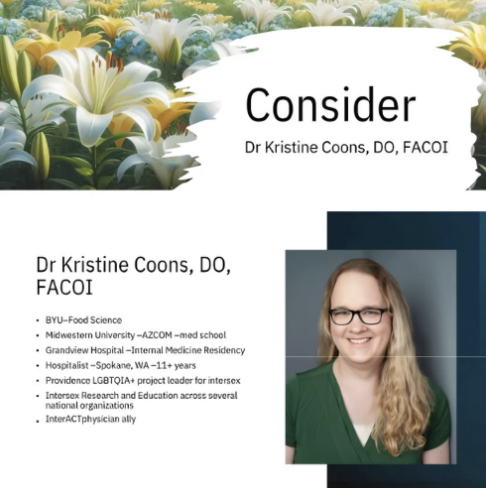
To read real stories about an intersex individual (or a family with an intersex family member), click here
Intersexis an adjective that describes a person. It is never a noun or a verb, because no one can be “intersexing” or “intersexed.”
The word “hermaphrodite” is considered archaic and can be offensive to intersex people.
Source: "It's Intersex Awareness Day - Here are 5 Myths We Need to Shatter" - www.amnesty.org
-
A woman who is emotionally, romantically, and/or physically attracted to other women. Non-binary people may also use this term to describe themselves, if applicable
-
LGBTQ and LGBTQIA are acronyms for lesbian, gay, bisexual, transgender, queer, intersex, and asexual. It is also common to use the term queer as an umbrella term for all of these.
-
A mixed-orientation relationship (MOR) is between partners of differing sexual orientations. Mixed-orientation marriage (MOM) is a mixed-orientation couple who are married to each other.
-
An adjective describing a person who does not identify exclusively as a man or a women. Non-binary individuals may identify as being both male and female, or somewhere in between, or completely outside of these categories. While many non-binary people also identify as transgender, not all non-binary people are transgender (but may share many of the same experiences as trans folks).
-
Pronouns are commonly used as part of speech that helps identify people by their characteristics. For example, you might tell someone that you “gave Susan a compliment” or you could also say that you “gave her a compliment”. In this example, Susan is identified as a woman because we have used the pronoun “her” instead of her name. Everyone has pronouns that are used to describe them. Usually assumptions are made about what pronouns are correct to use for a person, based on our perception of their physical appearance or our knowledge of their assigned sex at birth. However, for transgender, non-binary, queer, or gender-non-conforming people, the pronouns associated with their assigned sex at birth might not match their identify and.or expression of gender. Individuals may choose to go by any combination of pronouns that they feel best describe them. Honoring the choice of pronouns is a way that we can show respect and love.
-
Queer is an umbrella term for people who do not identify as exclusively straight and/or people who have non-binary or gender-expansive identities. Although this term used to have a negative connotation, it has been reclaimed by the LGBTQ community and is commonly used in a positive way.
-
this term (along with same-gender attraction) is not widely used in the LGBTQ+ community (but is commonly used in the Latter-day Saint publications and talks) to mean someone who is attracted to people of their same gender (ie, gay or lesbian).
-
A transgender person is someone whose gender identity and/or gender expression is different from the gender they were assigned at birth. Being transgender does not imply a specific sexual orientation. Transgender people may identify as gay, straight, bisexual, etc.
The term transgender should only be used as an adjective and never as a noun (i.e. “My friend is transgender” vs. “My friend is a transgender.”)
The term “transgendered” is grammatically incorrect and should never be used.
Though less common today, some trans people identify as transsexual. Some consider the term transexual to be outdated.
-
A series of processes that some transgender people may undergo in order to live more fully as their authentic self. This may include social transition, such as changing name and pronouns, medical transition, which may include hormone therapy or gender affirming surgeries, and legal transition, which may include changing legal name and sex on government identity documents. Transgender people may choose to undergo some, all or none of these processes.



research








videos we recommend
featured lift+love video

more videos


featured gather video