lift+love family stories by autumn mcalpin

Since 2021, Lift+Love has shared hundreds of real stories from Latter-day Saint LGBTQ individuals, their families, and allies. These stories—written by Autumn McAlpin—emerged from personal interviews with each participant and were published with their express permission.

lgbtq+ stories
family stories
ally stories
LGBTQ STORIES Allison Dayton LGBTQ STORIES Allison Dayton

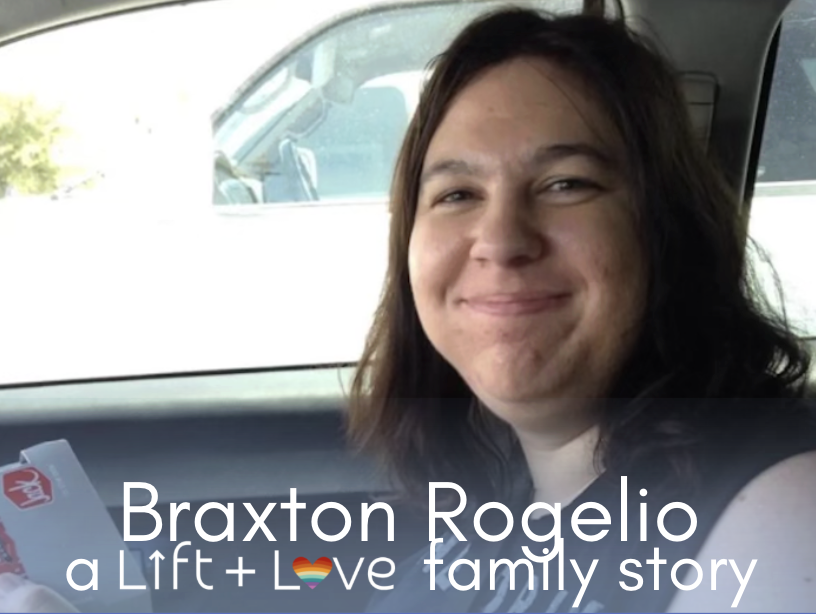
BRAXTON ROGELIO

Braxton Rogelio (he/him) has spent his life pursuing the arts while asking big questions—which has led him to embrace his identity as the proud transmasculine, gay man he is today…
**content warning: suicide attempt is mentioned**

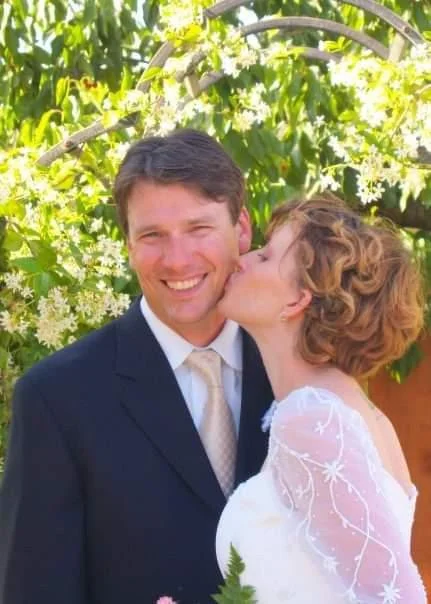
Braxton Rogelio (he/him) has spent his life pursuing the arts while asking big questions—which has led him to embrace his identity as the proud transmasculine, gay man he is today.

Now 39, Braxton lives in Mesa, Arizona, not far from where he was born and raised. A passionate writer since the age of 13, he’s currently working on a memoir with the support of his uncle, who is a Utah-based author, screenwriter, and director. Their bond is built on a shared love for exploring possibilities. “He’s such a sweet, funny personality,” Braxton said. “We’re so similar—we’re always asking what if, and what else.”

Braxton’s life is rich with passions. He loves anime, karaoke, travel, and his beloved cat, Bear—a tabby-Siamese mix he describes as a “gorgeous boy and absolute love bug.” He proudly embraces his Latino roots through his dad’s Portuguese and Spanish heritage. And when it comes to music, his playlist features favorites like David Archuleta, John Mayer, and Selena.

Music, in fact, quite literally saved Braxton’s life.

A few years ago, after leaving the Church of Jesus Christ of Latter-day Saints and facing pressure to return, Braxton found himself in a dark place. Depression overwhelmed him. “I had been told, 'You need to come back to church,' and it just got really bad,” he says. One night, feeling hopeless, he attempted to take his own life.

As he sat alone, still suffering yet having survived the attempt, a song shuffled onto his phone: David Archuleta’s “To Be With You.” He says, “Hearing David’s song—it saved my life.”

Later, Braxton had the chance to tell David Archuleta exactly that. At a Christmas concert at the House of Blues in San Diego, he met David, shared his story, and received a hug in return. “I was so grateful,” he said. “I gave him a gift—a few things he had said he liked on Instagram—and it was great to talk to him."

Last Mother’s Day marked another turning point: Braxton came out publicly as trans. While he had long stepped away from church activity, the day offered a bittersweet illustration of the complicated ties between faith, family, and identity.

His mother, still active in the church, asked him to attend services with her. Braxton agreed, despite his deep discomfort. "I was already in tears but thought, 'I'll suck it up for my mother.'" During the meeting, young children were handing out flowers to mothers. Braxton, who does not identify as a mother, was encouraged by his mom to accept one. "I thought, ‘this is so weird’," he said.

Later, attending a Relief Society meeting only deepened his feelings of isolation as Braxton had fully embraced his identity. “Ever since I was five or six years old, I knew something was going on,” he said. “I even told my brother when we were little kids, 'Hey, I'm your brother’."

Coming out to his family brought a range of responses. His younger brother, two years his junior, was the first person he told. “He wasn’t surprised,” Braxton said. “He said, 'You've always identified that way. As long as you're happy.'"

His sister, who is three years older, and his father were also supportive. His father’s response was simple and unconditional: "No matter what, I'll always love you."

Today, Braxton enjoys close relationships with his father and stepmother—whom he affectionately calls "Mama"—as well as with his brother and his brother’s family. "Everyone lives in Arizona,” he said. "My dad and Mama have lived in the same house for 25 years. My brother and his wife and five kids live just down the street."

While most of his family offers love and acceptance, there have been painful exceptions. But Braxton focuses on the love that surrounds him. “I have a good support system and love them very much,” he said.

Braxton’s journey of self-discovery has also included navigating relationships. Over the years, he’s experienced three failed engagements. Each time, he realized he couldn't move forward without first fully understanding and accepting himself. “It had to do with me, not them,” he reflected. “I couldn’t help them the way they deserved, not with everything going on inside me.”

Today, Braxton also identifies as demisexual or asexual, and finds belonging within the ace community. Trying to live authentically hasn’t been without its challenges. Braxton has faced harsh words, including being told he was “evil” or “being seduced by Satan.” But he stands firm in who he is and trying to be. “With everything going on in the world, don't be afraid,” he says. “Embrace yourself. You shouldn't feel ashamed. You deserve to be yourself.”

Looking ahead, Braxton says, “I hope to be a man married to another man,” he said. He feels a strong connection to his Latino heritage and hopes to build a life that honors all parts of his identity. He’s also working toward greater mental health support, planning to join a group therapy program through AZ for Change, an organization supporting LGBTQ+ individuals.

Music continues to be a source of healing and joy. Braxton eagerly looks forward to attending upcoming David Archuleta concerts—including two in southern California this week. “I'm excited to meet up with some friends there,” he said.

In the meantime, he continues writing, learning to play the piano from his mother, and pursuing his dream of publishing his memoir—which he hopes will prove a testament to a life defined not by fear or conformity, but by authenticity, resilience, and love.


Read More
FAMILY STORIES, LGBTQ STORIES Allison Dayton FAMILY STORIES, LGBTQ STORIES Allison Dayton

THE FRAZE FAMILY

Mell Fraze’s childhood home was one in which the Bible sat on the bookshelf beside the Dao De Jing, the Pearl of Great Price, and a myriad of philosophy books. Raised by a scientologist mom and a universalist dad who attended a “new agey Christian church,” she was instilled with the ideology that everyone has a different path in life, and it’s the individual’s job to ask the questions and do the research to find which path works for them. Mell was an apt audience. As a neurodivergent individual, her brain is wired to ask questions. Now as a mother of six kids (ages four to 16) with her seventh due in August, she likewise encourages her children to explore how when something’s not working, to consider what might fit better instead…
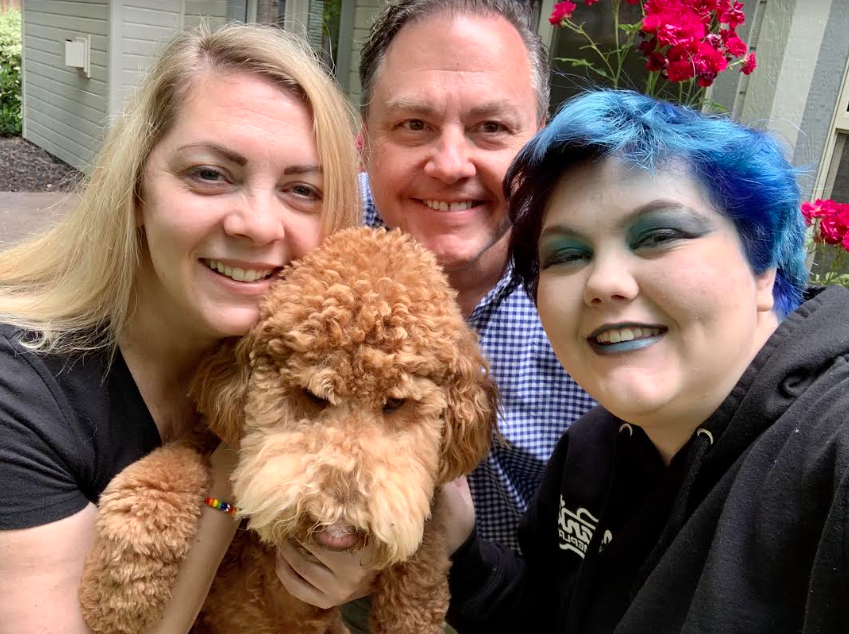
 

Mell Fraze’s childhood home was one in which the Bible sat on the bookshelf beside the Dao De Jing, the Pearl of Great Price, and a myriad of philosophy books. Raised by a scientologist mom and a universalist dad who attended a “new agey Christian church,” she was instilled with the ideology that everyone has a different path in life, and it’s the individual’s job to ask the questions and do the research to find which path works for them. Mell was an apt audience. As a neurodivergent individual, her brain is wired to ask questions. Now as a mother of six kids (ages four to 16) with her seventh due in August, she likewise encourages her children to explore how when something’s not working, to consider what might fit better instead.


For Mell, the LDS church entered her orbit in 2007, when she chose to get baptized one month after she married Cliff, who was born and raised in the church in Modesto, CA. 15 years her senior, Cliff was raised at a time when church culture didn’t understand what to make of his family. His three siblings had several Cerebral Palsy and uninformed members often wondered “what sin of the parents brought this upon them.” Cliff was raised with traditional church beliefs, but his family was largely marginalized by their congregation. Mell’s peers asked how she could go from her free-thought upbringing to being Mormon, but Mell said nothing about her inherent belief system actually changed—she just learned a new vocabulary to identify her beliefs. She says, “I finally found the one Christian denomination I could feel comfortable in, that didn’t raise the hackles on my neck and wasn’t teaching something in opposition to my lived experiences.” Their union set the stage for raising their own kids.


The Fraze children are given room to grow and explore in their Sacramento home, where Mell has home schooled them since 2015. Every member of the Fraze household of eight is neurodivergent, with all of them having ADHD and several identifying on the autism spectrum. Mell and her husband Cliff found their children’s various needs, which are often also in opposition to each other, were not all able to be met in traditional school, so they’ve brought the laboratory home. This has resulted in their most significant time with peers taking place at church, which has also proven difficult for many of the children who identify on the neurodivergent and LGBTQIA. While the youngest two find Primary fun, church has proven a challenge for some of the older kids.


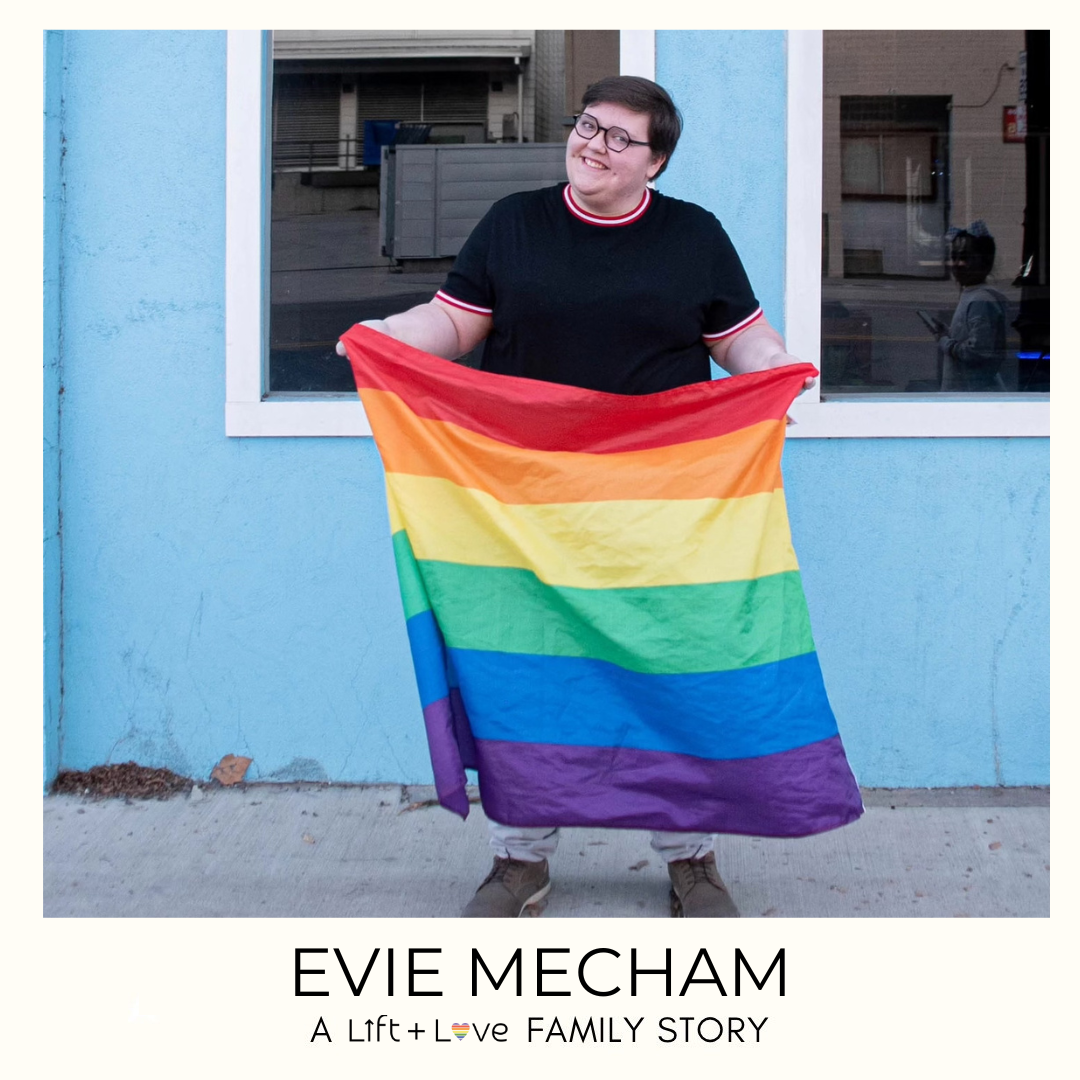
Evie, 16, (they/them) identifies as nonbinary, asexual, and panromantic and is not interested in dating and marriage. Liam (15) also does not currently wish to pursue dating. Frequent lessons about temple marriage have repelled them as it’s not something they see in their future. When leaders respond with phrases like, “When you grow up, you’ll feel it,” it further offsets the two and makes them feel misunderstood. As the Fraze’s 10-year-old son’s neurodivergent needs are also not able to be met in the church environment and Mell says “I’m unable to clone myself and be in every classroom where my kids need me,” Mell has found it difficult to make church work. For the past year, while Cliff shows up and fulfills his calling in the Sunday School presidency, Mell stays home with the kids who are most comfortable there. Home has also become the most comfortable place for Mell to feel authentic. She says, “I cannot show up on the defensive all the time, because then I’m not getting anything from church. And my child’s mental health is more important than their body being at church.” A big believer in autonomy and agency, Mell believes in letting her children choose whether attending church or serving missions and the like is what’s best for them. She let her kids choose whether getting baptized at age eight was the right choice for them, and some delayed that until they felt more ready.


The bishop in the Fraze’s ward had served as a high councilman prior where he was tasked with collecting helpful church resources for LGBTQIA families. At the time, he turned to the Frazes for resources, and they engaged in several hours of conversation. While Mell says her bishop has tried to be an ally, and some of the youth leaders are “great people who really try to show love and respect,” others don’t have a frame of reference for how to support kids who don’t fit the norms.


In the summer of 2022, with her bishop’s permission, Mell joined Evie on the stand during a fast and testimony meeting to share how the youth theme statements could be worded to be more inclusive of all gender identities. Evie had expressed to their parents a couple years prior how they felt different in regard to their assigned gender, and a felt a more gender-neutral identity fit them best. Mell supports her oldest in this, while also loving the “Gender is essential” phrase in the Family Proclamation that so many instead use to weaponize against people like Evie. Mell says she sees this idea of gender being essential, combined with Moses 3:7, to mean that everything is created in the spirit form first. “When we speak of bodies being perfected in the resurrection,” she asks, “doesn’t it make more sense that who you are as a spiritual being that your body would be changed to match your spirit, and not the other way around? In the resurrection, we don’t believe everyone’s going to be six feet tall, skinny, and blonde. We understand there will still be a diversity in perfected bodies. So why, when someone who experiences gender dysphoria and feels their body doesn’t fit their spiritual being, why would the spirit change to match the body instead of the other way around?”


Because her kids school at home, Mell shrugs off the current sound byte rhetoric of “LGBTQIA social contagion.” She says, “My kids aren’t hearing, ‘Oh I heard this and that and want to try it out.’ They’re coming to me saying, ‘I’m different and I don’t know why’.”


While their shared testimony bearing was an important moment for the two to honor this part of Evie’s reality, Mell breaks down as she describes how Evie, on the stand, witnessed how the members’ faces in the room turned from engaged smiles to stone-faced, disapproving looks. That, followed by an uncomfortable talk on the Proclamation shortly after, was the last time they attended. In the one year she has stayed home with Evie and younger children who need her, Mell says only three people from their ward have reached out to try to understand the difficulties her family faces with current church doctrine and policies. Hurtful comments have also been said, including one youth leader who said, “Satan is making kindergartners confused” and a primary teacher who told Mell, “Gays cause problems in society.” As such, Mell tries to speak up as much as she can about the extreme mental health duress and increased suicide rates that occur for kids on the LGBTQIA spectrum.


She says, “I would like to be able to stay in the church and be a voice of allyship and safety, but I’ve been called an apostate by a member of my ward for speaking up against rhetoric that’s harmful. I’ve also been told, ‘Sometimes you need to step away from the church,’ but I hate that alternative. When you point out that your choice is to live as a portion of yourself and feel hurt in the church, or to walk away to be able to live as a whole, authentic human being, the response people are conditioned to give is, ‘Don’t leave the church, try to stay, turn toward the Savior.’ But there’s no room or support to do that. I’ve taken to calling myself Schrodinger’s Mormon. Depending on who you ask, I’m either exactly what people hope members can be, or I’m a terrible apostate who should leave because if you don’t believe, why would you stay?” Mell says it goes back to people not understanding the breadth of the perspective she comes from, and the religion, anthropology, and various philosophies she studied as a youth that examine humans holistically. Mell stays in LDS parenting chat groups online, hoping she might be a light in the dark for someone in need, and hopes to help parents new in their journey. While Evie is considering resigning her church membership, Mell says, “They let me in; they’re going to have to kick me out!” of her membership.


“I already knew I was a divine, spiritual being before joining the church. I’m Christian; my philosophy is humanist and unconnected to any particular religion. I care about the environment, social justice, humanity – the same things I cared about before. I get closest to the Savior from listening to people’s lived experiences, and understanding their truths are just as valid as mine. All of that has prepared me for having queer kids, where other parents in the church might struggle. None of my spiritual identity depends on the church, which I recognize is different from my husband’s experience.” She acknowledges their marriage and co-parenting can be a difficult balance, but says, “He knew who I was before we married. He has no interest in changing me, but often doesn’t know how to deal with others’ responses to me being a fierce, vocal advocate for our children.” Mell, who identifies as queer herself, also recognizes she comes from a place of privilege, being in a perceptively cisgender-heterosexual temple marriage, a person “who happened to get lucky that my person is a cishet man.” She thus chooses to first present herself foremost as an ally in the LGBTIA space.


Of the changes she hopes to see in the church, Mell says, “People make choices all the time that slow the ‘in the Lord’s time’ phrase. They can make choices that speed the ‘in the lord’s time’ to be more inclusive and loving. There are stories of wards out there who have done this. And then there are wards who have sacrificed people because they were too afraid to change, to ask questions, to push boundaries.” This is where Mell hopes to make a difference. “It’s a horrible truth but as a church body, members are choosing to sacrifice their children for the sake of tradition. I absolutely refuse to sacrifice my kids because someone would rather follow tradition than the prophetic example we claim to follow of asking prayerfully and seeking inspiration.”

Read More
FAMILY STORIES Allison Dayton FAMILY STORIES Allison Dayton

THE ANDRUS FAMILY

I am a Child of God,

Their promises are sure;

Queer kids are precious in Their site

If they can but endure.

I am a Child of God,

Their promises are sure;

Queer kids are precious in Their site

If they can but endure.

Lead me, guide me

Walk beside me;

Help me find the way.

Teach me all that I must do -

To help them live today.


It’s a mantra and a mission for Andrea Andrus, who reworked the words of a favorite hymn to align with her own experience as the mother of Ash (they/them). At 17 years old, Ash identifies as pansexual, nonbinary, and asexual, and was also recently diagnosed with autism. Andrea feels it’s both a calling and a blessing to parent such a beloved child with unique gifts. “Ash is my miracle baby. I want them and the world to know how special they are.” And of the many children like her own who also struggle with their mental health, Andrea says of her advocacy, “We know there are lives on the line. That’s why we do this work.”  

Ash was born when Andrea was 35. Andrea and husband Kevin both recognized early on that there was always something extra special about them. Growing up, Andrea says Ash was the “sweetest, sweetest kid -- super smart, top of the class. Ash always wanted to do the right thing and be involved and have fun. They would come home from school all the time and say, ‘This is the best day ever’!” Ash is artistic and gifted musically. They performed with a youth theatre group, taught themselves the ukulele, and after taking piano lessons for several years, now play by ear.

While Ash has always been a delight to their parents, Andrea chokes up at recalling the rough road the Andrus’ faced when they realized the level of suffering their child had endured for years. Around Ash’s 8th grade year, Andrea and Kevin made an unexpected move back to Idaho, where they both were raised. Ash was forced to leave behind their friends and everything they knew. Then Covid hit. Ash seemed to be lost in their own world. Andrea vividly remembers the day she went in to wake up Ash for seminary and she realized there was something more going on – she knew her child was really suffering from major anxiety and depression. As they worked through that for a couple years, there was still something else Andrea felt she was missing. She then found out her child was autistic. Andrea says, “I feel strongly that someone being born with autism is just like being born LGBTQ – it’s how your brain is formed. And it’s great -- autistic people change the world. They think outside the box, they are beautiful and creative, just like our LGBTQ community.” 

But Andrea feels that Ash having been undiagnosed that long with autism, and not getting the right support and treatments was very harmful and likely made their depression a lot worse. Right after they found out they were likely autistic, Ash asked Andrea, “Mom, am I broken?” Andrea says, “I had this powerful download of words that were not my own: ‘No, you’re not broken. This is your superpower’.” She told Ash, ‘It’s just like being gay. It’s how you were born. There’s nothing wrong with that, and it’s beautiful.”

Andrea reasons so many children like her own came out during 2020, (or while on their missions), is because in times of deep introspection and isolation with both yourself and God, is when we get real with ourselves. It was the same for Ash, whose coming out was a bit of an evolution of identities as they navigated what felt most authentic. Eventually, they found identifying as nonbinary to feel like a better fit for them than being gender fluid or trans.  Andrea reports that in her research, she has found this to be a perfectly normal part of an LGBTQ youth’s journey. While she struggled with Ash’s name and pronoun shifts at first, she values the advice of (Lift and Love Trans Support Group Leader Mama) Anita who says, “Using preferred name and pronouns is another way of saying ‘I love you’.” This got really real for Andrea who, having been married once before, recently saw her former married name printed somewhere and it made her physically ill, which again reiterated to her the importance of believing people when they tell you who they are, and not dead-naming them.

Ash no longer associates with the church, and is unsure if they believe in God. Yet they have a deep connection with and find comfort in nature. Ash loves animals, mountains, the ocean, and forests. Spiritually, Ash leans into mystical things and loves crystals, essential oils, and finds Oracle cards fascinating -- much like a journal prompt. As Andrea has stepped back and watched her child’s interests develop, she has been reminded of the creation story witnessed in the temple, and that all the elements that fascinate Ash and cause them to listen to the divine are the same surrounding elements that God created. 

Rather than resist Ash’s affinities, Andrea has made it a conscience choice to lean in and learn what her child is experiencing. She recognizes that a long time ago, she was one of those people who thought being gay was a choice. But when her own child came out, and her daily need became keeping that child alive, Andrea shed some of her past reluctancies and now finds intense peace and joy in allowing her heart to remain cracked open. An early prompting to learn all she could about the LGBTQ space transformed Andrea’s own belief system as she started to see that her personal revelation and insights did not always align with what she’d been taught. At one point, she apologized to Ash for not being better prepared, and now the two have a very strong bond of trust and transparency. Because of the actions Andrea took to educate herself and become a stronger ally, not only does Andrea feel an extreme outpouring of love for Ash, but for all LGBTQ people, including her gay niece and nephew.

She advises others to “Stay curious. To try to accept and love. If something bothers you, ask yourself why.” When Ash first came out to their parents, at the time the Andrus family was living in Twin Falls, ID, where they had a remarkable affirming bishop and his wife – each with a gay sibling of their own. Andrea’s bishop advised her to seek her own personal revelation, while also saying, “Your job is to love them.” At first, she thought, “Of course, I do.” But with time, she learned that love really is a verb.

On her spiritual journey, many things uttered over pulpits have been hurtful to Andrea. “I try to be a stone catcher. But sometimes it feels like stones are being thrown by some of our own.” One recent talk in particular that made it sound like Andrea’s child might “end up in a lesser kingdom” was especially hard. “I reject that,” she says. “I think there’s a VIP section for our LGBTQ siblings in heaven. A special place for special people.” Andrea also embraces the notion of expecting miracles along this journey as we navigate from Point A to Point B. She says, “God loves all His children. If the gospel doesn’t include all God’s children, then it’s not the complete gospel.”  

Now residents of Eagle, ID, Andrea is hopeful the church may someday feel like a safer place for her family. But as of now, she says, “We’re hurting. It’s not ok. Such a huge percentage of LGBTQ families leave the church. There are some people and organizations doing great things, but until it comes from the top, it’s not going to change the masses. Unless you’re blessed enough to have an LGBTQ child, it’s a slow process of changing hearts. And in the meantime, we’re losing so many wonderful people. Every ward’s got a few safe ‘come sit by me’ people, but it’s not enough. It’s a huge loss. And it’s lonely.” That being said, Andrea takes great comfort in her knowledge that her child Ash has a divine purpose on earth, and that God will help them succeed. 

FAMILY LGBTQ
ASH MOM LGBTQ
ASH ANDREA ANDRUS
ASH LIFT AND LOVE
ASH LGBTQ FAMILY LDS
LDS LGBTQ RAINBOW BLANKET


Read More