lift+love family stories by autumn mcalpin
Since 2021, Lift+Love has shared hundreds of real stories from Latter-day Saint LGBTQ individuals, their families, and allies. These stories—written by Autumn McAlpin—emerged from personal interviews with each participant and were published with their express permission.

MONICA, HORACIO, & CAYLIN
Monica Bousfield met her husband Horacio Frey in the fortuitous aisles of Babies R Us, where they both worked in the early 2000s. At first, they were just friends. Then best friends. Then after about a year of hanging out constantly, they surmised they must be dating. A year later, Monica nudged Horacio that it was probably time for them to go ahead and get married. After an eight-month engagement, they did, and while they eventually both left Babies R Us, their commitment to each other later resulted in two babies they would together raise. Through all this, Monica kept her maiden name—primarily because she’d never known of another couple like her and Horacio to last, and she didn’t want to complicate legal paperwork around having to undergo name changes twice. Monica had never heard of a woman marrying a gay man and having it not end in divorce. While she’d known Horacio was gay from their early days of hanging out, there were two other things she knew about Horacio: he was her best friend, and she wanted to marry him. Over two decades later, the couple is still making it work in Westminster, Colorado, where they have two children—Caylin, who is 17 and also identifies as queer, and Dominic—13.
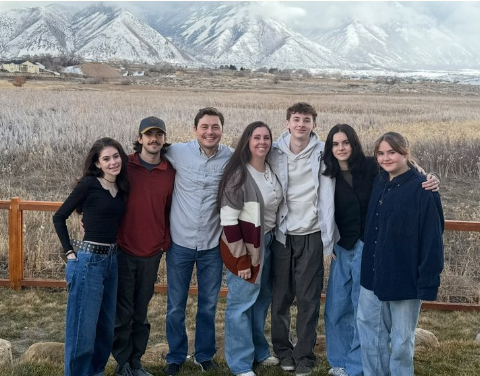
While Horacio has known he’s gay since a young age, this is the first time he has come out publicly. His childhood was marked with hardships, having suffered abuse and being adopted at age eight, which created abandonment issues. He came out to a few friends and his parents in high school, but very few people knew he was gay when he married Monica. He had been raised in a Christian church community in Santa Fe, New Mexico. While it was an open affirming congregation, Horacio opted for the white picket fence and kids route that was so highly encouraged. When he met Monica, she was not active in the LDS faith of her family of origin, but after their daughter was born, Monica says, “I realized I had this amazing, super special kid, and started going back to church gradually and then more actively.” After about five or six years of attending by herself with Caylin, Horacio converted. Monica laughs that she has the kind of mom who, every time they went to her house for dinner, would make sure the missionaries just happened to be there. Finally, Monica says, “She had a set there with the right personality at the right time.”
Horacio’s bachelor’s degree in Information Systems Security brought him to Colorado. After receiving her bachelor’s at what is now UVU, Monica started a graduate school program in counseling at CU Denver. But three years into the program and then married, she found while she loved learning about counseling, she had no desire to go into the practice. Instead, Monica went into management at Babies R Us, and then got her masters in HR. Now she works for a local municipality in compensation and benefits, a job she loves. Horacio works as a tech manager for a solar company.
Monica says, “if you’re going to marry someone who’s gay and you’re not, you need to be pretty confident, but we figured we’d never know if our marriage would work out unless we got married.” The beginning of their union felt lonely for Monica, having no one she could talk to who could relate to her variety of issues. “I internalized a lot, which is probably not healthy. But I didn’t want to out him. When others would talk about how great their marriage was, I was like, ‘Um, yeah…’” Monica didn’t actualize that hers was not the only mixed orientation marriage in existence until a few years ago. But of her almost-exclusive status, she says, “It doesn’t go away and it’s not easy. I’m not going to say it’s not worth it, but it’s not easy.” Horacio agrees it’s been difficult as well from his perspective with the couple talking about it, then not talking about it, when perhaps they should have more often. But after lots of counseling, he says, “We’re committed to making it work and have no interested in getting divorced or not making it work.” Monica appreciates how Horacio is still her best friend, despite the complexity of their issues.
Five years ago, new information about their children brought the two even closer together. Around the same time that Dominic (at age 8) was identified as being on the autism spectrum, Caylin revealed that she’s queer. Of their kids, Monica says, “She’s very creative, and he’s very, very logical. It’s two extremes, and definitely makes things interesting.”
While Monica was shocked about Caylin’s admission, Horacio was not as surprised, after Caylin had recently played Christina Aguilera’s “You are Beautiful” at the dining room table and asked her dad if he’d still love her if she came out. It was 2020 during the pandemic, and the family had spent much of their time together in quarantine. One afternoon, while on her way to her first outing to a friend’s house in a long while, Caylin sat in the back of her parent’s car, quietly drafting a text. She didn’t hit send until she’d safely entered her friend’s front door, and Monica and Horacio drove home in shock, processing. Besides the blindsiding of the information itself, they were now also apparently “old” because they had no idea what Caylin meant by: “I’m coming out as pansexual.” Monica googled it on their drive, while her heart stung with the second half of Caylin’s text: “I hope you still love me after this is over and done with.” Of course they did, she says.
However, needing more time to process as she hadn’t heard of a 12-year-old coming out that young before, Monica sent Horacio to pick up their daughter. When he pulled up to the house in a slight rainfall, he saw a rainbow in the sky behind Caylin’s friend’s roof. A scene that felt “picture perfect.” Caylin got in the car and Horacio abruptly revealed he was mad at his daughter--only because she had told him in a text and not in person. The two went and got ice cream at Chic-fil-A (Monica now laughs at the irony of that), and Horacio explained to his daughter that he was in a position to understand what Caylin was feeling. He revealed, “Not that I want to steal your story, but I understand because I identify as gay.” Horacio went on to explain how Caylin could still have church values, even though there is a lot of stigma in church communities about how to act. Horacio clarified, “You don’t have to do anything you don’t want to. Your mother and I still love you and will navigate with you, and you’ll get through it.”
Caylin says she’d known she “was some flavor of gay” since age nine, just growing up in the internet age, though she didn’t always have words for what she felt. She now prefers to identify as queer instead of pansexual, and says it has been hard to “figure out what I actually am and to surround myself with people who would accept me, especially in the church where a lot of people don’t necessarily agree with all of that.” Now a senior in high school, the church is still a part of Caylin’s life as she attends sacrament meetings on Sundays, but she prefers to go to Relief Society with her mom over Young Women’s. She also prefers to avoid seminary and youth activities, and keeps quiet about how she identifies at church. The family’s ward is small and skews a bit older and more conservative. With few youth, there are fewer opportunities for friendships. Caylin says her school has its ups and downs, but she has a good friend group and likes to do art and read fiction and romance books--the Caraval book series being a favorite. She also participates in theater, and is on the costume crew for the school’s current production of Chicago. While dating has been a part of her teen years, she’s not currently seeing anyone.
Shortly after Caylin came out to her parents at age 13, she was sitting at a stoplight with her mom. Monica remembers her saying, “Mom, I don’t know why God hates gay people.” Monica asked what she meant by that, reiterating that God loves everybody. Caylin replied, “I don’t know why gay people can’t get married in the temple, have kids, and do all the things.” Monica feels this messaging kids receive while sitting in the pews is important to share, as the words hit hard and create more harm than some may intend. While it took Monica herself time to process the news Caylin shared via text that day, she now feels protective “like a mama bear” and wears a rainbow pin and speaks up when it feels appropriate, which can be hard to gage in their ward. Horacio also wears some sort of rainbow every Sunday.
The family has attended some of the events sponsored by their local ally group Rainbow COnnection, which was started by members of their stake. While Monica’s an introvert, she values the gatherings. In her extended family circle, people tend to more quietly share big news to avoid big reactions. Monica has appreciated how talking with her relatives about Caylin has strengthened her relationship with her family members who were raised in a world where their family “looked good on the outside but weren’t that close.” Nowadays, they’re working on being closer at home.
Caylin says sharing a unique identifier alongside her dad has helped her to feel less alone. She now focuses on not letting others’ opinions bother her. One Sunday, after a lesson in which someone expressed how they had a kid “struggling with LGBTQ issues,” Caylin walked out into the hall and toward their car, confidently telling her mom, “I’m not struggling with LGBTQ issues. I’m quite good with them.”
For Monica, who has kept much close to her heart over the 20+ years of her marriage, she longs for a day when it feels more comfortable for people to share what they’re experiencing at church in a real way, instead of trying to present the image of “being perfect.” She says, “Wouldn’t it be wonderful if people could say, ‘I’m really struggling with this,’ instead of ‘Life is great’! I’ve dealt with a lot on my own, which is probably not the best way to handle things.” She continues, “It’s good more people have been talking about this in the last few years. It’s important to get out there and hear about it and share, so you don’t feel so alone.”
THE BALDWIN FAMILY
Natalie Baldwin has spent her life ensuring things run smoothly—whether as the administrative assistant to the Dean of UVU’s College of Health and Public Service where she currently works, or as the heart of her home in Salem, Utah, where she and her husband, Briggs, are raising five children. But her life’s journey has taught her that even the most careful planning cannot account for the unexpected. Diagnosed with Chronic Myeloid Leukemia in June 2022, Natalie’s health required her husband’s career overseas with the State Department to come to an abrupt halt; until she can hit certain markers, they cannot return to expat living. Instead, the Baldwins were forced to leave their last assignment in Turkey to move near her family in Utah where she could focus on her health. The past ten years of both adventure and change have left Natalie grappling with profound questions—about faith, culture, family, and the unique challenges of raising two LGBTQ children within the framework of her Latter-day Saint beliefs.
Natalie and Briggs’s children range in age from 13 to 22. Their eldest, Easton, is 22 and a manager at a popular chain restaurant. Emery, 20, a manager of a popular food truck, came out as bisexual at 15, but now identifies as pansexual. After exclusively dating women for a while, she now plans to one day marry her current boyfriend. Eli, 18, is a junior in high school, and Estelle, 13, is in middle school. Eloise, a 15-year-old sophomore, is in the process of exploring her identity and currently identifes as bisexual with just the “occasional” moment of attraction to boys. The Baldwin’s family dynamic has been shaped by love, questions, and a steadfast commitment to embracing their children for who they are.
For Natalie, the first major shift came when Emery came out at 15. Having always been open with her parents until then, Emery had given them a small “heads-up” about a year before her formal declaration, processing much of her identity internally. When she finally came out, Natalie’s immediate response was rooted in her conviction: “I know God doesn’t make mistakes. If you’re made that way, it’s the way you’re supposed to be. We’ll love you unconditionally regardless of any decisions you make.” Those words became a mantra, grounding Natalie through the ups and downs that followed.
Yet there were challenges. Living in Cairo at the time, Emery’s sexuality became a complicated and, at times, dangerous issue. In the predominantly Muslim country, where homophobia was rampant, Emery was outed by a peer. The news reached a church leader, who responded by incessantly preaching the Family Proclamation. Of that time, Emery says, “The year between realizing my sexuality, and finally coming out, I was battling some serious internalized homophobia. I couldn’t grasp the fact that I was queer, but I was also supposed to be a righteous daughter of God. It didn’t make sense to me that I could be both at once. I had a million questions, and so many bad days, but I was terrified to share any of these thoughts. My thought process was, ‘If I myself am having such a hard time accepting my own sexuality, how could anyone else’?” Feeling unsafe and unwelcome in a church community that for much of her childhood had taught her negative things about the LGBTQ+ community led Emery to eventually make the decision to step away from church entirely.
Though the family soon relocated back to the U.S., Emery has not returned to church, but Natalie remains proud of the strong, empathetic woman her daughter has become. Emery likewise is grateful for her family’s unconditional support, saying, “Feeling like you don’t belong, and feeling so utterly lost and helpless, is not an easy thing to come back from, especially when a lot of those feelings were created by peers and teachers from what was supposed to be my church, and my community. While I have nothing but love for the church, the hurt that I felt from individuals in the church is one I don’t think I could ever forget. Every single day of my life, I am eternally grateful for my parents who made the choice to learn more, and love more, rather than to judge and to try and teach.”
Of her eldest daughter, Natalie says, “She has a good head on her shoulders. It didn’t take her long to realize who she is doesn’t align with the church, but that doesn’t make her a bad person. The church is just not a good fit for her. Her sexuality, and Eloise’s, have given them an empathy for others we will never fully understand. They have the ability to see people in ways I never could.” The Baldwin’s oldest son has labeled himself “nonpracticing, but with a testimony.” While he occasionally attends church, Natalie points out that often young men feel out of place when, like Easton, they didn’t serve a mission. He “really doesn’t like the outspoken conservative culture in the church, but still has a love and respect for the gospel,” says Natalie who adds that Easton said he never plans on labeling himself an ex-Mormon.
For Natalie, the process of supporting her children has been deeply personal. She says, “I’m not afraid to ask questions, or of the answers that I’ll receive. I trust myself, my intuition, and my ability to hear God. I know God doesn’t make mistakes. The way these children come to us is the way they’re meant to be. Maybe sometimes it doesn’t align perfectly with gospel doctrine, but that doesn’t change the fact that they’re eternal beings with unique gifts and souls.” Briggs has had his own journey to see things through a different lens, thanks to his wife and daughters, and has grown to embrace and love the LGBTQ+ community.
Eloise, Natalie’s 15-year-old, is currently exploring her identity. Unlike Emery, who initially kept much of her early journey private, Eloise has been more open about her feelings from the beginning. She’s also benefitted from her older sister’s experiences and how they’ve prepped the family. Analytical and self-assured, Natalie says Eloise came to this earth like an adult, speaking in full sentences at age one. “Eloise has a strong sense of her worth. She knows she’s a child of loving Heavenly Parents.” That doesn’t mean her path has been without challenges. Recently, she called her mother in tears, asking to be picked up from seminary after a class discussion on good versus evil where another student included the LGBTQ community as an example of “evil.” Eloise has also been privy to conversations in which her peers have said LGBTQ people are mentally ill or just need to go to therapy. While Eloise’s seminary teacher has been a supportive ally, redirecting harmful comments and fostering a more inclusive environment, incidents like these still sting. Yet, Eloise remains resilient, determined to stay true to herself despite the occasional adversity.
Returning to Utah after years overseas presented its own set of challenges. The family had grown accustomed to the somewhat liberal and inclusive culture of the expatriate community. “Living among expats was a different world,” Natalie explains. “The schools were welcoming, the communities open. Moving back to Utah, we’ve had to face deeply rooted anti-LGBTQ sentiments and the realities of living in a predominantly conservative area. It’s made us all want to retract and keep to ourselves, not knowing who we can trust and who will be a safe space.”
For Eloise, navigating this environment in high school has been a learning experience. “She’s queer, she’s female, she’s liberal,” Natalie says. “It’s a triple whammy in this area. But she’s so bright, intelligent, and mature. She’s learning to decide when to speak up and when to let things go. That kind of wisdom is remarkable at her age.”
Natalie herself is no stranger to speaking out. Over the past two years, Natalie has become a visible advocate, not just for her children, but for all those navigating the intersection of faith and identity. Her ward itself reflects the complexities of her environment. Natalie describes her current congregation as very young and predominantly conservative. “We’re the old people here,” she jokes, noting that she and Briggs often feel out of place as what feels like the lone liberals in a sea of Trump signs and conservative culture. Yet, even in this environment, Natalie has found moments of connection. Her social media posts, particularly on Instagram, often address these themes, sparking private messages of support from some other members of her ward and broader community. “People thank me for being outspoken, but they’re afraid to say it publicly,” she shares. “They don’t want to face ostracization, but they’re grateful someone is saying what they feel. If I can make them feel less alone by being the one to speak up, it’s worth the target I’m putting on myself.”
Natalie’s hopes for the church extend beyond her immediate family. “I wish church leaders would genuinely try to get to know a variety of queer people,” she says. “Really know what they think, feel, experience, and then believe them. If they say they feel a certain way or have confirmation from God, don’t question them, just believe them.”
Through it all, Natalie’s love for her children has remained constant. She believes their unique journeys have made her a better mother and a better person. “I know without a doubt that God has guided us on this path,” she says. “Our family is exactly as it is meant to be. And I will never stop advocating for my children—because their worth is infinite, and their stories deserve to be heard.”
JAMEE MITCHELL
Several years ago, Jamee Mitchell stumbled upon the wedding video from her first marriage. Someone watching the video told her that, “Your body language clearly indicates that you didn’t want to be there.” And most would agree, Jamee looked quite different back then. Jamee was raised and known for most of her life as James, the son of an active LDS family with deep pioneer roots in Bountiful, Utah. From her earliest memory, Jamee felt different, but didn’t have the vocabulary to define the way she felt. Her family was amused that she played dress-up and loved pink until these things were no longer considered age-appropriate. Her parents took her to a church therapist at age 11 where she was told that if she would serve God faithfully, that “it would all work out.” …
**CONTENT WARNING: suicide attempt / suicide ideation**
Several years ago, Jamee Mitchell stumbled upon the wedding video from her first marriage. Someone watching the video told her that, “Your body language clearly indicates that you didn’t want to be there.” And most would agree, Jamee looked quite different back then. Jamee was raised and known for most of her life as James, the son of an active LDS family with deep pioneer roots in Bountiful, Utah. From her earliest memory, Jamee felt different, but didn’t have the vocabulary to define the way she felt. Her family was amused that she played dress-up and loved pink until these things were no longer considered age-appropriate. Her parents took her to a church therapist at age 11 where she was told that if she would serve God faithfully, that “it would all work out.”
Despite her misgivings, Jamee worked hard to do everything right and was eventually called to serve a mission to the Philippines. The mission was her first exposure to a culture that experienced gender differently—in the Tagalog language, there are very few gender pronouns. People have a child, not a daughter or a son. People have a spouse, not a husband or a wife. Jamee says, “I loved their beautiful language and how reflective it is of the culture.” While Jamee had no experience in accounting, her mission president called her as mission financial secretary, a rare assignment for a young elder. But this is where Jamee learned the accounting skills that would become her trade as an enrolled agent who now owns her own accounting firm, The Tax Company, in St. George, Utah.
After returning from her mission, Jamee continued her education in accounting. She mostly avoided dating but enjoyed attending institute activities. It was at one such activity that she met a kind but strong-willed girl who seemed determined to get married. That girl later wrote about the experience, “James seemed like the happiest and most carefree person I’d ever met. I wanted to find a way to date him. He had everything I was looking for!”
When the topic of marriage came up a few short weeks later, Jamee succumbed to societal pressures. She regrets not telling her first wife about her gender dysphoria until about a month after their wedding, thinking those feelings would go away. That announcement was understandably difficult, but they decided to stay together and try to work things out. Jamee finished school and they moved to St George, Utah where they began couple’s therapy. When that didn’t help, Jamee decided to throw herself into a life of work, church, and community service, and ignore the feelings she’d been experiencing all her life. Jamee served in the church, became a delegate for the Republican party, president of their HOA, and started her own business.
Living in St. George, the marathon was in Jamee’s backyard, and she had a visceral reaction her first time watching a friend cross the finish line. Jamee poured her sorrow into the distraction of running race after race, which over the years included close to 60 marathons, several ultra-marathons and even a full Ironman triathlon. One year, Jamee took on the challenge to run all six Utah marathons in the same year. A few years later, she did the St. George Marathon twice in one day, running from the finish line to the start and back again. She says, “I would run until the physical pain outweighed the emotional pain.” Her spouse hated the runs, and Jamee admits she neglected her spousal and parenting duties as running became her drug.
This led to a marital separation in 2010 which was kept secret from everyone, including the kids. In an effort to save the marriage, Jamee enrolled herself into conversion therapy which “was horrible.” And it didn’t work, to which Jamee adds, “The success rate is negligible, if at all.” Jamee had always been a fun-loving person, but the impossible challenge of changing an unchangeable part of herself led to her wanting to take her own life.
On one occasion she pulled her car into the garage and closed the door with the engine still on. While waiting for the end to come, she got a voice message from a friend who said, “I’m not sure why I’m calling you, but I feel inspired to let you know that you are a special person and that I care about you.” Jamee says, “To this day, I don’t think he knows that he literally saved my life.”
After that experience, Jamee received a priesthood blessing from her stake president. The takeaway was that the sin was not in being trans, but in harboring shame. Jamee felt the impression that, “You didn’t do anything wrong by being trans, but what you did wrong was to hide your struggle. Stop fighting it.” Shortly thereafter, Jamee’s first marriage dissolved in a bitter divorce. With four kids including three teenage boys still living at home, Jamee did not want to transition while the kids were still in high school. Instead, she got involved with North Star, where she was able to be more able to be herself and focus on her children without transitioning.
All of that changed in 2016 when Jamee was training for the Wasatch 100-mile endurance run. She dislocated her hip and just like that, her coping mechanism was gone. Within a year she made the decision to start hormone replacement therapy (HRT). The changes were gradual, and Jamee began presenting more and more as female.
Jamee’s legal name change came about once it became awkward to go to the doctor or bank and people questioned her ID. Once, she got pulled over by a police officer who looked at her driver’s license and said, “I take it you don’t go by James anymore?” Originally, Jamee had chosen a different female name for herself but as she started presenting as female, her friends just naturally started calling her Jamee. The unusual spelling is Jamee’s way of honoring her mother who was always proud of her firstborn’s given name. By keeping as much of the original name as possible, it gave homage to her parents. When Jamee was younger, she was never close with her mother, but now she says they’ve become remarkably close. Her dad still struggles, as do her brothers. At their last family gathering, Jamee was able to forge a bond by talking about cars with her brothers, who softened a little. Jamee reasons that, “It took me over 40 years to accept myself. If it takes 40 years for them, I need to give them that grace.”
Jamee remains very close with her best friend and sister, Jenny, who she once played dress up with, donning their grandma Arlene’s dresses as young children. Jamee loved her grandmother and later took her name as her middle name (instead of keeping her grandfather’s), feeling Arlene would have affirmed her and loved that honor. When Jamee turned seven or eight, she was told she could no longer dress up and do fashion shows in her grandmother’s closet. She didn’t understand why. Over this last Christmas break, Jamee teased Jenny for not having picked up on her gender dysphoria back in high school, saying, “How could you not have known? I worked at a formal-wear shop, had big curly hair, and was so effeminate.” After Jamee’s Grandma Arlene died, her jewelry was divvied out to her granddaughters, but being pre-transition, Jamee didn’t receive any. Once Jamee came out, Jenny brought over a care package for Jamee with some of Arlene’s jewelry as a gift, which Jamee says meant the world to her.
Three of Jamee’s four children still do not affirm or talk to her, but one is supportive. Her 26-year-old son who has autism lives with Jamee, identifies as gay, and is dating a trans man and is best friends with a trans woman. As this friend struggles to afford affirming care, Jamee says she uses her privilege (having had the funds to pay for medical procedures and the ability to change her name and gender markers on her birth certificate) to help people newer and less supported in their journeys.
A few years back, Jamee reconnected with a friend from high school named Susan Tolman. Susan showed interest in dating. It broke Jamee’s heart to have to tell her that she was trans and wasn’t attracted to girls. Jamee cried for about an hour over the second round of lost love until, to her credit, Susan said, “I don’t love the outside, I love the inside.” Shortly afterward, Jamee went to lunch with a friend who is the parent of a trans child and explained to Jamee she was likely pansexual, saying, “You love hearts, not parts.” Jamee now concludes, “If you have to put a label on me, that’s probably it.” While neither Jamee or Susan identify as gay (both say they’ll turn heads at an attractive man), Jamee says Susan is her best friend and they both realized “certain things are just better when you’re married.” At their wedding on 4/20/2020, Jamee says she “let Susan be the bride” as she had never been married before. Jamee presented as male at the ceremony but wore a black dress in some of their photos. The two love to laugh and have fun together. When Susan frets over her looks, Jamee jokes, “As long as you’re with me, honey, no one’s going to be looking at you!”
After spending decades building her tax business in St. George, Jamee feared she might lose clients after transitioning, but was pleasantly surprised when only four out of thousands of clients left. Her whole office staff still supports her as senior partner. She laughs, “I’m the girl boss, and I know this because no one listens to me.” Jamee does work hard to make her voice heard in her board role with Pride of Southern Utah. As a still active member of the LDS church, she acknowledges her presence as a trans woman makes some members feel uncomfortable at church; and her involvement in church makes some members of the PRIDE community challenge her loyalty. Jamee says she is an equal opportunity offender and that’s how she knows she is on the right path. Her relationship with the church is much like being presented with a form asking if you’re married or single. Her best answer: “It’s complicated.”
As someone who has served in bishoprics and stake presidencies, Jamee believes there is much room for change in the church—though it may take decades. To the “haters on the right and left who say, ‘God doesn’t change,’ I ask if they’ve ever heard of baptism for the healing of the sick?” (An ordinance that was performed in temples until around 1922, in which sick members were dunked in the baptismal font until the church learned about the sharing of germs and discontinued the process.) “To say the church will never accept gay or trans members--I can’t rule that out.”
Jamee recognizes the need to “be patient with others’ reactions and beliefs as we recognize experiences don’t have to be wrong or bad, just because they’re different from our own. Why do we have to have a mold? How shameful is it that there is a mold in the first place? Can we not have diversity? God made lots of different colors and types of people. Why are we trying so hard to homogenize?”
Recently, Jamee was a guest on the podcast of St. George’s ultra conservative city council member, Michelle Tanner, and both were surprised by the amount of backlash they each received from both sides for talking with someone with such different views. One of their interchanges included Michelle saying she doesn’t think people should have to honor trans individual’s preferred pronouns, to which Jamee replied, “Yeah, I could go around and call you Jerk Tanner but that would be rude, and I wouldn’t do that.” After the podcast aired, Jamee got comments from people on the far left accusing her of “being in bed with the enemy,” and notes that often, it is the allies and not LGBTQ+ people themselves who offer the harshest criticism. There were also comments from the far right calling her to “repent and turn from sin.” Much of the podcast episode was centered on Jamee and Michelle’s attempts to explain their respective sides, which was the goal of the episode and Jamee’s mission to try to listen better. Jamee appreciated when a prominent Utah politician assured her that “If you’re getting hate from both the left and the right, you’re probably on the right course.” Jamee says she’s strong enough to enter the fray, but there are many who aren’t, and she tries to do the outspoken work for them as much as possible, saying, “I’ve received so much grace—from my family, colleagues, coworkers.”
One of Jamee’s closest friends and first allies was her secretary. “She pierced my ears after I came out,” Jamee gushes. Recently the two were talking about the phrase, “Be careful who you hate; it might be someone you love.” Jamee says they deduced, “Hate can be an unreliable weapon. It cannot be easily aimed. It can go all ‘Elmer Fudd’ on you real fast and you can end up blackening the face of someone you love and care about. Put that weapon away; never let it see the light of day.”
THE ERVIN FAMILY
Every month, parents of transgender and nonbinary kids can join a Lift and Love online support circle facilitated by Anita Ervin of Canal Winchester, Ohio. It’s a topic with which she is very familiar. When Oliver—22, and Rome—19, the oldest of her four children, are both home together, the Ervin house is noticeably louder and filled with laughter. While the two say they fought sharing a room as children, they now share an inextricable bond. Rome credits Oliver for making their coming out journey much easier at age 16. Anita admits Oliver put them all through a learning curve when he first identified as queer in 2018. Rome says, “Oliver got the messy; I got the ‘all good’.”
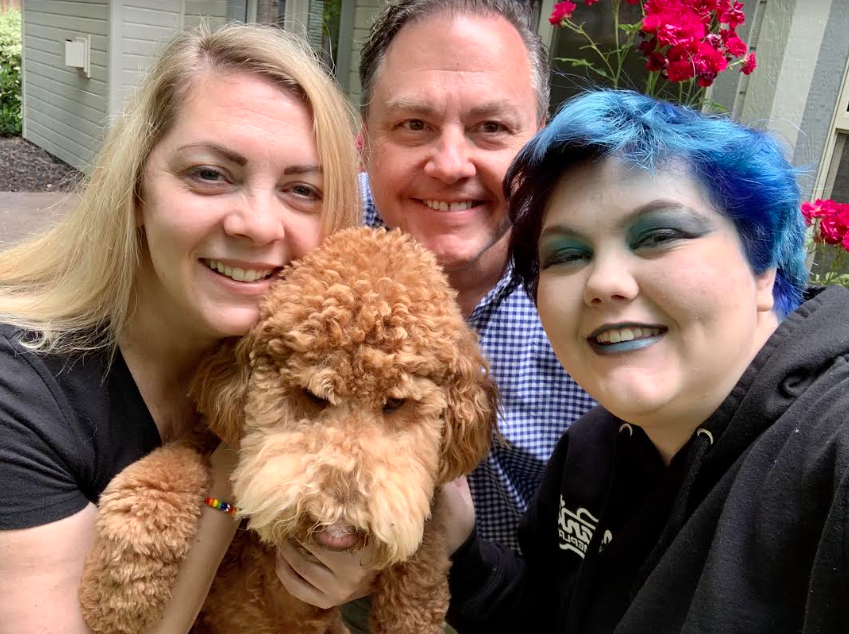
In summer 2018 at age 18, Oliver came home from BYU-Idaho and told their parents he identified as pansexual. This first happened in a car conversation with his mom in which Oliver asked if he would ever be kicked out of the house. When Anita passed the turnoff to their neighborhood and kept driving, Oliver was startled and feared he was about to be dropped off for good anywhere but home. But instead, Anita drove to a nearby park where they could have what turned out to be a complex conversation in peace. Anita assured Oliver that she would never kick him out unless it was something for his own good, not for his orientation. Almost 18 months later in December of 2020, Oliver (who was AFAB) came out as trans-masculine to Anita by sharing a handwritten letter he was going to send to his grandmother for whom he was originally named. Oliver’s coming out process has continued in a manner in which Oliver typically explains things to his mom, who then shares them with his dad, Ben. A couple months later, during a dinner conversation, Oliver explained to his siblings that there is a spectrum of gender identity with males on one side and the females on the other. Oliver shared he falls just left of center, on the male side, and would prefer to use the pronouns he/they and change their name.
“Growing up in a heavily Mormon family, I didn’t have the words for gender or sexuality and didn’t know what gay people were or gay marriage was until I was 12, and they read that letter in church about gay marriage. It just wasn’t discussed. I didn’t know trans people existed until well into high school. So I didn’t have words for it, but I knew I wasn’t the same as everyone else. I felt like an alien, trying to pretend, because I didn’t have the same guide book,” says Oliver. In college, they met their first queer person inside the church. In their time away from home while at school, Oliver explored how he best identified until he settled on what felt authentic. Oliver, who says he didn’t “get the hype” and hasn’t felt a connection to God since the age of eight, has removed his name from church records. He spent most of his adolescence with his family in a conservative ward in Oklahoma, where the Bible Belt climate often compared people like him as akin to murderers. Oliver is now more open in his spiritual practice, believing that actions beget consequences but does not adhere to a specific organized religion.
After spending many years babysitting and later working at a day care center, Oliver is now comfortable being out at their current workplace. He loves movies and TV, reading, painting and customizing black Vans shoes, and does a lot of art. Oliver has been dating Mya (AFAB) for almost three years, and also identifies as unlabeled orientation-wise. Oliver explains that often, LGBTQ humans first have a sexuality crisis, then a gender crisis, then another sexuality re-examination. Of he and Mya (who uses they/she pronouns and is bisexual), who has been with Oliver through his transition, Oliver says, “We’re not pressed on labels; it just is what it is. We both feel a little too old to lie awake at night trying to find a label or a box to put ourselves in. Sleep is already difficult; I’m not losing more over this.” Oliver and Mya also identify as “kitchen table” polyamorous, which they explain as not really a sexual thing, but more like being open to consensual emotional connections with others. The Ervins really like Mya, and Rome has told Oliver more than once they can’t break up because Rome and Mya are “besties.”
Rome, who was also AFAB, identifies as gender queer and bi-curious. (They have no preferred pronouns.) They selected the name Rome awhile ago, and Anita laughs she still hears the B52’s lyric “Roam if you want to” every time she calls her child’s new name. Growing up, Anita says she and her husband Ben were used to pairing off their kids, having two of each, and referred to their brood as “the girls and the boys” (younger siblings include Connor – 14 and Maddox – 12). But now, it’s the “gremlins and the boys.” Oliver laughs that he and Rome “are a little freakish” and so the name suits them well. Anita is very grateful that both of her oldest kids’ anxiety has improved since coming out.
Rome enjoys making jewelry, specifically earrings, out of miniature things, and loves the aesthetic (not the drug) of the mushroom. They also enjoy true crime, creating art, watching Criminal Minds, Minecraft, and claim they have an “unhealthy love of Mexican food.” Rome has done a year of college and is working at a BBQ joint for the summer.
In 2020, after listening in on a conversation Anita had with the Emmaus (LGBTQ and faith-affirming) group, Rome confided in her mom: “Mom, I think I might like girls.” This time, Anita responded more along the lines of, “I’ll love you forever and ever and ever,” laughs Rome. Anita recalls counseling Rome to not rush to label themselves, that they’d figure it out. Rome is grateful Oliver “paved the way for my ability to come out comfortably because he instigated the learning process for our friends and family,” and that they’ve had a family willing to accept them, no matter what. Rome also has benefitted from a more accepting ward in Ohio where several women wear pants to church and it’s easier to blend in. Anita encourages this, after observing Rome’s choice to wear slacks and a vest to prom. She believes Sunday dress is about “dressing your best” as your full self for the Lord, not adhering to some cultural norm.
Before Oliver came out, Anita says she always considered herself a “middle of the road, cliché Mormon.” She went on a mission, married in the temple, never turned down a calling. When Oliver first approached the LGBTQ subject with her, she didn’t know what to do – should she steer him toward the bishop? She didn’t want him living the life of shame she’d seen another close family member endure. Anita says, “As I prayed about what to do the only answer I got was to love him the way God loved him—fully. It was not my job to ‘teach more truth’ in an attempt to ‘fix’ him.” In the beginning, she and Oliver concur things were rocky; there were lots of tears. But Anita emphasized maintaining a strong connection with her child. She has close ally friends in her ward who she says got her on the right supportive path and to a place where she realized she could be all in with her family and all in with the church. “I loved realizing I didn’t have to choose between fully supporting them and being present in their lives, and being committed to my faith as well. I could do both.”
The Ervins have also reassessed how they teach faith at home, focusing more on how to develop a connection with Christ than follow a pamphlet of do’s and don’ts. “If you strip away everything else, at the core, it’s Jesus Christ and His grace that saves us, not going through the motions of church activity. I can’t limit Christ. I can’t say I have to expect my kids to live a certain way to be saved by Christ. I think He’s big enough to handle the complexity of their lives.” Anita says they have definitely moved on from a place of grieving over lost expectations, and now are able to see the humor in things. Their driveway is witness to the frequent “Can you make that straight?” joke, referring to a crooked parking job with a well-received double entendre.
A significant realization that’s helped Anita came from Richard Ostler’s second Listen, Learn, and Love podcast episode in which he deconstructed three partitions of church: the Church of Jesus Christ. The restored gospel. And the organization of the church. Anita likewise deconstructed her testimony and is able to safely linger in the first when things get hard. She can just focus on maintaining a pure connection to Christ. As looming fears of policy changes regarding trans individuals both in the national landscape and at church brew, Anita is choosing to focus on the one thing that won’t change: her faith in Christ.
Anita says, “I have faith and beliefs which haven’t changed, but I can respect where my kids are coming from. If they don’t go down the path I’d hoped, it doesn’t destroy my perspective. It’s okay for them to choose their paths; it’s only complicated because I don’t know the answers yet. But a pain point for me is that I see my kids in their gender journeys and some of the policies towards trans individuals, and I feel like they’re being treated like wolves instead of sheep. I want some recognition that they’re sheep.”
Oliver concurs there’s an untold level of pain kids like him experience. “The first time I thought about ending myself, I was eight years old… If people truly knew the level of discomfort, they would choose to learn. If people knew they could literally save a child’s life by listening and trying, they would.” He says Wrabel’s song “The Village” (lyrics below) perfectly sums up how important it is to listen to the trans experience in religious environments. Anita also laments the suicidality rates of trans individuals, as found at the Trevor Project. She’s had flashes of “What if? What if I had been the parent who’d said, ‘Not in my house’. I probably would not have all of my kids with me today. This isn’t just about us. We all change in our lifetimes; we all grow. People say, ‘What if it’s a phase?’ I respond, ‘So what if it is—this is real to them right now, and so right now I’m showing up 100% on their team. As their mom, I’ll do what I need to do to get them through the next five, ten years.”
What pains Anita most when she leads the parent support group is witnessing the sadness of families whose kids are being othered and excluded. “Too often when the kids don’t stay, the whole family goes. I feel that loss keenly. I understand when families step away. People need to realize that when they have those casual conversations against our kids, they are often sitting next to a parent of a nonbinary or trans child…” She fears the exponential hurt that may come in the near future for many. “Of all the places on earth where people should feel love and acceptance it should be among the followers of Christ and in His church. Unfortunately, that’s not always the case.”
Lyrics
No, your mom don't get it
And your dad don't get it
Uncle John don't get it
And you can't tell grandma
'Cause her heart can't take it
And she might not make it
They say, "Don't dare, don't you even go there"
"Cutting off your long hair"
"You do as you're told"
Tell you, "Wake up, go put on your makeup"
"This is just a phase you're gonna outgrow"
There's something wrong in the village
In the village, oh
They stare in the village
In the village, oh
There's nothing wrong with you
It's true, it's true
There's something wrong with the village
With the village
There's something wrong with the village
Feel the rumors follow you
From Monday all the way to Friday dinner
You got one day of shelter
Then it's Sunday hell to pay, you young lost sinner
Well, I've been there, sitting in that same chair
Whispering that same prayer half a million times
It's a lie, though buried in disciples
One page of the Bible isn't worth a life
There's something wrong in the village
In the village, oh
They stare in the village
In the village, oh
There's nothing wrong with you
It's true, it's true
There's something wrong with the village
With the village
Something wrong with the village
THE ANDRUS FAMILY
I am a Child of God,
Their promises are sure;
Queer kids are precious in Their site
If they can but endure.
I am a Child of God,
Their promises are sure;
Queer kids are precious in Their site
If they can but endure.
Lead me, guide me
Walk beside me;
Help me find the way.
Teach me all that I must do -
To help them live today.
It’s a mantra and a mission for Andrea Andrus, who reworked the words of a favorite hymn to align with her own experience as the mother of Ash (they/them). At 17 years old, Ash identifies as pansexual, nonbinary, and asexual, and was also recently diagnosed with autism. Andrea feels it’s both a calling and a blessing to parent such a beloved child with unique gifts. “Ash is my miracle baby. I want them and the world to know how special they are.” And of the many children like her own who also struggle with their mental health, Andrea says of her advocacy, “We know there are lives on the line. That’s why we do this work.”
Ash was born when Andrea was 35. Andrea and husband Kevin both recognized early on that there was always something extra special about them. Growing up, Andrea says Ash was the “sweetest, sweetest kid -- super smart, top of the class. Ash always wanted to do the right thing and be involved and have fun. They would come home from school all the time and say, ‘This is the best day ever’!” Ash is artistic and gifted musically. They performed with a youth theatre group, taught themselves the ukulele, and after taking piano lessons for several years, now play by ear.
While Ash has always been a delight to their parents, Andrea chokes up at recalling the rough road the Andrus’ faced when they realized the level of suffering their child had endured for years. Around Ash’s 8th grade year, Andrea and Kevin made an unexpected move back to Idaho, where they both were raised. Ash was forced to leave behind their friends and everything they knew. Then Covid hit. Ash seemed to be lost in their own world. Andrea vividly remembers the day she went in to wake up Ash for seminary and she realized there was something more going on – she knew her child was really suffering from major anxiety and depression. As they worked through that for a couple years, there was still something else Andrea felt she was missing. She then found out her child was autistic. Andrea says, “I feel strongly that someone being born with autism is just like being born LGBTQ – it’s how your brain is formed. And it’s great -- autistic people change the world. They think outside the box, they are beautiful and creative, just like our LGBTQ community.”
But Andrea feels that Ash having been undiagnosed that long with autism, and not getting the right support and treatments was very harmful and likely made their depression a lot worse. Right after they found out they were likely autistic, Ash asked Andrea, “Mom, am I broken?” Andrea says, “I had this powerful download of words that were not my own: ‘No, you’re not broken. This is your superpower’.” She told Ash, ‘It’s just like being gay. It’s how you were born. There’s nothing wrong with that, and it’s beautiful.”
Andrea reasons so many children like her own came out during 2020, (or while on their missions), is because in times of deep introspection and isolation with both yourself and God, is when we get real with ourselves. It was the same for Ash, whose coming out was a bit of an evolution of identities as they navigated what felt most authentic. Eventually, they found identifying as nonbinary to feel like a better fit for them than being gender fluid or trans. Andrea reports that in her research, she has found this to be a perfectly normal part of an LGBTQ youth’s journey. While she struggled with Ash’s name and pronoun shifts at first, she values the advice of (Lift and Love Trans Support Group Leader Mama) Anita who says, “Using preferred name and pronouns is another way of saying ‘I love you’.” This got really real for Andrea who, having been married once before, recently saw her former married name printed somewhere and it made her physically ill, which again reiterated to her the importance of believing people when they tell you who they are, and not dead-naming them.
Ash no longer associates with the church, and is unsure if they believe in God. Yet they have a deep connection with and find comfort in nature. Ash loves animals, mountains, the ocean, and forests. Spiritually, Ash leans into mystical things and loves crystals, essential oils, and finds Oracle cards fascinating -- much like a journal prompt. As Andrea has stepped back and watched her child’s interests develop, she has been reminded of the creation story witnessed in the temple, and that all the elements that fascinate Ash and cause them to listen to the divine are the same surrounding elements that God created.
Rather than resist Ash’s affinities, Andrea has made it a conscience choice to lean in and learn what her child is experiencing. She recognizes that a long time ago, she was one of those people who thought being gay was a choice. But when her own child came out, and her daily need became keeping that child alive, Andrea shed some of her past reluctancies and now finds intense peace and joy in allowing her heart to remain cracked open. An early prompting to learn all she could about the LGBTQ space transformed Andrea’s own belief system as she started to see that her personal revelation and insights did not always align with what she’d been taught. At one point, she apologized to Ash for not being better prepared, and now the two have a very strong bond of trust and transparency. Because of the actions Andrea took to educate herself and become a stronger ally, not only does Andrea feel an extreme outpouring of love for Ash, but for all LGBTQ people, including her gay niece and nephew.
She advises others to “Stay curious. To try to accept and love. If something bothers you, ask yourself why.” When Ash first came out to their parents, at the time the Andrus family was living in Twin Falls, ID, where they had a remarkable affirming bishop and his wife – each with a gay sibling of their own. Andrea’s bishop advised her to seek her own personal revelation, while also saying, “Your job is to love them.” At first, she thought, “Of course, I do.” But with time, she learned that love really is a verb.
On her spiritual journey, many things uttered over pulpits have been hurtful to Andrea. “I try to be a stone catcher. But sometimes it feels like stones are being thrown by some of our own.” One recent talk in particular that made it sound like Andrea’s child might “end up in a lesser kingdom” was especially hard. “I reject that,” she says. “I think there’s a VIP section for our LGBTQ siblings in heaven. A special place for special people.” Andrea also embraces the notion of expecting miracles along this journey as we navigate from Point A to Point B. She says, “God loves all His children. If the gospel doesn’t include all God’s children, then it’s not the complete gospel.”
Now residents of Eagle, ID, Andrea is hopeful the church may someday feel like a safer place for her family. But as of now, she says, “We’re hurting. It’s not ok. Such a huge percentage of LGBTQ families leave the church. There are some people and organizations doing great things, but until it comes from the top, it’s not going to change the masses. Unless you’re blessed enough to have an LGBTQ child, it’s a slow process of changing hearts. And in the meantime, we’re losing so many wonderful people. Every ward’s got a few safe ‘come sit by me’ people, but it’s not enough. It’s a huge loss. And it’s lonely.” That being said, Andrea takes great comfort in her knowledge that her child Ash has a divine purpose on earth, and that God will help them succeed.
THE TANYA & BRENDEN DAVIS FAMILY
My husband Brenden and I are the parents of four beautiful children: Courtney - 25, Ren - 23, Eme – 15, and Jackson – 13, who are ALL LGBTQ! We are the only family we know with all LQBTQ kids and we feel like we won the lottery! But it has been a process to get to this point in our lives.
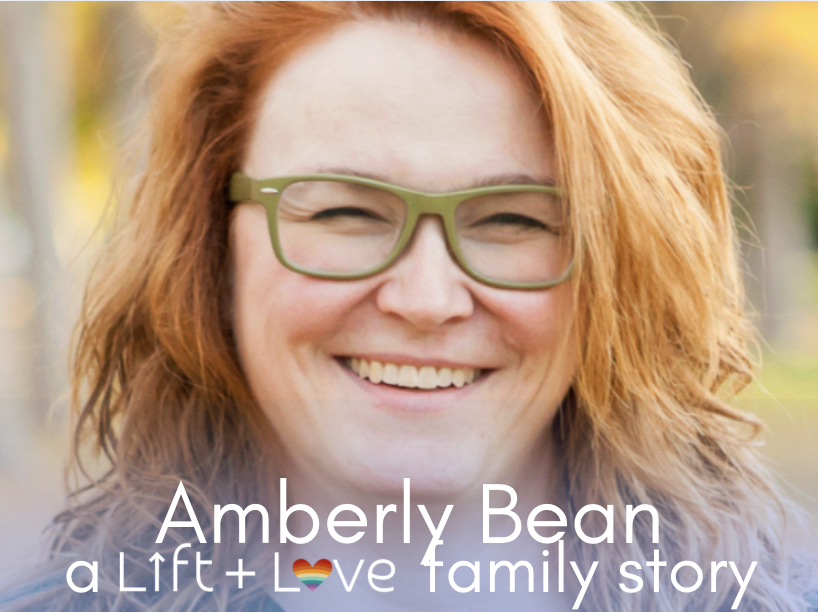
Our second child, Ren (they/them), was our first to come out in 2016 at age 16, originally as pansexual and more recently as non-binary as well. As our first to come out, Ren had the toughest time and we made SO MANY mistakes, especially me. Brenden and I were on our way to Europe to celebrate our 20th wedding anniversary when we found a note in our car at the airport, telling us Ren was pansexual, had known for more than five years, and was leaving the church. We were stunned. I found out later that they had a bag packed that day in case we asked them to move out – which broke my heart. We did call right away and shared our love and support, but that was really the only time we talked about it for the next few months. I chalked it up to giving everyone time to process; but the truth was, I was afraid, and hoped this was just a phase that would go away. I thought Ren was exaggerating pain to get out of attending church, and honestly, I made the experience at the time more about me and the pain I was feeling about their stepping away from the church, instead of about their feelings.
Even with our love and acceptance, Ren had internalized feelings of unworthiness and shame that were at times crippling. A suicide attempt in 2017 really opened my eyes. At the time, I felt there could be nothing worse than the despair you feel when your child tries to take their life. And then I witnessed the level of pain experienced by four separate family friends who each lost loved ones to suicide, some due to shame they faced from their church communities because of their identity.
After Ren’s attempt, the situation became painfully clear. It didn’t matter if this was a phase. It didn’t matter what I was feeling. What mattered was this kid, right now, and the fact that they were hurting deeply. And I needed to figure out how I could help. We were given a second chance – a gift many others don’t receive, and I was determined to do better, to be better for all of our kids.
It seemed unfathomable to me that the church that had brought such joy and fullness to my life could be causing pain for others. I asked Ren to explain more about what hurt at church, and several examples were shared. But the one that hit home the most was a regular and repeated experience – a brother in the ward who reliably bore his testimony every month about Satan’s attack on the family. With tear-filled eyes, Ren looked at me and said, “They are talking about me, Mom. He thinks that I am Satan’s tool to destroy families.” Ren continued, “How could God love me but make me this way?” It was the first time those thoughts had ever occurred to me, and I had no answer for my child who was hurting so badly. But from that very day, I became determined to dig in and learn more, to understand the pain points and to do a better job protecting. When I took my pleas to the Lord, they changed from “Change my child” to “Change me, help me to see.” As the Lord always does, He answered clearly and precisely: “Just love, without preconditions, without judgement, and without requirement to change.” I had four years to educate myself and to learn before life would change again.
One of the blessings for Brenden and I during the 2020 pandemic was lots of family time and many conversations that helped our kids to understand how we truly wanted to be supportive. Our daughter Eme (she/her), then 13, opened up in a tearful conversation and shared that she was pansexual. Five minutes into that conversation, our then 11-year-old son Jackson (he/him) burst into the room. He could tell he had walked into something important since we were crying together, and he started to back out of the room. Eme made eye contact with him and said, “I told her.” My response was, “Wait, he already knew?” To which my son responded that he might was well share his news, too: he was omnisexual (attracted to any gender, with a male preference) and gender fluid! That was a lot for one conversation! But the feeling was so palpably different than our first experience with a child coming out. I felt relief that we knew so early, without years of trying to hide and repress feelings. I felt so much gratitude that Ren had paved the way so that their siblings could have an entirely different experience.
Our oldest daughter, Courtney (she/her), got married civilly during the pandemic and about a year later came out in a Facebook post as bisexual. She shared this information with her new husband, Casey, prior to their marriage and he was nothing but supportive of her. He’s a keeper! She delayed telling us because she was worried that we would struggle with her decision to leave the church and that four LGBTQ kids might “put us over the edge.” By that point, I was a little bit relieved that for the first time, we were all in this together, in a different way than we had ever experienced before. We are making the decision to “come out” as a family together now because we want to celebrate how far we have come and to emphasize that there is no shame in the way the Lord made each of us. We are so incredibly proud of the amazing, talented, artistic, funny and empathetic children we have been blessed with. They have taught us the true meaning of love. We are better because they are part of our lives. We have told them repeatedly – and we mean it – that we will love whomever they choose to share their lives with!
These experiences have brought Brenden and I closer to the Savior, and to explain that further, I need to share a bit about my job. I am an architect and I work for the church in the Special Projects Department. I oversee the design of new temples in a large part of the world, and I have been participating in this work in some form or another since 2016, just months before Ren came out.
As I came to better understand the trauma our LGBTQ kids were carrying, I came to understand why the temple was such a source of pain for many. I have had tearful, honest conversations with my kids about the reality of their ability to attend the temple now and in the future. At times, it has seemed ironic to me that the majority of my time and effort on a daily basis is spent engaged in building temples that my own children may not be able to attend. It hurt tremendously, often more than I had words to explain. I don’t think it is a coincidence that I work where I do and that all my children are LGBTQ. It has given me the opportunity to search deeply for answers from the Lord.
As I repeatedly took my concerns to the Lord in the temple, several things were made clear to me. First, the valiant example of Eve: her ability to evaluate truth and evil and make a courageous choice allowed the unfolding of the Lord’s plan. She is someone I can emulate and admire as a mother and a woman who bravely does hard things. Second, the blessings pronounced in the temple go both forward and backward in time, they impact my ancestors and my children, and are based solely on my ability to keep my covenants, not theirs. Third, it was no accident that the focus of the temple is on the beauty and variety of the Lord’s creations. My children, and others like them, were beautifully and wonderfully created in His image and were some of the most valiant spirits saved for these latter days. That last truth came as I sat in a celestial room and looked up at the beautiful chandelier and saw hundreds – if not thousands -- of tiny rainbows. It literally took my breath away. I was also blessed with the opportunity to take my whole family to the open house and rededication of the Raleigh, NC temple, one of my earliest temple projects. As we sat in the celestial room together, I had the thought that it might be the only opportunity we would have, in this life, to be with our children in the temple and how grateful I was that we at least had that experience together. I was filled with tremendous peace that everything would be ok, and I have often looked back on that experience for peace and reassurance from the Lord.
We try to Lift + Love our children by believing them. We talk about everything honestly and openly. We try to help them process things that hurt, including comments and attitudes of others -- sometimes close friends. They have our permission to leave a space that doesn’t feel safe and to advocate for themselves and others. We are also working on allowing them the space and time they need to create their own relationship with the Savior and to understand that His love is not transactional; it does not need to be earned. The Lord has slowly been teaching me that I don’t have to hold on so tightly. He loves these kids infinitely more than I do – which is hard to imagine. Whether they stay members is not important; what matters most is that they connect with Him and feel His love in a way they can understand.
As for my husband and I, we feel called to stay, to tell our story, and to advocate for safety and inclusion. I believe that truly listening to each other and learning from each other paves the path to real Christlike love. Listening to the stories of other LGBTQ members as well as my own kids ultimately changed my heart. My desire is that one day we, as members of the church, will open our hearts and our minds to everyone and that we will have a desire to truly magnify our baptismal covenants -- to mourn with those who mourn and comfort those who stand in need of comfort -- with both our words and our actions. Church will be a place to come and heal, regardless of the trials and challenges we face individually and ALL will be welcome on the pews. We will be able to love without preconditions, without requirement to change -- to love like He loves!
We’d like to thank Tanya Davis for sharing her beautiful family story.