lift+love family stories by autumn mcalpin

Since 2021, Lift+Love has shared hundreds of real stories from Latter-day Saint LGBTQ individuals, their families, and allies. These stories—written by Autumn McAlpin—emerged from personal interviews with each participant and were published with their express permission.

lgbtq+ stories
family stories
ally stories
LGBTQ STORIES Allison Dayton LGBTQ STORIES Allison Dayton

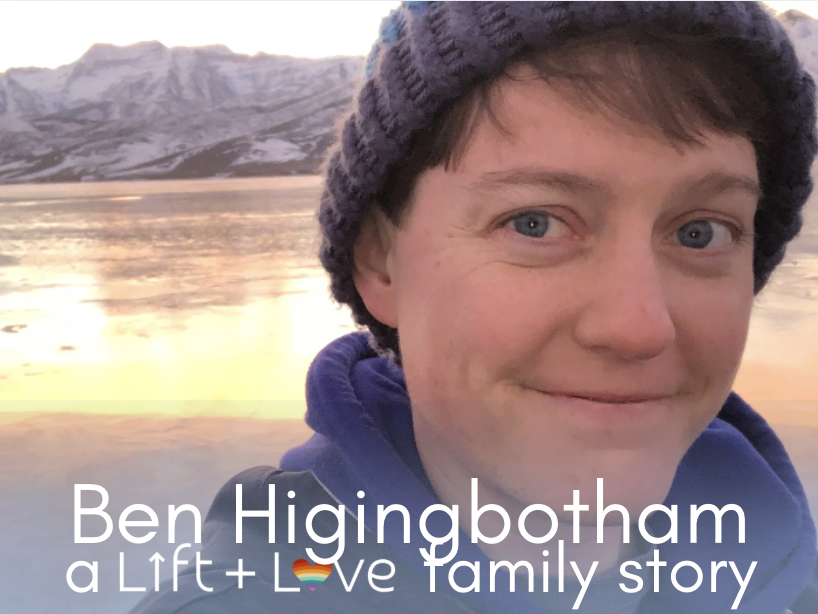
BEN HIGINBOTHAM

Ben Higinbotham (they/them) is gay and transmasculine non-binary. Ben says, “If I explained my personal version of non-binary to someone, I’d say, ‘If masculinity was a fork and femininity was a spoon, I’d be a spork.” Ben also sometimes has to explain their sexual orientation, saying, “When people ask what it means for me to be gay as a non-binary person, I say that I guess I’m half gay for girls and half straight for girls.” One thing Ben wants to emphasize is that being gay and/or trans is not a choice or contagious.
Ben Higinbotham (they/them) is gay and transmasculine non-binary. Ben says, “If I explained my personal version of non-binary to someone, I’d say, ‘If masculinity was a fork and femininity was a spoon, I’d be a spork.” Ben also sometimes has to explain their sexual orientation, saying, “When people ask what it means for me to be gay as a non-binary person, I say that I guess I’m half gay for girls and half straight for girls.” One thing Ben wants to emphasize is that being gay and/or trans is not a choice or contagious.

Ben remembers being about four years old and pretending to be Peter Pan in preschool. "I liked the way he looked, that he could fly, have adventures, that he helped people, and that kind of thing," they recall. Ben had a crush on a girl in the class and would ride around on a tricycle (because they couldn’t actually fly, and that was obviously the next best option), pretending to save her from pirates. "I thought that maybe if I rolled my socks down instead of folding them, to make them look poofy like the people’s socks in Sleeping Beauty, she might think of me as a handsome prince. It didn’t work.” 

Growing up socialized as a girl, Ben didn’t have language for what they were experiencing. But Ben often escaped into imaginative play where they could be their favorite characters like Peter Pan, Robin Hood, Simba, Harry Potter, but never the Disney princesses. Things like bows and arrows, sword fighting, and playing with bugs were great, but pretty dresses were kind of the worst. 

Ben was born and raised in Orem, Utah, in a large family that was always active in the LDS church. But from a young age, they felt a disconnect between their inner sense of self and what they were told was expected of them. As a young kid, they didn’t know what the word ‘gay’ meant, and had never heard terms like ‘transgender’ or ‘non-binary.’ Nobody was pressuring them to be queer - if anything, there was pressure to not be queer. And yet, those feelings were all naturally, instinctively there. "I didn’t have the words to describe it. But I did get the sense that it wasn’t normal, and that I wasn’t supposed to talk about it."

Ben’s first memory of queer-related shame came early: a kid in kindergarten asked if they were gay and instructed them to look at their fingernails - palm up if you were gay, palm down if not. "I had no idea what 'gay' even meant, but I figured from the kid’s tone that it was bad," Ben says.

Still, they instinctively volunteered to take on the male roles in school performances. "I always wanted to do the guy part - it was what felt the most natural." In elementary school, they were part of a Spanish immersion program. Each year, there was a cultural dance performance for each grade. There were always more girls than boys, and whenever the opportunity came up, Ben would volunteer to take on a male role. Once, a mother of their dance partner came up to them afterward and said, "I’m so honored my daughter was able to dance with you." Looking back, Ben thinks that mom was likely an ally.

In their teens and twenties, the internal turmoil deepened, but they tried not to let it show. "I was always the teacher’s pet, the (mostly) straight-A student at school, and always had the right answers at church.” They developed romantic crushes on girls, but hid the feelings. They were afraid of rejection if anyone - especially those friends - ever found out. “I thought, 'this is a trial I can handle by myself. I don’t want to burden anybody - I’m the one who’s broken, so it’s my job to carry all of the discomfort.’" Ben thought they were alone. "I thought being queer was super rare. I didn’t think a girl would ever like me back." Friendships were hard. When they had crushes on friends, they assumed those friends didn’t care as deeply in return. They had no outlet for the "spiraling thoughts" in their head. "I couldn’t talk to anyone about what I was feeling, so the thoughts often spiraled out of control. Being in the closet was very emotionally unhealthy for me." 

During this time, Ben still didn’t totally have some of the words to describe what they were experiencing. One hard part of being in the closet was not being able to talk to anyone who could help make things make sense. They knew about the acronym LGBT, and tried to figure out which letter fit them best. The ‘T’ was particularly confusing, because they knew they sort of felt like a boy, but at the same time, also didn’t totally feel like a man. 

Ben says that for years, they likened their queerness to a Horcrux from Harry Potter. Harry had a little piece of Voldemort basically injected into his soul. “I thought my queerness was kind of like that - a little piece of Satan injected into my soul. I figured that it wasn’t actually a part of me, it was something separate, and that when I died, it would go away - as long as I never accepted it as a real part of myself.” 

Ben served a three-month mission in Nauvoo as a young performing missionary, followed by an 18-month Spanish-speaking mission in San Jose, CA. Ben reflects, "I thought a mission would cure me of being queer. I figured I’d come home, get married, and live a 'normal' LDS life." But nothing changed. "As a missionary, I realized almost immediately that my same-sex attraction wasn’t going away." The first person Ben came out to was their Nauvoo mission president. The mission president reassured them: "You’re not doing anything wrong." Ben felt better but still didn’t have language or clarity to help mitigate their emotions.

After their mission, they came out to their kind and definitely well-meaning bishop, who referred them to therapy. "I basically voluntarily went looking for conversion therapy - I thought it might help me live the life I was supposed to live," says Ben. “Thankfully, the therapy that I got probably didn’t actually count as conversion therapy, at least for the most part.” The therapy didn’t change their orientation or gender identity, but it did help them understand themselves better. "It wasn’t what I originally thought it would be, thankfully."

At BYU Provo, Ben studied music composition and audio in the commercial music program. They played clarinet in university ensembles, and toured internationally with those groups through Europe and Asia. They were also a temple worker for a time. Ben says, "I realized a lot of older sister temple workers had short hair. I’d always wanted short hair but was afraid people would think I was gay." Seeing those women helped Ben realize that getting a short haircut would probably be okay. Eventually, they got the short haircut and never looked back. "Someone told me I’d look good with short hair - I got it cut, and never plan on going back."

The pandemic gave Ben time to reflect. When in-person church started back up again, they connected with a non-binary friend who became a safe person to talk to. For the first time, they had someone who truly understood. This was the first time that Ben had heard the term ‘non-binary,’ and they realized that finally there was a term that accurately described what they were experiencing. All of this helped Ben to finally feel comfortable enough to come out publicly. Still, talking about gender identity felt harder and kind of more taboo than talking about being gay. 

That friendship led to an unexpected romantic relationship with the friend’s sister. The relationship was something Ben had never planned to pursue. Ben says, "I had always told myself that I couldn’t be in a queer relationship. But itkind of just happened naturally. We’d ‘hang out’ one-on-one, and for a while I wouldn’t admit that it was a date. But eventually we realized that we were in a relationship." They didn’t tell many people. The relationship ended nearly three years ago, but it was meaningful. "The thing that I’d been taught my whole life was bad didn’t feel evil. It felt right. I was learning and growing as a person."

Through that experience and hearing stories of other queer people, Ben began to shift their view of gospel living. "I don’t think the gospel is about your orientation or gender identity. It’s about being a good person - and that’s not dependent on those things." They began to lean into the scripture, “By their fruits ye shall know them.” In considering their future, Ben figures, "If it’s bringing good fruit, it’s probably good." Now, most of the shame surrounding their queer identity is gone. Ben feels that God has been healing them - not from their queerness, but from the darkness and shame and fear. 

Last year, Ben signed up for the Gather Conference. When asked for their name and pronouns, they used "Ben" and "they/them" for the first time. Ben smiles, "It felt good. It felt like me." They had long admired the name Ben, a tribute to their baby brother who passed away 30 minutes after birth. "I tended to imagine my angel baby brother as a good, caring, kind, calming person. After a while, I realized that the way I imagined him was actually my own ideal self. I also like that in Latin, the root ‘ben’ means ‘good.’ That’s who I want to be."

They prayed and went to the temple repeatedly, asking if changing their name and pronouns was the right decision. "I figured God would give an answer in both mind and heart," Ben says - “and I believe that He has, repeatedly.” In the celestial room one day, after praying about the name and pronoun change, they saw two people who they knew - one named Ben, and another who had always tried extra hard to use the right pronouns. "It felt like a confirmation."

Ben changed their name and pronouns, started wearing a tie to church, and decided to be even more open about their identity. All the while, they’d check in during prayer, asking their Heavenly Father if what they were doing was the right thing. The answers always felt affirming, understanding, and loving.

When Ben told their bishop about the name and pronoun change, the bishop was respectful and kind. Though Ben did lose their temple recommend and can’t serve in certain callings because of current church policy around social transitioning, they’ve been embraced in their YSA ward and now serve on the FHE committee. "I’m just trying to be a normal person, so people can see that trans people aren’t scary - we’re just people, and we’re here."

One of the most spiritual moments of Ben’s life came years earlier, on a trip to Israel. At the Garden Tomb, they’d hoped to get a photo of them in front of the empty tomb, but were rushed out by another group’s leader. Frustrated, Ben walked away. "I thought, 'God’s good at turning bad experiences into good ones - maybe He can do that for me here.' I decided to identify what I was feeling, and realized that I was feeling pushed aside. Then this strong, clear prompting came: ‘I would never push you aside’." It wasn’t until years later that Ben connected that message to their identity. "Even though I’m queer, God won’t push me aside. Even when well-meaning members think that’s the best way to live the gospel - that’s not God. That’s people." 

Ben lives with their family and their beloved yorkie, Woofard Woodwoof (Woofie). They still play their clarinet in an orchestra as well as bagpipes, and they work at a printing shop. A couple of their siblings are also queer - a trans sister and a gay brother. Ben, their gay brother Matt, and their mother Barbara have all shared their stories on the Listen, Learn & Love podcast. Now Ben is excited to share their story with Lift+Love. They’re hopeful that their story will help others feel less alone. "It’s scary sometimes, but I’m trying to be visible, so that maybe someone else in the ward or community will see me and think, ‘Ben’s cool, not scary. Maybe other gay or trans people aren’t scary either’."

Through all of this, Ben is very grateful for a Savior who understands all of it, because He felt it along with us - and comes to us and loves us, right where we are, even in the hardest times.

You can hear more from Ben at the 2025 Gather Conference www.gather-conference.com

Read More
LGBTQ STORIES Allison Dayton LGBTQ STORIES Allison Dayton

BRAXTON ROGELIO

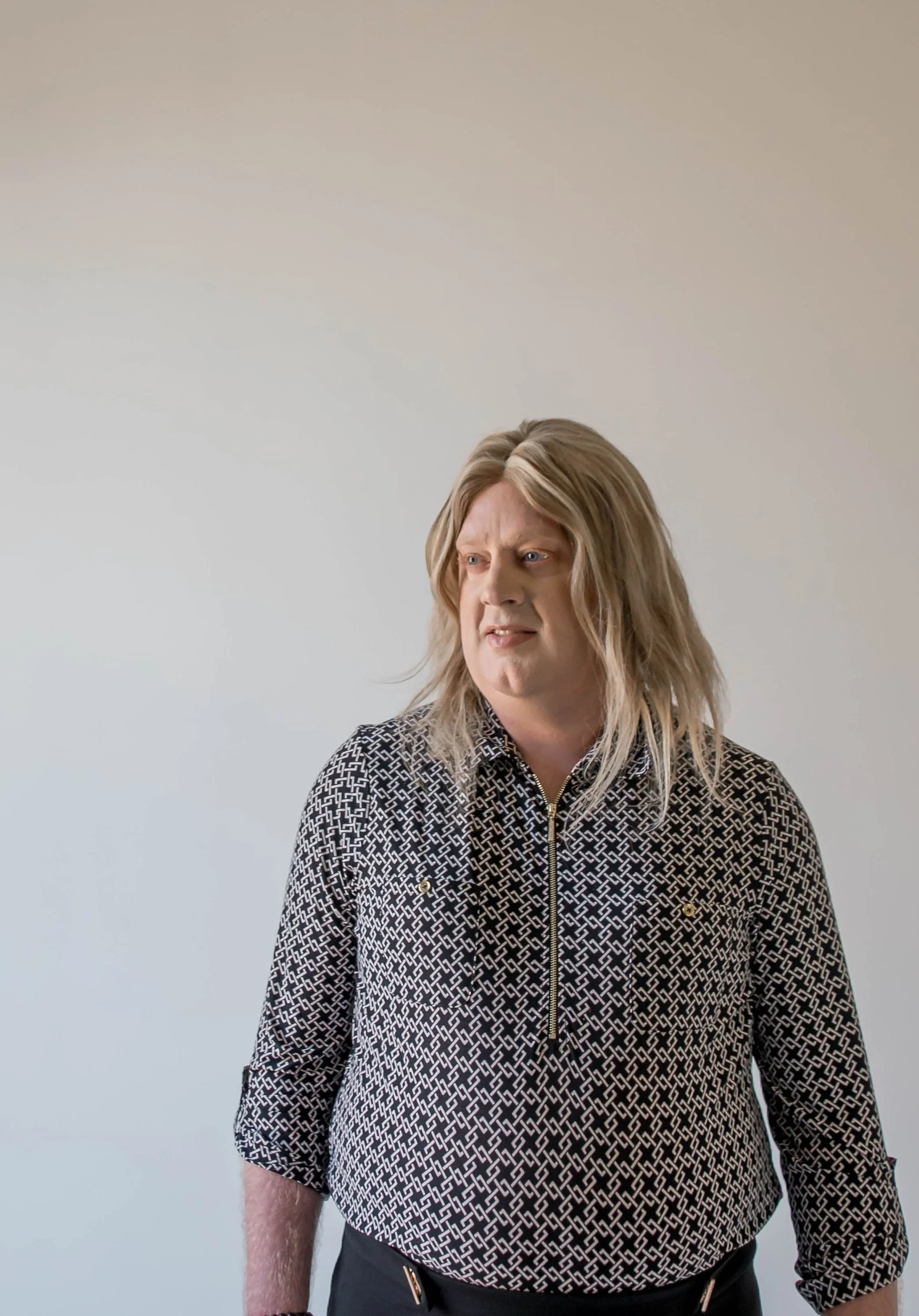
Braxton Rogelio (he/him) has spent his life pursuing the arts while asking big questions—which has led him to embrace his identity as the proud transmasculine, gay man he is today…
**content warning: suicide attempt is mentioned**

Braxton Rogelio (he/him) has spent his life pursuing the arts while asking big questions—which has led him to embrace his identity as the proud transmasculine, gay man he is today.

Now 39, Braxton lives in Mesa, Arizona, not far from where he was born and raised. A passionate writer since the age of 13, he’s currently working on a memoir with the support of his uncle, who is a Utah-based author, screenwriter, and director. Their bond is built on a shared love for exploring possibilities. “He’s such a sweet, funny personality,” Braxton said. “We’re so similar—we’re always asking what if, and what else.”

Braxton’s life is rich with passions. He loves anime, karaoke, travel, and his beloved cat, Bear—a tabby-Siamese mix he describes as a “gorgeous boy and absolute love bug.” He proudly embraces his Latino roots through his dad’s Portuguese and Spanish heritage. And when it comes to music, his playlist features favorites like David Archuleta, John Mayer, and Selena.

Music, in fact, quite literally saved Braxton’s life.

A few years ago, after leaving the Church of Jesus Christ of Latter-day Saints and facing pressure to return, Braxton found himself in a dark place. Depression overwhelmed him. “I had been told, 'You need to come back to church,' and it just got really bad,” he says. One night, feeling hopeless, he attempted to take his own life.

As he sat alone, still suffering yet having survived the attempt, a song shuffled onto his phone: David Archuleta’s “To Be With You.” He says, “Hearing David’s song—it saved my life.”

Later, Braxton had the chance to tell David Archuleta exactly that. At a Christmas concert at the House of Blues in San Diego, he met David, shared his story, and received a hug in return. “I was so grateful,” he said. “I gave him a gift—a few things he had said he liked on Instagram—and it was great to talk to him."

Last Mother’s Day marked another turning point: Braxton came out publicly as trans. While he had long stepped away from church activity, the day offered a bittersweet illustration of the complicated ties between faith, family, and identity.

His mother, still active in the church, asked him to attend services with her. Braxton agreed, despite his deep discomfort. "I was already in tears but thought, 'I'll suck it up for my mother.'" During the meeting, young children were handing out flowers to mothers. Braxton, who does not identify as a mother, was encouraged by his mom to accept one. "I thought, ‘this is so weird’," he said.

Later, attending a Relief Society meeting only deepened his feelings of isolation as Braxton had fully embraced his identity. “Ever since I was five or six years old, I knew something was going on,” he said. “I even told my brother when we were little kids, 'Hey, I'm your brother’."

Coming out to his family brought a range of responses. His younger brother, two years his junior, was the first person he told. “He wasn’t surprised,” Braxton said. “He said, 'You've always identified that way. As long as you're happy.'"

His sister, who is three years older, and his father were also supportive. His father’s response was simple and unconditional: "No matter what, I'll always love you."

Today, Braxton enjoys close relationships with his father and stepmother—whom he affectionately calls "Mama"—as well as with his brother and his brother’s family. "Everyone lives in Arizona,” he said. "My dad and Mama have lived in the same house for 25 years. My brother and his wife and five kids live just down the street."

While most of his family offers love and acceptance, there have been painful exceptions. But Braxton focuses on the love that surrounds him. “I have a good support system and love them very much,” he said.

Braxton’s journey of self-discovery has also included navigating relationships. Over the years, he’s experienced three failed engagements. Each time, he realized he couldn't move forward without first fully understanding and accepting himself. “It had to do with me, not them,” he reflected. “I couldn’t help them the way they deserved, not with everything going on inside me.”

Today, Braxton also identifies as demisexual or asexual, and finds belonging within the ace community. Trying to live authentically hasn’t been without its challenges. Braxton has faced harsh words, including being told he was “evil” or “being seduced by Satan.” But he stands firm in who he is and trying to be. “With everything going on in the world, don't be afraid,” he says. “Embrace yourself. You shouldn't feel ashamed. You deserve to be yourself.”

Looking ahead, Braxton says, “I hope to be a man married to another man,” he said. He feels a strong connection to his Latino heritage and hopes to build a life that honors all parts of his identity. He’s also working toward greater mental health support, planning to join a group therapy program through AZ for Change, an organization supporting LGBTQ+ individuals.

Music continues to be a source of healing and joy. Braxton eagerly looks forward to attending upcoming David Archuleta concerts—including two in southern California this week. “I'm excited to meet up with some friends there,” he said.

In the meantime, he continues writing, learning to play the piano from his mother, and pursuing his dream of publishing his memoir—which he hopes will prove a testament to a life defined not by fear or conformity, but by authenticity, resilience, and love.


Read More
LGBTQ STORIES Allison Dayton LGBTQ STORIES Allison Dayton

MADDIE FOX

Every February is Bald Eagle Month in Utah, and Maddie Fox (she/her), takes full advantage of the season.  A self-described amateur wildlife photographer, Maddie, 35, sets out early on one February Saturday a year to photograph her favorite creature. While she’s also garnered a frame-worthy collection of bison, elk, wild horses, and black bears, there’s something about the way the bald eagles soar overhead as they migrate south looking for food—so free and unencumbered—that captivates her…

Every February is Bald Eagle Month in Utah, and Maddie Fox (she/her), takes full advantage of the season.  A self-described amateur wildlife photographer, Maddie, 35, sets out early on one February Saturday a year to photograph her favorite creature. While she’s also garnered a frame-worthy collection of bison, elk, wild horses, and black bears, there’s something about the way the bald eagles soar overhead as they migrate south looking for food—so free and unencumbered—that captivates her. 

The proximity of her West Jordan home to the mountains affords Maddie opportunities to enjoy other outdoor activities like hiking and rock hounding for minerals and gems in the state in which she was born and raised. But as of late, she has been less than enthralled with recent Utah legislation that affects the trans community she is a part of. She says, “Transgender people just want to go about living our lives. We are who we are, the same people we always were—we’re just trying to match our external to who our internal selves tell us we are.” In a state that has now passed some hostile policies including the recent bathroom bills and legislation preventing PRIDE flags from schools and public buildings, Maddie continues, “I wish people knew that I am not the threat politicians say I am. I’m kind, loving, and just want to have the best quality of life I can being my true authentic self.”

For Maddie, her authentic self has felt “different” for as long as she can remember. Growing up, she didn’t know what it all necessarily meant, but she always felt something was unique about her. While she was assigned male at birth and grew up playing sports like basketball and baseball alongside her two younger brothers, Maddie typically felt more drawn to feminine things until a sense of shame would inevitably set in. Maddie grew up in the church, and later loved serving a mission to Ireland, but saw when she returned home after two years, her feminine feelings had not gone away as she’d presumed they would. This time, she got into a therapist who helped her work through various thoughts. After some time spent building up trust, based on all Maddie shared, she was diagnosed with gender dysphoria. 

While Maddie had experimented with wearing women’s clothing intermittently throughout her life, she started officially socially transitioning about a decade ago, at age 25. Six months ago, she began hormone replacement therapy, which she says has greatly helped with her gender dysphoria and increased her ability to feel authentic and “much more happy.”

With the recent shift in transgender policies instituted by the LDS faith, “and even before then,” Maddie says she has experienced a faith awakening. Last August’s policy shift has made activities and second hour meetings too difficult for her to attend. Now, she says, “With the policies, I just kind of go for a sense of community, but I don’t know where my faith journey will lead. I am still blessed to have a knowledge of my Heavenly Parents and their love for me.” Maddie says her family is coming to terms with her transition and she is grateful to feel their unconditional love. 

Besides working at a university as a testing proctor and enjoying outdoor activities, Maddie stays busy watching college sports – with football being a favorite. She also belongs to a few support groups for trans individuals that she attends as her work schedule allows. Maddie takes comfort in hearing others’ similar stories and seeing how they live her lives. “I see what I can take from them and apply it to my own.” Maddie also identifies as lesbian ad has dated a little. She says, “Being trans and lesbian can be difficult here in Utah. I hope one day I can find someone I can date and settle down with and have a relationship.”

As the temperature rises nationwide when it comes to LGBTQ+ issues, Maddie says, “I wish that whether it’s church or state or federal that they would get input from transgender individuals who have lived experience instead of listening to the fearmongers.” Maddie prefers a gentler way, much like the nature of Jesus as portrayed in her favorite TV show, “The Chosen.” She says, “How Jesus is portrayed in The Chosen is how I see my Savior. That’s how I imagine He would be.”

Read More
FAMILY STORIES Allison Dayton FAMILY STORIES Allison Dayton

MARY ANN ANDERSEN

Mary Ann Andersen had always believed that love was unconditional, yet nothing could have prepared her for the totally unexpected revelation that would reshape her life and her marriage. For years she had built a life with Dave, a man she knew as a devoted husband, caring father of four, and committed member of the Church of Jesus Christ of Latter-Day Saints. Their days were marked by shared routines: family dinners filled with laughter, lively discussions, the typical demands of raising kids, and the steady pressure of church and community service. Yet, beneath this familiar rhythm lay a secret that would eventually alter the contour of their relationship…
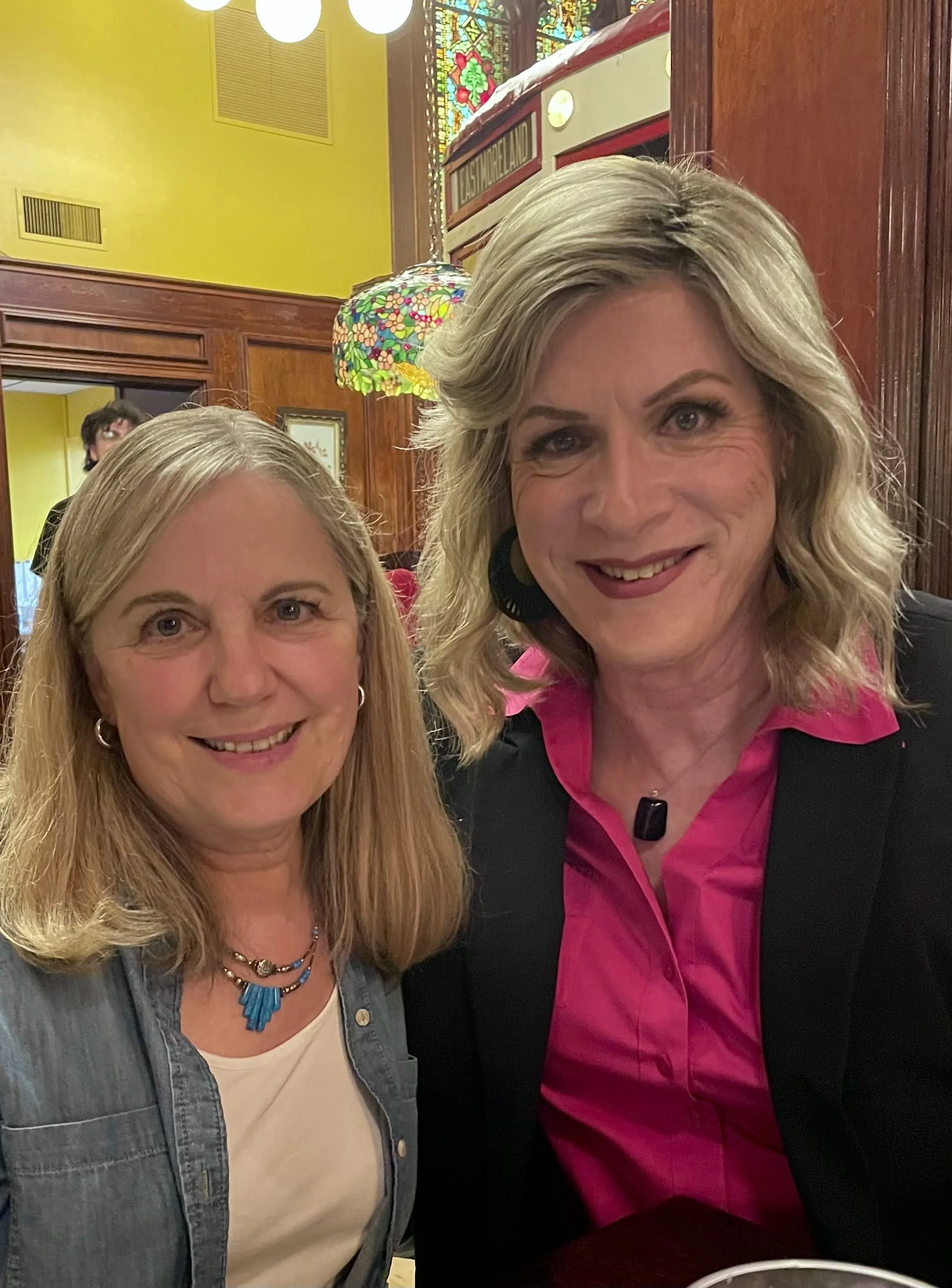
Mary Ann Andersen had always believed that love was unconditional, yet nothing could have prepared her for the totally unexpected revelation that would reshape her life and her marriage. For years she had built a life with Dave, a man she knew as a devoted husband, caring father of four, and committed member of the Church of Jesus Christ of Latter-Day Saints. Their days were marked by shared routines: family dinners filled with laughter, lively discussions, the typical demands of raising kids, and the steady pressure of church and community service. Yet, beneath this familiar rhythm lay a secret that would eventually alter the contour of their relationship.

It began 14 years into their marriage in 1993, when Dave confided in Mary Ann about the inner conflict he had carried since youth—a dissonance born of a desire to express a feminine side he had long kept hidden. At the time, Mary Ann was busy raising four kids and managing a farm and bed and breakfast while Dave worked full-time and served as the bishop of their ward. Dave had always gone to great lengths to keep his feminine interests and clothing hidden, though Mary Ann had observed how complementary Dave was about how she did her own hair and makeup. “It didn’t make a lot of sense back then, but I just thought what a goldmine of a husband I had that he even noticed. But really Jennifer was living her life through me.”  While some wives might have loved having their husbands encourage more facials and makeovers, Mary Ann started to resent this, wondering if she wasn’t attractive enough for her husband.

Back then the term “transgender” was nearly unknown, and the idea that the man she loved might also be the woman he felt inside was as bewildering as it was painful for Mary Ann. She remembers that Dave’s first hesitant admission was filled with both fear and hope for understanding. As Dave revealed that he carried within him a longing to be seen as female, Mary Ann felt shock, confusion, and an aching vulnerability. She wondered if her husband was gay and wouldn’t admit the truth to her. “And why didn’t he tell me this before we got married?” Back then, they both didn’t fully understand the difference between sexual orientation, gender identity, and gender dysphoria. After a difficult month of trying to process this news and wandering the aisles of local bookstores and libraries to pour over whatever literature she could find in search of answers, Mary Ann informed Dave, “I can’t change who I am, and I’m not attracted to women. This isn’t going to work for our marriage.” She figured he would do the “right thing” because he had always done so in the past. Being raised in the church, and being a teenager during the 70’s, it was taught that being gay was a choice, it was so black and white. This is something you can choose not to do. So the two shelved the topic for over two decades, never bringing it up or discussing Dave’s confession. She figured he had control over it.

Yet over the last ten years, as Mary Ann began meeting people from the LGBTQ+ community and hearing their lived experiences, her perspective began to shift. She learned that transgender identity was not a flaw or a choice, but an aspect of human diversity. Slowly, her heart softened. The realization eventually came that the hidden part of Dave’s soul—Jennifer—was not a betrayal of their love but a long-suppressed truth that needed to be acknowledged. It was in 2018 that Dave came forward a second time, revealing his authentic self as Jennifer. This time, the revelation carried with it both shock and sorrow—as Mary Ann recognized the pain Dave had suffered suppressing this side of him for so many years. It also caught her by surprise and many conversations ensued. She did a lot of soul searching to understand her own feelings and how to make things work in her marriage.

In 2020, when they felt it was time to tell their children and their spouses, Mary Ann was concerned how they would receive the news. She knew they would be surprised and shocked because she remembered feeling that way the first time she found out about Jennifer. It took time for their children to process the news and to their credit they led with love, acceptance, and curiosity. Each child was concerned with how their mom was coping with this change. Mary Ann appreciated their checking in with her. The Andersen grandchildren, accustomed to the familiar image of their granddad gradually were introduced to Jennifer and soon began to accept this new reality.

Their oldest son, Blaine, shares this insight about his journey. “Prior to my father revealing to me that he was part of the transgender community, I had recently chosen to leave the comfort and security of my Mormon-influenced worldview. Part of this process involved the painful re-evaluation of what I once believed to be etched in stone. My soul dragged my mind to a state of intrepid curiosity. This beautiful ‘hell’ I found myself in was the ideal climate for learning that my parent had far more dimension than what was previously known. Knee jerk, black and white thinking had been replaced with an ability to see nuance and adjust focus, which I had control over. I was able to give myself permission to explore the world through his/her eyes without the crippling fear that I was on the wrong side.” Knowing that her family continued to love and support them lifted a huge burden from Mary Ann’s soul.

Blaine continued, “When a person comes out as trans, it’s important for all affected parties to have compassion. My initial reaction was that of acceptance, love and curiosity.  But to be sure, I have dealt with feelings of loss and second guessing along the way.  I admittedly have many more miles to cover on this journey and I have made peace with the idea that it's okay to feel a range of emotions.  Patience, humility, love, and curiosity have been effective checks and balances for me. My father and Jennifer are both amazing. They are incredibly courageous and loving. Members of the LGBTQ+ community add a depth and spirit that is badly needed in our world.”

Mary Ann says that, “Now that Jennifer is out, we laugh more. We can be ourselves, and are more relaxed. We definitely communicate better.” Mary Ann laughs at how with her spouse alternating throughout the week between presenting as Dave and Jennifer, she avoids name confusion by calling her spouse “Babe.”

Mary Ann has found that the outside world, particularly the church and some segments of their broader community, have been slow to offer support. In church circles, Mary Ann was often asked hurtful questions like, “Why do you stay in your marriage?” Or  “What’s wrong with you?” instead of questions she’d prefer like, “How do you make it work?” She does appreciate some LDS friends and others who have remained loyal and caring, and who often open conversations with her and others by modeling the welcoming words, “Tell me more.”

In their former stake, where news of Jennifer’s emergence spread like wildfire, some of those who the Andersens once considered friends began to distance themselves, and invitations to gatherings dwindled. For a variety of reasons, Mary Ann stopped attending church services altogether. This happened well before Dave began attending church as Jennifer in 2022. Now, neither attend LDS services, instead preferring to attend another more welcoming congregation in town. 

Mary Ann’s decision to step away from the church, largely due to their LGBTQ+ policies, was met with a reticence from many who remained. She says, “I’ve noticed when I let people know I no longer attend, they’re almost a little fearful of me. They don’t want to engage with me. I don’t hold any weight anymore; when you leave, you’re no longer believable nor credible.”

As Mary Ann has listened to the stories of other spouses of trans individuals and engaged with the broader LGBTQ+ community, she’s come to understand Dave’s struggle was never a denial of her worth, but rather a reflection of the rigid expectations imposed upon them by doctrine and culture. She says, “I now understand that this isn’t a choice, this is who these people are and they’re not broken. It’s made me open my arms to humanity and not just our little church world.” This realization has been liberating for Mary Ann, paving the way for a profound redefinition of what it means to love and be loved.

A voracious reader and talented seamstress, and as one who genuinely enjoys learning from and listening to others’ stories, Mary Ann loves to engage with those around her, and has always pursued her own passions and interests. Her organic skincare business, formed due to her own experiences having sensitive skin, flourished for a decade as an online business. In sharing her creative pursuits with Jennifer—offering alterations, fashion advice, and collaborating on projects—their lives have become interwoven in new, dynamic ways.

The evolution of their marriage also brought changes in how Mary Ann and Jennifer spend their time together. While Mary Ann doesn’t like to shop as much as Jennifer does, she loves to go out to dinner and to the beach with their friends. Mary Ann cherishes any time spent with their four children, their spouses, and their 11 grandkids, 5 of whom live nearby in their Oregon community. And Mary Ann has observed how Jennifer, now free to be her authentic self, has become much more social. They both enjoy attending dinners with their friends in the Rose City transgender group (including spouses), and participating in Affirmation, Gather, and other trans-affirming conferences where they both feel well understood. 

While Mary Ann did not know this part of her spouse before they married, she understands Dave’s former presumption that it would all go away if he just “married a good wife.” She recognizes now that Dave didn’t have the words for what he was experiencing. Mary Ann has always appreciated how her spouse has been “such a wonderful, kind, thoughtful person and very much a team member with raising our kids, and still is.” As Jennifer emerged, their relationship was tested and ultimately transformed but Mary Ann embraces the belief that no marriage remains static.

“Having always enjoyed people and hearing their stories, I like this version of me so much better. It’s so much healthier. There’s a whole new world out there, with amazing, wonderful people. This has all made me more friendly, and more able to depart from my comfort zone.” Mary Ann acknowledges, “I didn’t sign up for this, and it’s not what I agreed to. But on the other hand, if you thought your spouse would never change and will always be the same person you married, that’s a grave misconception. The key is to grow and change together—to support each other, give each other space, and let them be who they are.”

Want to learn more? You’ll find Jennifer’s story here


Read More
FAMILY STORIES Allison Dayton FAMILY STORIES Allison Dayton

ANONYMOUS FAMILY

“Sometimes being in the ‘Top Ten’ of a ward’s hierarchy can pay dividends,” surmises Molly*, the mother of a family for whom we’ll be honoring their request for privacy by using pseudonyms in this story because frankly, it’s a tough time for families of trans kids. It’s especially tough when you have two trans kids. Such is the case for today’s family of 7, with Peter* and Molly’s children ranging in age from 15-23. Molly laughs that, “We started with four girls and one boy, and we ended up with four girls and one boy.” But a lot has changed since their first child was born, shortly after the couple met and married while at BYU…

Content warning: suicidal ideation.  

“Sometimes being in the ‘Top Ten’ of a ward’s hierarchy can pay dividends,” surmises Molly*, the mother of a family for whom we’ll be honoring their request for privacy by using pseudonyms in this story because frankly, it’s a tough time for families of trans kids. It’s especially tough when you have two trans kids. Such is the case for today’s family of 7, with Peter* and Molly’s children ranging in age from 15-23. Molly laughs that, “We started with four girls and one boy, and we ended up with four girls and one boy.” But a lot has changed since their first child was born, shortly after the couple met and married while at BYU.

“I was always the perfect Molly Mormon, and he was Peter Priesthood. We were the ideal LDS unit, and we popped out cute babies like good LDS families do,” says Molly. By the time Peter graduated from law school, they already had two kids, and the family rolled straight into the Marine Corps, with Peter working as a lawyer and Molly managing the family as they moved every three years. “Every ward was excited when we moved in because we brought five kids and were active doers, solid pioneer stock. And we were super judgmental—anyone not pulling their weight? We didn’t want to deal with them. We were excited to be and work with doers.”

When their oldest was around 16, the family was stationed overseas.  Molly was sitting in the pew on Mother’s Day Sunday next to Child #1 (who was AMAB), and who leaned over and said, “I don’t want to go to church anymore; I don’t have a testimony. I’m quitting.” This pronounced dissatisfaction came out of the blue; Molly was shocked. She now admits she did not handle it very well. Peter was even less sympathetic. While Molly allowed herself to become the “kind of parent I never wanted to be who let their child wear ear buds all through church, I thought, ‘Well, at least they’re here’.” Eventually Molly realized their child had been struggling with both church and depression, and acknowledged it’s hard to feel the spirit when you’re depressed. Child #1 had also discovered anti-LDS literature and felt church was “horrible, wrong, and stupid.” Molly said her initial counter-argument was along the lines of “Well, you’re dumb for reading the wrong stuff.” When their oldest turned 18, she moved across the ocean to Cedar City to attend Southern Utah University.  The next summer, in the middle of Covid, the family moved from Japan to California and shortly after, child #1 sent her parents a text out of the blue saying, “I’m trans; I’m Sierra* now.”

This really threw Molly and Peter for a loop. This child had grown up “all boy, a Thomas the Tank Engine fan, a mild-mannered child which we thought was due to having four sisters. It took us a moment to realize this was not a punchline.” Yet this time, it was Peter who acted quickly, by calling Sierra just to say, “We love you. I don’t know anything about this, but I love you.” Having the physical distance was good for the family as each slowly got used to their new reality, and Molly said, “It was a time of ‘how do we deal with this?’ but admittedly, it wasn’t as hard as when she said she was vegan. That probably changed more for us. But it was that moment of ‘How does this fit into my view of the gospel and families and everything I believe?’ It also led to the realization of, 'Oh my gosh, my kids aren’t a reflection of me.’ I thought if I taught them all the right things, they’d grow into future prophets.” Molly also struggled with knowing what everyone else was probably thinking, because she owns that she was that person who formerly judged families like hers.

When Sierra came home for Christmas that year, she expressed an extreme amount of anger toward her parents for “ruining her life.”  She was angry at everything from her parents staying in the church to the fact they’d had to move around so much as kids, even though Molly thought that provided cool opportunities for the kids, like getting to live in Japan for six years. While Sierra’s anger hurt Molly, she realized it was best to validate that whatever Sierra was feeling was real to her, and that she could apologize for any pain they’d caused, which eventually helped Sierra to work through her anger. 

“I did not think this was how my life would turn out,” says Molly, a box checker who did all the FHE, Come Follow Me tasks she was supposed to in raising her kids, expecting certain results. “It was mind-blowing.” Molly and Peter also joke their family is the “alphabet mafia”—as most in their family have been diagnosed with either autism and/or mental health challenges, including OCD, ADHD, anxiety and depression. As things finally began to improve with Sierra, Child #4—John*, who was 13 at the time and assigned female at birth, suddenly wanted to cut their “glorious, blonde hair that fell to their waist into a short boy cut, like they had done to themselves when they were age four,” says Molly. Later, she took 15-year-old John to be tested for autism, and as they got on the elevator to the psychologist’s office, John put on a pin that said he/him. Molly says, “I was like, ‘What? We’re doing this right now’?”

After a “definite personality change” that kicked in at puberty, Molly learned from the counselor John had also suffered extreme depression, suicidal ideation, and self-harm that ultimately required stay at an outpatient program. Once John was able to overcome his fear of admitting to himself that he was trans and coming out to his parents, he immediately began to turn around and has been “awesome ever since. He’s the posterchild of the program he was in,” says Molly. Molly eventually found out at a parent’s night at school that the teachers had been honoring John’s chosen name for some time, and felt a little embarrassed thinking they probably assumed he didn’t have support at home. After finishing his treatment program, John was able to get a 504 and access to a gender-neutral bathroom. Availability was not what it should have been, and Molly had to fight with the school to keep the bathroom open, but the school was supportive, aside from that struggle” 

John has always willingly attended church, and the family was touched how local leaders in California honored his wish to attend Young Men’s once he started wearing a suit. Molly says that socially, it was somewhat seamless as his best friend was a “giant, hulking kid so no one messed with him.” After being gone for summer travels, Molly had already posted on the ward Facebook page about John's transition and new name with a request to be kind, “even if you don’t support this.” She knew one of her “super homophobic friends” would see the post, but no one said anything. She found it humorous when the same woman who removed her kids from the local public school, saying “there were too many gay people there” still called to invite one of Molly’s kids over to play with her child.

Molly believes all those years of being in the “top 10” families of doers built up a currency which paid off in that most handled it well in California. John's seminary teachers and Young Women's leaders met with them and asked how they could help him feel welcome and agreed to comply with his wish not to be called on by any name in class until he was out to the ward. Their stake president even organized an LGBTQ+ fireside, inviting in a psychologist to speak alongside him. In the stake president’s talk, he shared a story about a young man he'd watched at local baseball games who would always get up and help an elderly couple with season passes up to their seats as they returned from the snack bar. The stake president commented how the (LDS) young man never chided the couple for buying and drinking beer, or refused to carry it – he just saw a need and met it. The stake president challenged his stake’s congregants to just be the person who sees the need, and meets it, despite your feelings about it.

Back when the family was stationed in Japan in 2017, Sierra was given a patriarchal blessing after which the patriarch stayed for lunch and shared an impression he’d had during the blessing that this child would have a difficult life, but didn’t know how to say it in the blessing where it wouldn’t sound bad. During this summer (2024), the two youngest kids received patriarchal blessings from a family friend in which John's name and pronouns were honored and he was called a “son of God,” and told that God “knows who you are and is proud of you.” Molly and Peter found these blessings personal and meaningful. The whole family found it funny when a young man who was new to the ward asked John to pass the sacrament, not knowing he wasn’t able to have the priesthood. A sibling teased John, “You can pass but you can’t pass.” 

After Peter retired from the military earlier this year, a new job search forced the family to consider where they could safely move so their kids could maintain continuity of care. Sierra (now 23), who has been living in Utah, has plans to move somewhere safer with their (trans) partner. The rest of the family wanted to stay in California, but the promise of a job took them to another state. Because of the move, John had to fly back to California to get his Lupron shot, which is the only thing that stops his periods, and gender dysphoria.  As John also has some genetic anomalies, Lupron is the only drug that works for him. He started testosterone in February. Now 17, John has also consulted with a medical team about pursuing top surgery—something his mom supports as he can only wear a binder for eight hours a day and she wants him to be able to be confident and stand up straight and tall and proud. John also struggles with extremely painful periods without the Lupron, and would like to do a hysterectomy, but is not sure they’ll find a doctor to perform it.  The family’s military insurance covers gender-affirming care, but not surgery.

Now that they’ve moved away from their welcoming ward in California, things are not quite so friendly at church. With the handbook’s recent new policy that disallows trans individuals from entering bathrooms or attending gendered classes that don’t align with their gender assigned at birth, their new stake president has said John can either attend Young Women’s, or go home for second hour every other week.  If he wants to attend Young Men’s classes and activities, John will have to receive a waiver from the first presidency, and was told chances are grim. This stake president followed up with the instruction that gendered meetings are for those preparing to attend the temple, and since John is not allowed to do that, those classes are not for him. Hearing this, Molly sat next to John in shock at the realization that unlike others who have tried so hard to make them feel welcome, this new climate represented a new reality--this man genuinely did not want her son at church. “In California, John made the sacrament bread every Sunday, saying, ‘I can’t pass the bread, but I can make it.’ He currently wakes up every school morning and leaves the house at 5:30am to go to seminary. He wants to go to church. Why would you say no to someone who genuinely wants to be involved?” 

When Molly asked the bishop what John should do during second hour, he was much more affirming and wanted to find ways to help him stay and be involved--while walking the line of following the church’s position. While the bishop has seemed supportive, the stake president made them feel unwelcome. When Molly opened up to John’s friend’s mom about this, she replied, “I go every week and don’t feel welcome. You’re going to stop going when you feel unwelcome?” And thus, Molly says she stays because, “Someone needs to represent, and bring up the things no one wants to talk about. I don’t want to be that person with an agenda where everyone rolls their eyes when she begins to talk. I just want to offer different ways of looking at things that can be more inclusive.” She continues, “I stay because my mom taught me the gospel and the church are not the same thing—the gospel is pure, perfect. I’m all in. The church is not perfect because God has no one to call who is perfect. He's only working with imperfect people, but we also can’t get revelation for questions that haven’t been asked.” 

"My trans children have been a blessing in my life.  This has required me to examine my testimony and pare it down to my most basic beliefs and to build it back from there.  I know absolutely that God loves me. I know absolutely that He loves my children. And I know absolutely that He wants me to help the rest of His children feel loved. I may not know much else, but I know that."

The other children in the family have varying levels of activity. Their 21-year-old is at BYU Idaho, where she hosted waffle Saturdays and games in an apartment that always displays a Pride flag. Their 19-year-old struggles with anxiety and OCD, and has just been called to a service mission near home. John still attends church, but commented after the new church policy that he could have his records removed and would have more rights to the church than if he stayed a member. Molly’s 15-year-old still attends, but Molly anticipates they may eventually feel pushed out as well. 

Since the election, Molly feels some relief her trans children are both soon to be safely in their adulthood and live in states where they can continue gender-affirming care, but she feels for those in other states who are not afforded the same opportunities. “To them, I’d say get out, but sometimes you can’t.” When they moved, the family chose a home that could be a gathering space. They have a large basement and extra room, anticipating they’ll likely always house someone who needs a safe place to stay. While the election results worry them, Molly is trying to be optimistic and not live with fear. She says, “I just watched a Hallmark movie with a cute love story about a gay couple—if we are mass marketing Christmas movies like that, it must be mainstream enough where people must be ok, I hope? Although trans issues are a whole new thing.” For now, Molly is holding on to what she has, and for her, it’s, “I love my kids—they’re such neurotic little goofballs, they’re the best.” 

*names have been changed for privacy

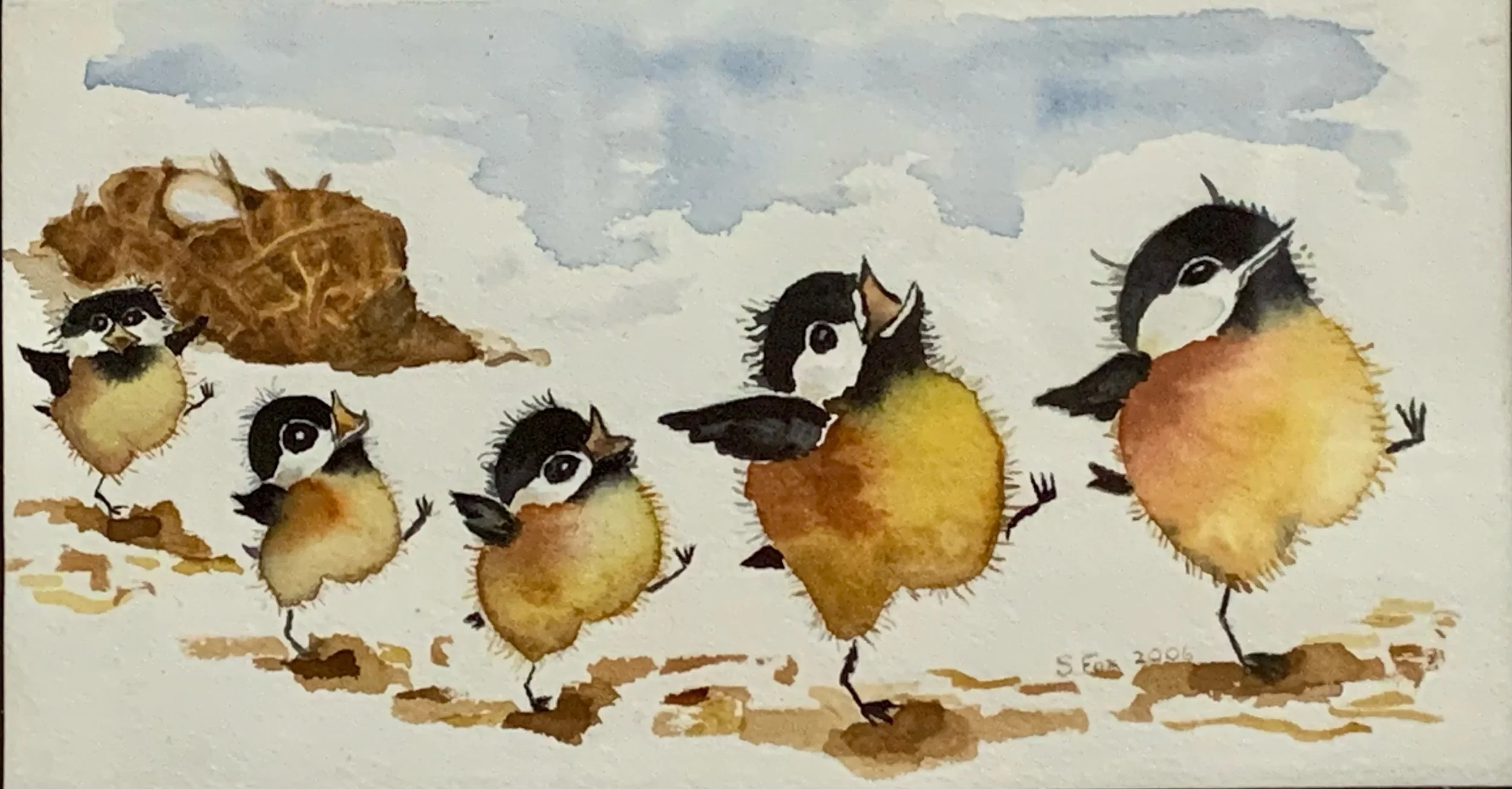
The first piece of art shown below was painted by the grandmother of the kids in today’s story in 2006 and is beloved by the family as a representation of their family in 2006. The second piece of art (by artist Erin Nimmer @erinnimmerart) was purchased by Molly*, the mother of the family, at the Gather Conference, and she says she loves how the visual reflects the idea how she’s paving her covenant path with rainbow stones.

art credit: Erin Nimmer @erinnimmerart

Read More
FAMILY STORIES, LGBTQ STORIES Allison Dayton FAMILY STORIES, LGBTQ STORIES Allison Dayton

THE CASE FAMILY

“We both love live music, the Utah Symphony, college sports, and theater. That’s one of the joys of the relationship we have—she doesn’t drag me to ballet and I don’t drag her to football,” says Jeff Case of Pleasant Grove, UT, sharing that loving going to these things together is just one of the perks of their mixed orientation marriage. Both Jeff and his wife Sarah are classically trained musicians, owning that, “Music is a gigantic part of our lives.” It’s a passion they’ve passed down to their three kids, Andrew—25, Danae—22, and Moth—18, though the younger ones may gravitate toward different genres. “We don’t always get what they listen to, but it seems like that’s just par for the parenting course,” says Jeff...

“We both love live music, the Utah Symphony, college sports, and theater. That’s one of the joys of the relationship we have—she doesn’t drag me to ballet and I don’t drag her to football,” says Jeff Case of Pleasant Grove, UT, sharing that loving going to these things together is just one of the perks of their mixed orientation marriage. Both Jeff and his wife Sarah are classically trained musicians, owning that, “Music is a gigantic part of our lives.” It’s a passion they’ve passed down to their three kids, Andrew—25, Danae—22, and Moth—18, though the younger ones may gravitate toward different genres. “We don’t always get what they listen to, but it seems like that’s just par for the parenting course,” says Jeff.

After staying at home with their kids for 15 years, for the past seven, Sarah has been teaching junior high. She teaches family consumer science which includes sewing, interior design, and behavioral health. Jeff, who leads the Lift & Love mixed-orientation marriage group for men, had originally joined the National Guard as a musician in ’95 before being sponsored by the Army to do his doctoral work in psychology at BYU. He was then commissioned as a psychologist in the Army for eight years. He is a veteran of the war in Iraq. Since getting out of the Army, he continues to work with veterans and their families as the director of the Provo Vet Center (a nationwide organization with 300 centers around the country).

Raised LDS on military bases while his dad served in the Air Force, the culture and era in which Jeff grew up did not feel conducive to coming out, though he knew he was gay by the end of high school. He was one of six kids who had to pay out of pocket for his own college and rely on military scholarships so it felt safest not to rock the boat. He went to BYU freshman year, then served a mission where he finally came out to himself after feeling “tightly boxed up and unsure what to do.” Jeff laughs, “God sent me on a mission to South Beach, Miami, which was a gay mecca in 1993. Two contrasting lifestyles were in my face—the BYU/LDS path, or South Beach gay life of the early 90s. I had a strong testimony, and still do—though it’s evolved over the years. I decided to come back to BYU.”

Jeff met Sarah the first day of class that year. Both music ed majors, she sat behind him, and they quickly became best friends. Jeff knew he wanted to get married and have kids—and his patriarchal blessing said as much. After a couple years of their friendship, Sarah was preparing to go on a mission herself. But suddenly they went from being best friends to getting married, without really dating. Sarah laughs, “I didn’t want to be one of those BYU couples who got engaged after four minutes, but essentially we got in the car one day and decided to date, and got out of the car engaged.”

Sarah had told Jeff first she had feelings, actually having fallen in love with him a year prior. At first, Jeff felt panicky—unsure of how to be a boyfriend, and he didn’t want to ruin the friendship, but says, “A lot of things happened that led to me falling in love with her.” He found her beautiful, and when she started completing her mission papers, he started having romantic inklings. “I had a series of small miracles happen that showed me we could get married,” says Jeff. He told Sarah he loved her but didn’t want to stop her from going on her mission. Sarah replied, “What mission?”

After meeting in 1995, they were married in 1997. While Jeff served in the Army, they lived in Washington, Germany, and Texas, before moving to Utah, where their kids completed high school. His military service was during the peak of “Don’t ask, don’t tell,” and Jeff had become accustomed to not telling. In fact, he did not even tell Sarah about his attractions to men until after they’d been married for six months. He says, “I thought it might have just been a phase and would go away, that I just needed to take a leap like Indiana Jones stepping out into the chasm. But it didn’t go away (with getting married).” And a lot was on the line—at that time, one could get kicked out of BYU just for being gay. He could lose his scholarships and get kicked out of the military. And he really didn’t want to lose Sarah. But as things “were bubbling and that tight box called ‘Jeff’s sexuality’ opened and spilled out,” Jeff finally broke down and said, “Sarah, I need to tell you this—I’m attracted to guys.” Sarah asked, “So what’s the plan, are you leaving? Will we work this out?” They decided to see where it would go, just the two of them. They navigated it quietly for a couple years, with no additional support.

After their first son was born, they each confided in their best friends, and started to talk to their friends in the music department—many of them who understood themselves. “There wasn’t really a way for gay people to connect back then; all of us were afraid to speak openly.” Talking seemed to help, and over the years, they opened up to their parents and siblings. When Jeff got out of the army in 2014, they felt it was time to speak openly about their story. “We experienced a number of moments in the temple and felt sharing our story could be a gift back to God who’d shown us how to live in this world,” he says. In 2014, Jeff published an essay for North Star’s Voices of Hope website. Then they made a video together. (Jeff now spends most of his volunteer time working with Emmaus and Lift & Love.)

After their bishop attended a North Star conference with them in 2017, the bishop asked Jeff what the temperature was in their ward about LGBTQ+ topics. Jeff replied, “There is no narrative. The only comment I’ve ever heard at church was that, ‘Modern day Korihors are the gays and feminists’.” The bishop asked the Cases to facilitate a fifth Sunday lesson on LGBTQ+ latter-day saints in 2017, saying a number of ward members had grandkids coming out and he wanted people to be willing to talk. Jeff says, “That got a narrative going, and our ward has been accepting, loving, never hostile to our faces.” As there has been some turnover since Covid, they’re unsure if everyone knows, but Jeff does talk about LGBTQ+ issues in priesthood and Sunday School lessons from time to time.

 When Jeff’s essay was about to come out, Jeff and Sarah told their oldest kids (then 14 and 12) that he was gay, feeling it might still be too complex of a topic for their 8-year-old. Their 12-year-old replied, “I thought you loved mom.” Jeff confirmed that that was the case and made sure it was clear nothing in their family dynamic would be changing.

Many years later, it was their youngest, Moth (his preferred name), who chose to come out at age 15—first as pansexual, then lesbian, then nonbinary attracted to women, then as trans male. The Cases found an affirming therapist whom Moth adores, which Sarah says is “an important step to Moth being able to work through their transition in a safe environment.” Sarah continues, “Moth is interesting—he’d like to be seen as a fem boy. He likes makeup and dying hair, wearing skirts. He’s very fun.” Moth’s parents have been supportive during the medical process, which they did have to pause a few years ago when Utah passed a law that wouldn’t allow trans-affirming medical care for minors. Sarah says, “We’re trying to be present and supportive wherever Moth is at.” Their middle child, Danae, has also come out as bisexual, though doesn’t love labels.

The two younger Case children no longer attend church, and Jeff and Sarah have made it clear to them and others that, “Being gay and in a mixed-orientation marriage and active in the church is our path. You figure out your path, what works for you.” Jeff likes to view the long game, and has seen that the church offers value for him, but that their adult children need to find their own values related to spirituality. “That’s fine,” he says, “I don’t want to drive them away. I want them to still be around and look to us. They only get that if they sense we love them where and how they are.” The Cases asked all their kids to join them at church one year for Christmas Sunday, and one child had a near panic attack. Jeff now reflects, “Why’d we do that? Are we trying to punish them? I now say, ‘Come if you want. I want to know where and how you see yourself on a spiritual level and just be present with you wherever you’re at’.” As to what advice he’d give other parents, he quotes his friend Bennett Borden who says, “You only have influence on people you have access to.”  Jeff also advises parents to remember the Hitchhiker’s Guide to the Galaxy and to not panic if their kids come out—”Parents who panic often drive their kids away.” 

Jeff says, “Being in the closet as long as I was, I never heard the bad types of advice from well-meaning parents and leaders (that was common during those years). We want to show up for our kids, but let them do the work.” Their parenting approach has been to focus on teaching their kids to be good people and to move themselves as parents into more of a consultant role. He values how Elder Neal A. Maxwell spoke of the need for individualized curriculum.  “We’re not too worried about the box-checking outcomes; we don’t need our kids to be like the Israelites who checked so many boxes but didn’t recognize Christ when He came. Just because they don’t believe in our same religion doesn’t mean they can’t be spiritual or have a relationship with Deity—they just have to figure out what that means for them.”

As to how she experiences being in a mixed orientation marriage, Sarah says, “It comes with its own set of trials and obstacles, but every marriage has something others don’t have to deal with. I believe you choose your trial by who you marry; you choose your tough parts. We decided these are worth it. I also believe if he wasn’t gay, that might take away parts of him that are really important and lead him to being a sensitive person, considerate, kind. I love who he is and wouldn’t take that part away. Him being gay is an important part of Jeff.” On the other hand, Sarah and Jeff are quick to say it’s really important that people know they would never prescribe their path for others. Sarah says, “It works for us, but I’d never suggest it should work for anyone else. It’s not going to work for everyone.”

The Cases love to travel, and Sarah and Jeff just completed a 3,400-mile road trip during which Jeff visited his 50th state right before turning 50. It was a long and winding road (or roads) that not everyone may experience, much like their journey together, but it’s one they’ve decided to keep navigating together.

LINKS:

Jeff’s presentation at Gather Conference 2023

Jeff and Sarah’s “Voices of Hope” video

Read More
LGBTQ STORIES Allison Dayton LGBTQ STORIES Allison Dayton

MICHAEL SOTO

In light of the recent publication of the new church handbook rules regarding transgender individuals, we wanted to re-share Michael Soto's story.  Michael was kind enough to include some words of encouragement to our trans members and their loved ones…

"To my transgender sisters, brothers, and siblings, our families, friends, and community members:

Every trans person has so much to offer this world, society, and the church. I know this feels like a rejection and loss for us right now, but the truth is, it is loss for the church community – because, without us, the church community is not complete, is not reflective of the full glory and diversity of God’s love and plan – because we are a part of that plan and fully live within God’s love.

These handbook changes tell me one very clear thing: the church is still learning how to care for and love transgender people as members.  But the good news is that this is our opportunity as trans people and our families and friends, to teach about trans people so that someday the Church can minister to and love us.  We can show the church through our actions what truly loving trans people looks like. Let’s put our shoulder to wheel and do everything we can to help our faith community grow and learn more about God’s love for all human beings."

-Michael Soto
In light of the recent publication of the new church handbook rules regarding transgender individuals, we wanted to re-share Michael Soto's story.  Michael was kind enough to include some words of encouragement to our trans members and their loved ones…

"To my transgender sisters, brothers, and siblings, our families, friends, and community members:

Every trans person has so much to offer this world, society, and the church. I know this feels like a rejection and loss for us right now, but the truth is, it is loss for the church community – because, without us, the church community is not complete, is not reflective of the full glory and diversity of God’s love and plan – because we are a part of that plan and fully live within God’s love.

These handbook changes tell me one very clear thing: the church is still learning how to care for and love transgender people as members.  But the good news is that this is our opportunity as trans people and our families and friends, to teach about trans people so that someday the Church can minister to and love us.  We can show the church through our actions what truly loving trans people looks like. Let’s put our shoulder to wheel and do everything we can to help our faith community grow and learn more about God’s love for all human beings."

-Michael Soto

Michael Soto’s is a name widely known and respected in the LGBTQ+ equality space. As the former director and now President of Equality Arizona, and as a political consultant for over 25 years intrinsically involved in the LGBTQ+ movement, Michael has watched the ebb and flow and now crux of policy change. After the Marriage Equality Act passed in 2015, Michael felt the pendulum swing personally as, in response, a new cultural war specifically targeting trans people has ignited across red states, with recently proposed and passed legislation causing increased polarization. As such, Michael is eager to tackle his newest endeavor—later this year, he'll be helping launch the Equality Campaign which will work with other equality groups at a national level to increase conversation, civil respect, and equality. 

With his generous, hearty laugh and impressive grasp of legislative history, Michael feels uniquely qualified to reach across the aisle and have these tough conversations. It doesn’t hurt that he himself identifies as a trans man and queer individual who knows what it’s like to have grown up in a conservative regional and religious environment before the internet, when the right terminology to describe how he had been feeling since he could walk was not within reach.

Born and raised in Mesa, Arizona, Michael’s parents were converts to the LDS faith. Growing up in suburban Mesa in the 80s and 90s, Michael recalls the word “gay” was only used in a bad way or when bullying. Michael didn’t hear the word “transgender” until he was an adult, but he always knew he was different. Sunday mornings were a fight as his house as his parents tried to force him into a dress for church. He’d wail, “This is horrible! I hate this,” knowing he was a boy. He now laughs that his parents found it “cute as a boy, less cute when I got older.” School was rough, as gender divisions were part of daily life. He resisted having to step into the “girl line,” next to the boy line to walk to lunch or recess. “Girl things” were of no interest to him. When Michael’s mom bought him a Barbie dream house for Christmas, he remodeled it, installing tile floors and painting the walls; but after that, he was done with it. For as long as he can remember, Michael knew he wasn’t a girl and vocalized it in word and attire. He recalls how the women in his family would say, “Someday, you’ll grow up, fall in love with a man, have babies, and be a wife and mother,” to which he’d reply, “Heck no!” And they’d retort that he would change his mind. Now, he jokes with them, “I didn’t change my mind, did I?” 

After graduating from Red Mountain High School in 1998, Michael took his hard-earned scholarship money to ASU. He’s now working on his third degree--a PhD in justice studies, which was also the focus of his master’s program. In his fourth year of his PhD program, Michael plans to analyze what’s happening in extreme movements with the current right wing authoritarian culture wars targeting trans people for his dissertation. “It’s so important to have a playbook for this stuff. Whether it’s the trans movement, or Jews in Nazi Germany, or immigrants, we know how to beat discrimination—we just need to rally the forces and educate people. I see a better path forward.”

Michael had once planned to study medicine, but at ASU, was the first trans person he knew of, and he observed how the campus was not a safe place for people like him. He was harassed in classes, where professors refused to call him anything other than his birth name and otherwise belittled him. “It was not fun,” he says. Searching for a place where he might not be attacked, he decided to major in women and gender studies, which turned out to be a great fit. As Michael had navigated what he calls his “drag years” of junior high school through his freshman year of college and observed the cultural punishment and penalties for trying to be who he was, he now started to notice gay couples on campus holding hands He says, “I thought it was really interesting and terrifying, watching from around the corner—I thought, who are these people?” Eventually, Michael found there were other LGBTQ+ people like him on campus. He went to a social group where the woman leading the meeting was “very tall.” At 5 feet tall, Michael says most people are tall to him, but he watched as this woman came out as trans to the group and defined something entirely foreign to Michael until that point. “As soon as I met a trans person in this world, I knew that’s who I am. It was exciting.” 

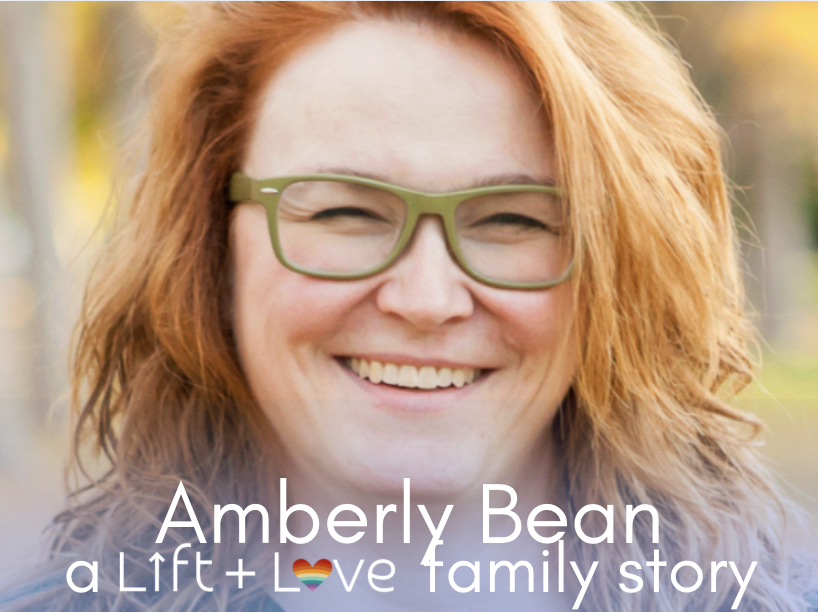
But even in the LGBTQ+ space, Michael observed that trans was not a popular way to identify. He experienced backlash from some of his new gay friends who would tell him to “just be a butch woman.” Michael says, “It was not a convenient choice to come out and be who I am—I sacrificed a lot to be authentic and dealt with a lot of rejection from my university and friends, except my best friend, Brie, who always supported me (and is pictured in this post with Michael at her wedding). I had to pave my own path, and trust my own instincts and vision for my life. It has served me well to live a happy and authentic life. The best decision I’ve made was to pursue that medically and live authentically.”

While his family members initially struggled for years to understand Michael’s transition, he says, “They all get it now; it’s congruent and makes sense.” Michael’s mother (who he now lives with and helps care for) says she wishes she had had more resources back then so that Michael could have had a happier childhood without so much interior struggle. Michael says his mom is “so sweet and now can’t refer to me as anything but her son in childhood.” He credits his mom’s teachings and example of dedication, undying love, and hard work to making him the man he is today. He says, “I want to make a world where everyone can be respected for who they are; all should have the same protections under law. The same right to freedom. The things that make this country incredible in the course of human events include being able to be true to who you are and live life according to the dictates of your own conscience.” 

As a member of the LDS church, Michael also believes, “All should worship the way they see fit, and at the same time enjoy the same rights to live their lives as fully realized humans. I’m working to get us closer to the ideas that all deserve freedom and equal protections under the law. Those things make us stronger.” While he enjoys his work, Michael says it’s hard, especially in seasons like this one. “My own experience has served me well in that I know most Americans just want others to live their lives, go about their business, contribute to society, and be people. We don’t need to demonize each other because we look differently. Our various faiths, genders, who we love, our race--all makes us stronger as a community.”

Michael struggled to connect to the LDS faith as a youth as so many of the gender-segregated practices and goals taught didn’t connect for him. He says, “I knew my future wasn’t as a woman, and I’m not good at faking things.” But as a pre-transitioned 19-year-old, Michael faced a turning point. He says, “I needed answers, I needed to see my life for itself, and I just couldn’t envision a future at that time. It felt so wrong, like such a lie.” While in Italy at St. Peter’s Basilica in Rome, while praying near the St. Peter statue, Michael felt God’s love for the first time after asking what God wanted for his life. He felt God say, “I made you to be exactly who you are.” Michael says, “That was such a powerful moment for me, not to just be who I am but to also find my faith…I feel really lucky to be trans. It’s opened every door that’s led to my happiness—my career, being seen for who I am and loved by my family and community, by God—all of that came through being a trans person.” While Michael doesn’t talk a lot about the church as he works politically with religious organizations and feels his call to focus on governmental change will hopefully trickle down, Michael values how the church instilled leadership qualities and the importance of having a moral compass as a person of worth and character. 

He also says it’s fueled his fire for social justice work. Michael says, “I love the church, and I know it’s flawed. I also love our country, and also, it’s deeply flawed. People ask, ‘How can you affiliate with a church that’s not as affirming with its policies?’, and I say, ‘It’s about the journey.’ I also work in policy, and primarily with institutions who need to know LGBTQ+ people more specifically, so governments, churches, and universities can see our full humanity and incorporate kindness into making love more tangible.” Michael recognizes that local church leadership can largely determine the experience a queer member has, and is always hopeful the church will prioritize the commandments to love God and love others first. He says, “So many trans and LGBTQ people have so much offer this institution. It’s always my prayer and hope they’ll continue to honor our differences and appreciate the common ground… I have a lot of faith at the end of the day that God’s going to open the path to let LGBTQ+ people feel fully loved and valued as individuals.”

Michael identifies as queer and dates people “of any gender, race, faith, or walk of life in general.” He has been blessed to have had several loving partners who he says made him a better person, in the past, and says he’d love to find someone who shares his beliefs, and most of all, “knows themselves and is passionate about something in life.” In the meantime, Michael enjoys time with his pit bulls, FDR and Teddy (named after you guessed it), and his mom’s chihuahua, Tucker, who at 11 pounds is the boss of everyone at home. He also has close relationships with his two half-brothers’ and step-brother’s families, which include a niece and two nephews who he adores. “I have lots of wonderful family and family of choice who’ve become family.”

In his field, Michael’s studied that after society “bought into” the idea that gay marriages actually don’t weaken or devalue heterosexual marriages, the far right conducted some intentional messaging testing which revealed only about 23% of society knew they knew a trans person. “This created an opening for some of these groups like Alliance for Freedom and Moms for Freedom and Eagle Forum to organize together to chip away some of the legal advances the LGBTQ+ movement was making, and roll back and prevent future.” Michael quotes Brene Brown’s, “It’s hard to hate up close” when speaking of these fear-based agendas that often start with bathroom bills. “All these bills use the same language…they are part of an effort to roll back rights based on fears. Fear is a powerful motivator. But the best way to get rid of the fears is to open up. My life is an open book—it’s really boring actually. I work a lot, go to school a lot, spend time with my dogs and family. It’s not too exciting, but I find it great. Most of us, when you look at our lives—we’re just putting on our pants one leg at a time and making dinner for our families.”

Since 2019, Michael’s observed a trend of “we win one, lose two, then lose two, win one. The medical bans around trans youth and kids, the ‘don’t say gay’ bills… they’re kind of crazy. And they don’t stand up judicially, and are typically reversed for violating personal liberty, like the ‘Don’t say gay’ Florida bill was recently. But even when repealed, just seeing them pass is hard for a lot of people to cope with. LGBTQ+ people just want to live our lives; there is nothing harmful about our goals. We’ll get through it in a positive way, but we have to do the work.” And for those who are still living in fear, Michael affirms, “I don’t want anyone to be trans who isn’t trans. I just want trans people to be able to be safe, own a home, and have a job. These laws are trying to unnecessarily harm and it’s cruel in a fair civil society. It’s a scary moment, but we’ll beat this moment.”

Read More
FAMILY STORIES Allison Dayton FAMILY STORIES Allison Dayton

THE DAVIS FAMILY

“All great spirituality is about what we do with our pain. If we do not transform our pain, we will transmit it to those around us.” This was the Richard Rohr quote TeriDel Davis opened with at a recent presentation at an ally night in her Gilbert, AZ hometown. Joined by her husband, Tad, TeriDel then passed the mic to their 17-year-old trans daughter Kay to expand on the pain she thought she’d be able to bury until after high school, when it might be a better time to “figure it out.” But Kay explained, “This didn’t work out very well for me, as the only way I could bury the pain was to try and make myself numb to (it).” Citing Brene Brown, she continued, “When you numb your pain, you numb your joy.”

“All great spirituality is about what we do with our pain. If we do not transform our pain, we will transmit it to those around us.” This was the Richard Rohr quote TeriDel Davis opened with at a recent presentation at an ally night in her Gilbert, AZ hometown. Joined by her husband, Tad, TeriDel then passed the mic to their 17-year-old trans daughter Kay to expand on the pain she thought she’d be able to bury until after high school, when it might be a better time to “figure it out.” But Kay explained, “This didn’t work out very well for me, as the only way I could bury the pain was to try and make myself numb to (it).” Citing Brene Brown, she continued, “When you numb your pain, you numb your joy.”

The desire to teach their kids to pursue rather put off joy is what has propelled the Davis family to share their journey. 

For TeriDel, the import of the call to be Kay’s mother started while she was pregnant with her oldest and being set apart for a calling. After the standard calling-related language, TeriDel was given specifics about the child she carried, that she would “find being his mom hard because it would be very difficult, but if I raised him unto God that he would then bring me the greatest joy I would ever know.” Anticipating her child would be born with severe special needs, TeriDel was surprised when Kay was born a healthy, happy newborn. As a toddler, Kay proved to be quite advanced, demonstrating high intelligence. But as she continued to grow, TeriDel says it was indeed difficult to raise and connect with Kay. The Davis family learned Kay was autistic, which propelled TeriDel to adjust her parenting style so that she could better connect with and teach Kay. 

When Kay was baptized at eight years old, her parents felt immense joy and gratitude that despite the challenging years, they had gotten to a good place and that Kay was “a kind, loving, smart kid who had proven very dedicated to pleasing her Heavenly Father.” About five years later of growth opportunities for the family, which now included younger siblings Gibson aka “Gibby” – now 16, Langston aka “Badger”—14, Cliff—12, Lilah—9, and an older foster child, Cynthia, Kay asked if she could talk about something that had been weighing on her. She wanted to know if TeriDel thought her younger brother Gibby had ever shown signs of being gay. TeriDel initially was upset Kay had asked this, thinking Kay might be agreeing with the school bullies who had been teasing Gibby for some time. She firmly replied that they’d had many conversations with Gibby and his therapist and that he wasn’t gay and that these kinds of questions were hurtful to Gibby.

The conversation initiated several months of heated conversations between TeriDel and Kay about LGBTQ issues, until one day, Kay approached her mother and again asked the same question about Gibby. Upset at her persistence, TeriDel turned from the dishes she was washing to scold Kay but saw a pained look in her eyes. TeriDel replied she needed a moment before she could answer. She went to her room to pray, where she was prompted that Kay was asking these questions about herself, and that TeriDel needed to become okay with Kay being gay or transgender very quickly and go talk to her about it. TeriDel says, “It was made very clear to me that Heavenly Father would not be okay with me doing anything other than loving Kay and supporting her.” 

TeriDel called her husband Tad at work, who concurred. She then called Kay into her room and point blank asked her if she was gay. Panicked, Kay mumbled in return that no, but she was experiencing feelings of gender dysphoria. TeriDel had to ask what that meant. Tad explains, “It’s like you don’t even know the questions to even ask until you have to.” He explains that over the next several months in their research, things would come up that proved unsettling to his theretofore reliance on binary, black-and-white church doctrines. “It was unsettling in the sense I thought I could put everything in the right place on the bookshelf. But this was like someone had knocked over the whole shelf, and some of the books on the floor I didn’t need anymore, and I realized I needed some new books, too.”

While this was the first time they were able to talk about it as a family, Kay had been quietly battling complex thoughts and emotions for sometime privately. When returning from a family party with cousins on her 13th birthday, Kay sat in the back of the family van pondering her reality and future. Asking herself questions about how she might avoid typical teenage pitfalls and drama, Kay identified that she’d never felt an attraction to boys and thus must not be gay, nor did she desire to get into a romantic relationship as she felt “I’m not very romantic, impulsive, or charming.” A new question emerged: “Am I trans?” A sense of dread settled in as Kay realized she could not say no to this, as she had never been comfortable being labelled, grouped with, or seen as a boy. She preferred to be known by other labels such as “smart, creative, kind.” This new thought induced terror as Kay presumed her firmly conservative Christian family would hurt her mentally or emotionally if they found out—which is why she shrouded her initial questions about the topic as a concern about her brother. But Kay says, “Without any guidance, I could never come to an answer.” She had searched on social media, but struggled to find anyone who likewise didn’t see being trans as a testimony-breaker. As the sun set in the horizon outside the van, she knew it was time to pray and ask God her question: “Am I trans?” The answer she received was “not a declaration of my identity but just a comforting message that, ‘either way is okay’.” Kay says, “It was in that moment that any worry of God’s judgment or wrath dissipated, and while it didn’t answer my original question, it released a weight I didn’t realize I was carrying. It seemed like my inner conflict was much more manageable with the knowledge of God’s love for me.” 

The new knowledge of her daughter’s identity and struggles opened TeriDel’s eyes to a heightened awareness of how she had been getting all her information “from straight people” and “somehow thought I had an accurate view on what would cause gender dysphoria.” She also realized how hard church can be when harmful rhetoric about the LGBTQ+ community is shared. While in the temple and privately she relied on the spirit to personally guide and direct her to a state of joy and enlightenment in her journey, it became difficult to hear comments like that of one woman in Sunday school: “The fastest growing tool of the devil is suggesting that having tolerance and love for other people means that we should be supportive of people who don’t follow the gospel. We need to rid the church members of any behavior or persons that prohibit us entering the temple.” 

While Kay has not gone public with a social transition yet, not wanting to deal with the social or political consequences, she has found herself in many uncomfortable situations in which she has struggled with anxiety, deep pain, and fear of rejection. Even after initially telling her parents, Kay says she didn’t really know how they felt for a while as it took them time to be more open to talking about it. “They didn’t know how painful it was to sit and wonder who I was all by myself, especially because it had been much easier to ignore and sideline it.” She has also experienced a state of stasis and abstract dread, as if feeling stuck in a swamp. Even her favorite hobbies like art projects can feel like hopeless wastes of time. Kay credits conversations with her mom and an excellent therapist for helping pull her out of these funks. 

TeriDel says with her new lens, church has become a hard place for her with the “random comments and misguided lessons.” She’s uncomfortable in any calling other than serving in the nursery, and is grateful that having a relationship with God has remained the priority of Kay, saying, “Hopefully we’ve helped her understand as long as she has that relationship with God either in or out of the church, we’re ok with that.” Tad often finds himself reflecting on Joseph Smith’s adage to “teach them correct principles and let them govern themselves,” deferring to prayer and personal revelation and his belief that God judges us on a curve tailored to us. 

Church can be unwelcoming at times according to Kay, “though our ward does its best to be welcoming and respectful, which is appreciated.” It meant a lot to Kay while attending seminary last year that she had a teacher who was inspired to gently answer the prescient question, “What should I do if I feel what the spirit is telling me and the teachings of the church contradict?” The teacher said that when Kay is conflicted, she should continue to make that a conversation between God and her, and to continue to pray about it until she feels peace. Kay says, “I think it’s hard for my seminary teacher to understand how much his answer meant to me. That answer allowed me to let go of my mental image and went leaps and bounds in allowing me to feel more comfortable in seminary. It even meant that when the lesson turned to the topic of how we must treat LGBTQ individuals with kindness even if we don’t approve of them, that I could at least be in that space and rely on my own personal answers to prayer.” Kay continues, “Even though it stings to hear that I am the person they don’t approve of, I believe that at some level my seminary teacher believes that God knows me and accepts me as I am.”

 When their son, Gibby, recently asked why the nature of God seemed to change so much across different books of scripture, Tad explained that explaining the grand plan of God would be like explaining all the complex levels, tricks, lore and Easter eggs of his favorite video game to his five-year-old cousin and expecting her to understand. TeriDel says, “That is what God is dealing with. He has this amazing, beautiful, complex, and fulfilling plan, and then he goes to his children (who are metaphorically five-year-olds) and tries to explain things to them and then has to deal with whatever they thought they heard. So it’s not surprising that God might sound a little different over time. God is limited by us.”

While Kay remains grateful for her reliance on personal revelation in discovering her own identity, TeriDel is increasing appreciative of a Christ-centered perspective and the grace and love that has come into her life by “not worrying about all of that stuff and just focusing on the very basic principle of showing love to those around me. In the end, God’s plan is just love.” Tad appreciates how their close-knit family, in which their kids are all each other’s best friends, can now have healthier conversations about the long term because they trust Kay to make good decisions for herself. He says, “Kay is such a good kid and has always wanted to be a good person and do her best to make her Heavenly Father and Savior happy. I’ve realized I needed to take a backset and trust she’ll make good decisions. She’s proved us right.”

Read More
FAMILY STORIES Allison Dayton FAMILY STORIES Allison Dayton

ANONYMOUS

M* drives across state lines to seek the healthcare for her preteen daughter that has improved her sense of well-being. She tells very few people where she is going, as few seem to understand. But a nearby state allows a puberty blocker shot that’s recently been banned for minors under 18 in M’s home state. It’s a shot that has been widely given without major concerns for decades to patients with early onset puberty, until the politicking of the trans community dominated airwaves and stigmatized it as “unsafe.” It’s a shot that can help prevent the further need for medication for trans individuals if timed right, which is why the trans-affirming medical community prioritizes its use in younger patients on the verge of puberty. But this process requires a parent and a medical team to trust the intuition and identity of a patient who is still a child.

M* drives across state lines to seek the healthcare for her preteen daughter that has improved her sense of well-being. She tells very few people where she is going, as few seem to understand. But a nearby state allows a puberty blocker shot that’s recently been banned for minors under 18 in M’s home state. It’s a shot that has been widely given without major concerns for decades to patients with early onset puberty, until the politicking of the trans community dominated airwaves and stigmatized it as “unsafe.” It’s a shot that can help prevent the further need for medication for trans individuals if timed right, which is why the trans-affirming medical community prioritizes its use in younger patients on the verge of puberty. But this process requires a parent and a medical team to trust the intuition and identity of a patient who is still a child.

M does trust her daughter to know herself better than anyone, describing her as an intelligent and fun-loving home schooled young tween who has “read all the things,” says M. “I know she doesn’t know everything, but she knows a lot more than I do.” 

Healthcare. Safety. Well-being. They are the basic human needs most parents desire for their children. But when a child comes out as transgender, the method of how best to pursue each ideal can vary drastically between parents, often creating unease at home. Societal pressures can isolate children and families who don’t fit the binary norms of a classroom or bathroom, further exacerbating isolation. State legislation can dictate what is allowed in the doctor’s office, resulting in mental duress. These are the common realities for families of trans kids, and when a child comes out at an especially young age, the collateral fears can drive the child or family right back into the closet.

As M views the best path forward for her daughter differently than her social circle, church community, and state legislature does, she is only out anonymously, as the creator of the Instagram account, @mama_trans_kid_in_the_closet. The community she has built on this account, as well as her Mama Dragons network, have served as a salve for M, who has appreciated having public forums to discuss social transitions, hormone replacement therapy, puberty blockers, and bathroom bills. They are topics she once knew nothing about, but her network and a helpful book, The Transgender Child: A Handbook for Parents and Professionals Supporting Transgender and Nonbinary Children by Stephanie Brill and Rachel Pepper, have contributed to her new vocabulary and understanding. They have also been able to get acquainted with adult trans women, who offer hope for what can be. 

A self-described “Molly Mormon,” M’s advocacy for her children surprises even herself. But she’s grateful for the 2020 impression she had to study LGBTQ+ issues, coupled with Elder Ballard’s oft-quoted nudge for LDS members to learn more about the experiences of LGBTQ+ people. Feeling compelled to do a deep dive into something she had never thoughtfully considered, M picked up Charlie Bird’s book, Without the Mask, at Deseret Book, feeling it might be a “safe” source, then Ben Schilaty’s, A Walk in My Shoes, and began listening to their podcast, “Questions from the Closet.” More podcasts, including “Listen, Learn and Love,” helped her begin to consider what life is like for an LGBTQ+ member of the church. 

After reading past church teachings and some messages about queer people delivered over pulpits that were “really tough to swallow,” M began to understand why people in this community were misunderstood. Still, when her daughter came out as trans, it was “super shocking” for M and her husband. “I had heard about trans kids knowing about their identity from a young age—always dressing up as princesses or pirates. But ours was typically into boy things. Even now, besides growing out her hair, she hasn’t expressed a strong interest in make-up or dressing in a feminine way often. Though she has yet to come out publicly.” She came out to her mom via a phone message exchange, sharing she had been feeling confused for some time, like she didn’t know what was going on. And then she said a prayer and had a moment of clarity as a thought entered her head: “I’m trans.” M says her child described suddenly feeling good about that, like God was telling her, “Yep, that’s it.” She felt excited to tell her mom then, having felt some peace about who she was. M says this was at first very hard for her to grasp. Like all their kids, this child was named after a beloved relative, so honoring the name and pronoun transition took some time for M. While navigating this new reality, shortly after, one of M’s older children came out as bisexual.

M feels grateful her kids have had each other’s support and are close, as they have lost friends over people saying disparaging things about LGBTQ. While she and her husband still attend, the church has been a tricky place for some members of the family. When one of her older kids was asked about their plans to serve a mission, their response was, “I don’t see how I can tell people to go join a church where people like my siblings won’t be treated the same as everyone else. It doesn’t feel right.” M’s bisexual child doesn’t feel like they fit in, but says they’d return overnight for the social structure, if the church changed their LGBTQ+ policies.

Bi-erasure is also a new vocabulary word for M. “One of the hardest things with the church is that the teachings on marriage and family are all clearly directed for someone to choose a male or female—the opposite gender—and do what’s expected of them… People assume you can just choose the more simple path, making it much harder for you if you don’t. Also, you’re in between two spaces, making you feel like you don’t fit or are forgotten.” M says when she goes to the temple she can’t help but notice all the binary division, and considers if her trans daughter could ever feel comfortable in church spaces. “Like if she did come to church, would they let her go to Young Women’s? I have so many questions. She doesn’t go, so it’s not an issue.” M’s trans child is only out to her immediate family members and a few others. 

M says her kids don’t speak out against her church involvement, but she has explained to them, “I’m not going to church because I support everything they say, but because it’s what feels right, right now. I’d like to help create change. I don’t want to leave, but sometimes I feel so tired.” As someone who naturally wants to talk through her current struggles, M says, “It’s hard when you have a kid in the closet. You want to talk about it, but can’t when they’re not out.” So for now, she speaks out from a closet of her own. And she reminds people that this is a topic that affects everyone. “If you think you don’thave an LGBTQ person in the family, the chances are very slim you don’t. They have always been here; there is just now more vocabulary to be understood and people feeling safe to come out.”

M continues, “It can never be said enough: we parents of LGBTQ kids know our kids, and for those of us who’ve grown up in the church, this is me following inspiration and following my God who wants me to support my child. That’s probably the most hurtful thing I hear people say—that you’ve got to be careful to ‘not be deceived,’ like you don’t know the gospel, when it’s all you’ve known for your whole life.”

(M* = to protect her children’s safety and well-being, M has elected to remain anonymous)

Read More
LGBTQ STORIES Allison Dayton LGBTQ STORIES Allison Dayton

THE JENKINS FAMILY

Content warning: suicidal ideation

Kathryn and Jare (rhymes with “care”) Jenkins had been married for eight years and were expecting their third child when Jare handed Kathryn an eye-opening letter. Kathryn opened it to read that the husband who she had met and fell in love with and married in the Salt Lake City LDS temple was now coming out to her as transgender. Kathryn was in complete shock: “It was a lot to process. I was emotional. It was a hard time for both of us.” Further complicating things, as soon as Jare (they/them) came out to Kathryn, they immediately went back into the closet, not ready to talk about it…

Content warning: suicidal ideation

Kathryn and Jare (rhymes with “care”) Jenkins had been married for eight years and were expecting their third child when Jare handed Kathryn an eye-opening letter. Kathryn opened it to read that the husband who she had met and fell in love with and married in the Salt Lake City LDS temple was now coming out to her as transgender. Kathryn was in complete shock: “It was a lot to process. I was emotional. It was a hard time for both of us.” Further complicating things, as soon as Jare (they/them) came out to Kathryn, they immediately went back into the closet, not ready to talk about it. 

That was in 2015, and the not talking about it continued for another five or six years. Whenever Kathryn would ask Jare how they were doing, Jare would reply everything was fine, they could handle it. But downplaying it only elevated Kathryn’s concerns. She says, “Jare was used to hiding a lot of things and good at playing a part. We were happy in many ways, but this part of our lives was always hard.”

Around 2021, everything fell apart. Jare let Kathryn know they had been battling suicidal ideation for the past several years among hiding other significant things throughout their marriage. Feeling that Jare needed to seek outside help and support, she asked for a separation and Jare moved out for awhile. Jare remembers this as a time they felt like two different people. Jare says, “I was happy with certain things in life, like my relationship and family. But on my own, I focused a lot on negativity, feeding on any negative articles and comments I could find. I felt a lot of resentment and anger.” Jare credits Kathryn as being an immense support, saying, "Even though my life was caving in, Kath really saved me during that time. We separated but she still helped see me through a mental health crisis as I had to face everything I had been hiding; she didn't give up on me."

Having grown up in a conservative, southern California, LDS household, Jare had experienced a lot of shame with the way they’d felt since age three or four when they first knew they were different but didn’t have a word for it. There were a few instances in Jare’s youth when they dressed up in feminine clothing or attempted to deal with body parts in a way deemed socially unacceptable, and it was made clear through comments from family or church members that it was not okay to identify as LGBTQ. Instead, Jare threw themselves into sports to throw people off, “trying to be the best athlete possible so no one would ever realize I was transgender.” Their efforts resulted in Jare in fact becoming a national punt pass kick champion, and their team won the Little League World Series against Venezuela. As a teen in the ‘90s, Jare saw a Jerry Springer episode about transgender people, and even though the trans guests were not talked about positively, it was helpful for Jare to know they were not the only person in the world experiencing these feelings. But when Jare told a few close friends as a teen about their feelings, the friends never spoke to Jare again.

While coming of age, Jare says, “I figured I had three choices: 1- to take my life, which I considered a number of times; 2- to run away--leaving my old life behind and letting go of past relationships, and transition, or 3 – to hide and not let anyone know, which is what I tried to do.” Because of all the shame they’d suffered as a child, Jare never considered a fourth option as even possible: to come out and be accepted.

While it took some time for Jare to talk about it with Kathryn after that initial letter, because of the couple’s love for each other and their four sons, they came back together after their separation to try and work it out. They would go on long walks each evening, in which Jare opened up and shared earlier life experiences and all those pent-up feelings of shame. These conversations gave Kathryn time to listen, ponder, and process. She says, “I saw how much pain there was going on underneath, and just how long Jare had handled this alone… Jare was also responsive to me—how hard this was to have a relationship with someone who had lied for over 15 years in our marriage about what was going on. But still, we shared a lot of love and wanted to be together, which is why we are.” Kathryn says now they focus “a lot on the day to day, making the right decisions for us now, and knowing there are a lot of things we don’t have full control over. We’re working our way through that.”

As the parents of four young boys, two of whom are on the autism spectrum, Kathryn felt it was important to increase conversations about inclusion and kindness. In 2016, she had started her company the @inclusion_project, to not just shine a light on LGBTQ inclusion but toward anyone living with differences. This afforded her opportunities to participate in PRIDE parades and get to know those in other marginalized. She and Jare have adopted three mantras to guide their household: 1- Love should lead. 2- Be a good human. 3- Be careful who you hate; it could be someone you love. Embracing these themes helped their kids come to terms quickly with Jare’s identity, which at first was deemed “a little weird” by one of the boys, but now the Jenkins say their kids are very accepting and loving and they all talk openly about it. Jare appreciates how all the fears and worst-case scenarios they once had about how things would go if they came out have turned out to be much easier than imagined. 

Most Sundays, Jare attends sacrament meetings with Kathryn and the boys, but goes home after, while they stay for their classes. Jare says, “I’ve had a complicated relationship with the church over the years--how things have been taught and the shame it brought me, especially in my youth. It was hard for me to see the differences between my relationship with God and His feelings about me, and with the church leaders and policies I’d hear. I felt God must hate me to have made me this way. But now, I’m working through these feelings. Now I believe that if there is a God, He loves everyone. I’m able to feel much more love now that I’m able to be who I am and how I feel.”

Kathryn’s spiritual journey is one that brings her to tears when she considers how “Heavenly Father loves me, and He equally loves Jare.” While she has a calling at church and says she gets something out of it often when she goes, she feels, “It’s not a safe place for everyone. I’ve had to adjust how I participate to preserve my relationship with God and my family.” Doing this has allowed her to have a lot of empathy for those going through difficult things and to give hugs to many at church as she realizes, “We’re all going through hard things—but there’s a lot I have questions about.” 

One youth leader from Jare’s past who was “pretty awesome” made a real difference in their life, and was one of the only people in 2021 who Jare came out to, besides family. Many of the both Jare and Kathryn’s extended family have also been “incredibly kind and accepting,” though there have been some who haven’t been so supportive. Jare came out publicly last New Year’s Eve on Kathryn’s Instagram account, and the couple watched in trepidation after they pressed post. They were pleasantly surprised to see a steady stream of supportive comments, without anyone saying anything negative. Jare dresses differently now to match how they feel and they do participate in some gender affirming care that they say has helped a lot, but they haven’t fully socially or physically transitioned at this point. At church and in their neighborhood, Kathryn says they feel the eyes on them, and are nervous about sensitive questions some might ask about what this means for the Jenkins’ relationship, but feel they have mostly been met with kindness during Jare’s coming out.

In their ward, Kathryn says more people reach out to her to ask about Jare than to Jare directly, but, “In all fairness, Jare is very shy. They might get a little nervous about how best to approach.” Kathryn feels the weight of this and wishes sometimes she could just be Jare’s partner, a role she loves, rather than feeling like she has to be an educator or advocate all time. But those are also roles she owns as the mother of two kids with autism—she often wants to lead with introductory information, so people don’t say something offensive first. It helped when Kathryn and Jare recently recorded their story on their Spotify podcast; the link is available at their bio on their @inclusion_home IG site.

While Kathryn and Jare were worried about what Jare’s public coming out would look like, they have both felt “an incredible peace that has been freeing,” says Kathryn. “Seeing Jare as someone who is loved, who matters, who has these feelings and can still be valued, has also allowed me a chance to love and receive love and support from others.” Kathryn continues, “Even if it hadn’t gone well, we both feel giant relief and were able to take a deep breath for the first time.” For Jare especially, it’s been a long-awaited deep breath.

Read More
LGBTQ STORIES Allison Dayton LGBTQ STORIES Allison Dayton

JAMEE MITCHELL

Several years ago, Jamee Mitchell stumbled upon the wedding video from her first marriage. Someone watching the video told her that, “Your body language clearly indicates that you didn’t want to be there.” And most would agree, Jamee looked quite different back then. Jamee was raised and known for most of her life as James, the son of an active LDS family with deep pioneer roots in Bountiful, Utah. From her earliest memory, Jamee felt different, but didn’t have the vocabulary to define the way she felt.  Her family was amused that she played dress-up and loved pink until these things were no longer considered age-appropriate.  Her parents took her to a church therapist at age 11 where she was told that if she would serve God faithfully, that “it would all work out.” …

**CONTENT WARNING: suicide attempt / suicide ideation**

Several years ago, Jamee Mitchell stumbled upon the wedding video from her first marriage. Someone watching the video told her that, “Your body language clearly indicates that you didn’t want to be there.” And most would agree, Jamee looked quite different back then. Jamee was raised and known for most of her life as James, the son of an active LDS family with deep pioneer roots in Bountiful, Utah. From her earliest memory, Jamee felt different, but didn’t have the vocabulary to define the way she felt.  Her family was amused that she played dress-up and loved pink until these things were no longer considered age-appropriate.  Her parents took her to a church therapist at age 11 where she was told that if she would serve God faithfully, that “it would all work out.” 

Despite her misgivings, Jamee worked hard to do everything right and was eventually called to serve a mission to the Philippines. The mission was her first exposure to a culture that experienced gender differently—in the Tagalog language, there are very few gender pronouns. People have a child, not a daughter or a son. People have a spouse, not a husband or a wife. Jamee says, “I loved their beautiful language and how reflective it is of the culture.” While Jamee had no experience in accounting, her mission president called her as mission financial secretary, a rare assignment for a young elder. But this is where Jamee learned the accounting skills that would become her trade as an enrolled agent who now owns her own accounting firm, The Tax Company, in St. George, Utah.

After returning from her mission, Jamee continued her education in accounting. She mostly avoided dating but enjoyed attending institute activities. It was at one such activity that she met a kind but strong-willed girl who seemed determined to get married. That girl later wrote about the experience, “James seemed like the happiest and most carefree person I’d ever met. I wanted to find a way to date him. He had everything I was looking for!”

When the topic of marriage came up a few short weeks later, Jamee succumbed to societal pressures. She regrets not telling her first wife about her gender dysphoria until about a month after their wedding, thinking those feelings would go away. That announcement was understandably difficult, but they decided to stay together and try to work things out. Jamee finished school and they moved to St George, Utah where they began couple’s therapy. When that didn’t help, Jamee decided to throw herself into a life of work, church, and community service, and ignore the feelings she’d been experiencing all her life. Jamee served in the church, became a delegate for the Republican party, president of their HOA, and started her own business.  

Living in St. George, the marathon was in Jamee’s backyard, and she had a visceral reaction her first time watching a friend cross the finish line. Jamee poured her sorrow into the distraction of running race after race, which over the years included close to 60 marathons, several ultra-marathons and even a full Ironman triathlon. One year, Jamee took on the challenge to run all six Utah marathons in the same year. A few years later, she did the St. George Marathon twice in one day, running from the finish line to the start and back again.  She says, “I would run until the physical pain outweighed the emotional pain.” Her spouse hated the runs, and Jamee admits she neglected her spousal and parenting duties as running became her drug.  

This led to a marital separation in 2010 which was kept secret from everyone, including the kids.  In an effort to save the marriage, Jamee enrolled herself into conversion therapy which “was horrible.”  And it didn’t work, to which Jamee adds, “The success rate is negligible, if at all.” Jamee had always been a fun-loving person, but the impossible challenge of changing an unchangeable part of herself led to her wanting to take her own life.  

On one occasion she pulled her car into the garage and closed the door with the engine still on. While waiting for the end to come, she got a voice message from a friend who said, “I’m not sure why I’m calling you, but I feel inspired to let you know that you are a special person and that I care about you.” Jamee says, “To this day, I don’t think he knows that he literally saved my life.”

After that experience, Jamee received a priesthood blessing from her stake president. The takeaway was that the sin was not in being trans, but in harboring shame. Jamee felt the impression that, “You didn’t do anything wrong by being trans, but what you did wrong was to hide your struggle. Stop fighting it.”  Shortly thereafter, Jamee’s first marriage dissolved in a bitter divorce. With four kids including three teenage boys still living at home, Jamee did not want to transition while the kids were still in high school. Instead, she got involved with North Star, where she was able to be more able to be herself and focus on her children without transitioning.  

All of that changed in 2016 when Jamee was training for the Wasatch 100-mile endurance run.  She dislocated her hip and just like that, her coping mechanism was gone. Within a year she made the decision to start hormone replacement therapy (HRT). The changes were gradual, and Jamee began presenting more and more as female. 

Jamee’s legal name change came about once it became awkward to go to the doctor or bank and people questioned her ID. Once, she got pulled over by a police officer who looked at her driver’s license and said, “I take it you don’t go by James anymore?” Originally, Jamee had chosen a different female name for herself but as she started presenting as female, her friends just naturally started calling her Jamee. The unusual spelling is Jamee’s way of honoring her mother who was always proud of her firstborn’s given name. By keeping as much of the original name as possible, it gave homage to her parents. When Jamee was younger, she was never close with her mother, but now she says they’ve become remarkably close. Her dad still struggles, as do her brothers. At their last family gathering, Jamee was able to forge a bond by talking about cars with her brothers, who softened a little. Jamee reasons that, “It took me over 40 years to accept myself. If it takes 40 years for them, I need to give them that grace.” 

Jamee remains very close with her best friend and sister, Jenny, who she once played dress up with, donning their grandma Arlene’s dresses as young children. Jamee loved her grandmother and later took her name as her middle name (instead of keeping her grandfather’s), feeling Arlene would have affirmed her and loved that honor. When Jamee turned seven or eight, she was told she could no longer dress up and do fashion shows in her grandmother’s closet. She didn’t understand why. Over this last Christmas break, Jamee teased Jenny for not having picked up on her gender dysphoria back in high school, saying, “How could you not have known? I worked at a formal-wear shop, had big curly hair, and was so effeminate.” After Jamee’s Grandma Arlene died, her jewelry was divvied out to her granddaughters, but being pre-transition, Jamee didn’t receive any.  Once Jamee came out, Jenny brought over a care package for Jamee with some of Arlene’s jewelry as a gift, which Jamee says meant the world to her.

Three of Jamee’s four children still do not affirm or talk to her, but one is supportive. Her 26-year-old son who has autism lives with Jamee, identifies as gay, and is dating a trans man and is best friends with a trans woman. As this friend struggles to afford affirming care, Jamee says she uses her privilege (having had the funds to pay for medical procedures and the ability to change her name and gender markers on her birth certificate) to help people newer and less supported in their journeys.

A few years back, Jamee reconnected with a friend from high school named Susan Tolman. Susan showed interest in dating. It broke Jamee’s heart to have to tell her that she was trans and wasn’t attracted to girls. Jamee cried for about an hour over the second round of lost love until, to her credit, Susan said, “I don’t love the outside, I love the inside.” Shortly afterward, Jamee went to lunch with a friend who is the parent of a trans child and explained to Jamee she was likely pansexual, saying, “You love hearts, not parts.” Jamee now concludes, “If you have to put a label on me, that’s probably it.” While neither Jamee or Susan identify as gay (both say they’ll turn heads at an attractive man), Jamee says Susan is her best friend and they both realized “certain things are just better when you’re married.” At their wedding on 4/20/2020, Jamee says she “let Susan be the bride” as she had never been married before. Jamee presented as male at the ceremony but wore a black dress in some of their photos.  The two love to laugh and have fun together.  When Susan frets over her looks, Jamee jokes, “As long as you’re with me, honey, no one’s going to be looking at you!”  

After spending decades building her tax business in St. George, Jamee feared she might lose clients after transitioning, but was pleasantly surprised when only four out of thousands of clients left. Her whole office staff still supports her as senior partner.  She laughs, “I’m the girl boss, and I know this because no one listens to me.” Jamee does work hard to make her voice heard in her board role with Pride of Southern Utah. As a still active member of the LDS church, she acknowledges her presence as a trans woman makes some members feel uncomfortable at church; and her involvement in church makes some members of the PRIDE community challenge her loyalty. Jamee says she is an equal opportunity offender and that’s how she knows she is on the right path.  Her relationship with the church is much like being presented with a form asking if you’re married or single. Her best answer: “It’s complicated.” 

As someone who has served in bishoprics and stake presidencies, Jamee believes there is much room for change in the church—though it may take decades. To the “haters on the right and left who say, ‘God doesn’t change,’ I ask if they’ve ever heard of baptism for the healing of the sick?” (An ordinance that was performed in temples until around 1922, in which sick members were dunked in the baptismal font until the church learned about the sharing of germs and discontinued the process.) “To say the church will never accept gay or trans members--I can’t rule that out.”

Jamee recognizes the need to “be patient with others’ reactions and beliefs as we recognize experiences don’t have to be wrong or bad, just because they’re different from our own. Why do we have to have a mold? How shameful is it that there is a mold in the first place? Can we not have diversity? God made lots of different colors and types of people. Why are we trying so hard to homogenize?”

Recently, Jamee was a guest on the podcast of St. George’s ultra conservative city council member, Michelle Tanner, and both were surprised by the amount of backlash they each received from both sides for talking with someone with such different views. One of their interchanges included Michelle saying she doesn’t think people should have to honor trans individual’s preferred pronouns, to which Jamee replied, “Yeah, I could go around and call you Jerk Tanner but that would be rude, and I wouldn’t do that.” After the podcast aired, Jamee got comments from people on the far left accusing her of “being in bed with the enemy,” and notes that often, it is the allies and not LGBTQ+ people themselves who offer the harshest criticism.   There were also comments from the far right calling her to “repent and turn from sin.”  Much of the podcast episode was centered on Jamee and Michelle’s attempts to explain their respective sides, which was the goal of the episode and Jamee’s mission to try to listen better. Jamee appreciated when a prominent Utah politician assured her that “If you’re getting hate from both the left and the right, you’re probably on the right course.” Jamee says she’s strong enough to enter the fray, but there are many who aren’t, and she tries to do the outspoken work for them as much as possible, saying, “I’ve received so much grace—from my family, colleagues, coworkers.” 

One of Jamee’s closest friends and first allies was her secretary. “She pierced my ears after I came out,” Jamee gushes. Recently the two were talking about the phrase, “Be careful who you hate; it might be someone you love.” Jamee says they deduced, “Hate can be an unreliable weapon. It cannot be easily aimed. It can go all ‘Elmer Fudd’ on you real fast and you can end up blackening the face of someone you love and care about. Put that weapon away; never let it see the light of day.”

Read More
FAMILY STORIES, LGBTQ STORIES Allison Dayton FAMILY STORIES, LGBTQ STORIES Allison Dayton

THE COONS FAMILY

Achievement and distraction. These were the coping techniques that have proved both useful and life-saving for Dr. Kristine Coons, who has struggled with gender dysphoria for as long as she can remember. Now happily married to her wife of 20 years, and working as an internal medicine physician at a hospital among supportive coworkers, Kristine has found her stride…

Achievement and distraction. These were the coping techniques that have proved both useful and life-saving for Dr. Kristine Coons, who has struggled with gender dysphoria for as long as she can remember. Now happily married to her wife of 20 years, and working as an internal medicine physician at a hospital among supportive coworkers, Kristine has found her stride.

Growing up in western Washington in the ‘80s as a middle child of five was especially complicated for Kristine. An older brother had contracted HIV from a bad blood transfusion, and as it was the height of the AIDS crisis, Kristine’s parents frequently moved jobs and homes to get their son the care he needed while trying to give all their kids enough fresh starts in new schools that they could overcome the stigma of being “the family of the kid with AIDS.” Kristine, who with Laura is now a parent of four kids ages 18 to 8 (Ben, Rachel Lizzy and Alex), marvels at all her parents endured. 

As a young child, Kristine sensed her parents didn’t need one more thing to worry about, so she tried to lay low and battle her gender dysphoria alone. But every day, she experienced an intense quandary of wondering why she felt like she was a girl in a boy’s body. She says it felt “like a pressure cooker in which you’d stuff your emotions, lock them in place, and watch as the steam built to the point you felt like exploding.” Not wanting to cause trouble, she worked really hard in school while also striving to minimize the static coursing through the headphones of negative self-talk she endured. Sometimes the static is louder than others, sometimes softer, but Kristine says, “Never being able to take off those headphones with the constant noise drains you. It’s absolutely exhausting.”

Kristine’s hard work in school paid off, and she went on to a semester at BYU Provo where she met her future wife, Laura, before leaving for her mission to Phoenix, Arizona. While serving, she and Laura faithfully wrote to each other; the two married shortly after Kristine returned. Of their marriage, Kristine says, “Laura’s amazing, we are head over heels for each other. I love my wife.” As a newlywed, Kristine quietly negotiated her dysphoria, rationalizing something might fix it or make it go away—she trued prayer, fasting and study. She even attempted herbal remedies she’d heard might dampen the emotions, but found no fix. Alas, she threw herself into what she knew best—hard work.

While Laura and Kristine started having children, Kristine graduated in food science with minors in chemistry and business. She then entered medical school. Though she promised Laura they would not return to Phoenix after her mission because of the heat, the Coons moved back so Kristine could attend the Arizona College of Osteopathic Medicine. They eventually moved to Ohio for her to continue her training and residency. There, Kristine balanced working 24-hour shifts, moonlighting on her one night off at an urgent care, serving as chief resident which required scheduling duties and teaching interns, and helping rewrite training manuals once it was decided the osteopathic and medical world would merge. Kristine now calls this harried time “a perfect distraction from myself.” On their rare down time vacation, the Coons would take road trips during which Kristine would insist on driving so she could keep her mind focused on the road and elaborate math problems or mind games she’d play so her brain stayed busy—distracted away from the gender dysphoria.

As Kristine’s graduation day approached, it hit her that all the distractions she created were about to disappear. With a pending fresh schedule and new start, Kristine would have to face all she’d been battling and it scared her. In March 2014, standing alone in her kitchen, Kristine recalls an overwhelming spiritual impression wash over her. She felt the words, “Have you ever considered accepting this as part of yourself?” No, she hadn’t. Instead, Kristine says she’d spent years trying to pray, fast, wish, read, and study her gender dysphoria away, hoping it would just disappear. While the idea of acceptance had seemed foreign thus far, suddenly it felt right, even intentional. At that moment, Kristine had the strong impression to go confide in Laura—right then.

This was terrifying, as the few times her parents had found her cross-dressing as a child had been very bad experiences, as had reading what happened to relationships with a transgender spouse. Laura found Kristine on their couch, shaking and trembling as Kristine admitted she couldn’t keep up the secret any further. She had to tell someone—for the first time ever, at age 32. Laura listened patiently as Kristine shared two very important truths: 1) that she wanted to follow God as much as possible, and 2) she didn’t want to do anything to hurt the family. Those confessions opened up communication lines between the couple, as they both aligned with wanting to keep their family together, continuing their relationship, and working together to figure out what were the right next steps.

Kristine did not transition right away. Instead, this was a time of the self-reflection of navigating a difficult course. How does one manage gender dysphoria, maintain a marriage relationship, follow guidelines arranged by The Church of Jesus Christ of Latter-day Saints, and interact with a world and community? For Kristine, abruptly transitioning felt drastic and even overwhelming, but she knew it was important to work it out. The course of understanding herself and her family relationships required a significant amount of thought, prayer, and communication with Laura about what felt right and what didn’t. As the Coons moved to Spokane, WA for Dr. Coons to start her first official job in the fall of 2014, she began hormone therapy. She fondly remembers Laura saying it felt like Kristine had finally come alive, suddenly more present and engaging with their children and family life. Kristine concurs that this awakening allowed her to feel more authentic and able to bond with those in their family. In the midst of these transitional years, Laura was thoughtful, loving, kind and patient. However, Kristine’s transition still had its difficult moments for the relationship. In the end, they found working together and with God helped them most in navigating uncharted waters. 

Starting hormone therapy has its physical side effects. As Kristine wasn’t trying to work toward transition or reveal herself to the world yet, it became necessary to hide the effects of hormone therapy under a daily uniform of baggy scrubs at work. There were occasional glances from co-workers Kristine noticed which made her wonder, “Do they know?” One observant nurse suggested maybe she should get her hormones checked, while another patted her on the back in a way she could sense the nurse was checking for a bra strap. Kristine laughs, “Yep, she found it.” Over time it became harder and harder to hide the effects of hormone therapy. 

After coming out to Laura, Kristine and Laura slowly expanded the circle of who she told. Laura needed someone to confide in and share her feelings and Kristine needed to work to overcome her fear. Sensing they would be the most accepting, Kristine opened up to Laura’s family first, and they proved supportive. She mustered the courage to eventually tell her parents via an email and was grateful to have her parents accept her. After receiving the email, her dad called immediately and stated, “First thing, we love you.” Eventually, Kristine, with the support of Laura by her side, explained her gender dysphoria to the bishop and stake president. During these initial encounters with church leaders, Kristine stated she was trying to do her best to balance her reality with the recommendations from church policy (which currently prevent transitioned individuals from holding the priesthood and entering the temple). Unfortunately, that attempt at balancing turned into a “massive list of do’s and do not’s.” The constant worry of potentially doing something wrong intensified and depression led Kristine to a dark place. “I felt trapped. I felt stuck between a rock and a hard place with the pressure of maintaining policy and trying to be myself.” The pressure and depression became so intense she considered taking her life. She recalls, “The thought came, ‘There is a way out, why don’t you take it?,’ which scared me as for so many years I’d prided myself on never getting to that point.” But the feeling became palpable one day while dressing for work. In her closet, Kristine found medication from a past surgery and thought, “All I had to do was take those pain meds and it would all go away.” She lay there looking at the medications, thoughts racing. One of the things that helped her finally get up was her patients in need at that very moment.

As Kristine worked through her morning shift, the floods of thoughts of all the other people who would be affected entered her mind--her wife, her family. She realized something needed to change. She went out to her car, “cried a lot,” and tearfully called the suicide hotline. She says it was a very encouraging call that led her to go home and talk with Laura about what had happened and figure out how to make this work.  Kristine continued to get help from her doctor, and her mental health improved. Both Kristine and Laura knew some things needed to change. Through continued work together and through prayer, there were intense spiritual experiences that offered Kristine assurance. “I sensed He knows me, sees me, and that my task was to continue to try as hard as I could to negotiate this pathway; and that through the spirit, it could work.” In 2022, with the help of Laura and spiritual guidance, Kristine decided to transition. The morning after she made this decision, Kristine woke up feeling a “huge weight off my shoulders.” The mental clarity allowed her to think and feel; gone were the suppressed emotions of anger, happiness, and sadness. Kristine says, “To start feeling those emotions and have them mean something was incredible.” Kristine stated she knew the struggle would continue, but this was her first glimpse at feeling real. 

Kristine began the process of changing her name and markers, and lauds her medical community of bosses, coworkers, and patients who have in all but one or two cases been extremely kind and supportive. When she walks into a hospital room, she says, “Most patients don’t even bat an eye.” Using her medical experience, Kristine became curious about her own genetics and obtained a whole genome sequencing study. Using prior abnormal hormone levels before transition along with journal articles linking abnormal congenital bone growths, leading to eight hip surgeries, Kristine was able to link a diagnosis of congenital hypogonadotropic hypogonadism to her gender dysphoria, with the help of her primary care doctor. The results fascinated Kristine and she delved into an intense study of our genetics and human development. This work demonstrated gender dysphoria and even intersex conditions don’t always derive from one gene. Often, it’s multiple genes working in concert in a massive orchestration of hundreds of genes that lead to a clinical effect.

As Kristine has expanded her research, she started joining online forums where people discuss gender dysphoria, transgender concerns, and intersex conditions. She has even helped others study and decipher their own genetic testing. At the forefront of her mind, Kristine teaches that the problem is not that a child is born intersex or with gender dysphoria, but how do we care for that child so they can grow and be respected and loved in a way that’s meaningful? Kristine now regularly gives presentations to medical students, residents, medical schools and conferences. She shares her own story with colleagues and church members, educating others about our incredible genetic makeup and development that leads to an amazing human diversity to be loved and respected. 

Because Kristine works every other Sunday, she tries to be as active in her ward as possible, where she is called “Sister Coons” (as is Laura). Kristine serves as ward organist. She says, “My prior spiritual experiences have helped me navigate muddy waters, and they are muddy. I find some policies hurtful, but I also know I need to keep going. My faith has grown as I see so many who have been wonderful, kind and thoughtful. I am grateful for my stake president who has said he’s seen a huge change in our stake just from me being present. The vast majority are open and curious in a good way.” 

The Coons family lives near many relatives who they enjoy spending summers with, boating on the lake or skiing during the winter. Kristine says, “My kids like to brag they have two moms. Laura goes by ‘mom,’ I go by ‘madre.’ My kids are amazing. They stand up for me. I stand up for them. We have a great family.” All four of the Coons’ children are on the autism spectrum and Kristine says, “Their spirituality differs from what you’d expect from many other people. They believe in God and know their Savior… whether they keep going or not, I think they’ll navigate that while having a relationship with Christ.” Kristine has become involved with the political scene in states like Florida and Utah among others, contributing her medical research and opinions to policymakers. Because of laws in certain states, Kristine has been hesitant and even fearful of traveling to other states where things are not favorable for the transgender community. But she asks, “How do you negotiate or interact with a group of people who are fighting against you? The perspective I’ve found to be the most successful is to just do the next right thing. One step at a time. A lot of work, a lot of change – one step at a time, along the way – will have positive outcomes. I have to be hopeful with this, look for next right thing, and stand up for what’s right.”

“My work and efforts aren’t finished. I’ve been Kristine Coons now for two years, and I feel and love myself. I love me, I love seeing me, and even more importantly, I love helping others to see themselves.” At work, Dr. Coons has observed that “for some reason,” she is often assigned the transgender patients. “I wonder why,” she laughs. “But every time I interact with these wonderful humans and see what they go through and have to fight for, the more I want to share and work to make sure we have a voice and can stand up for those who don’t.”

Read More
FAMILY STORIES Allison Dayton FAMILY STORIES Allison Dayton

KELLEEN POTTER

(Content warning: mention of suicide, and suicidal ideation)

Raised in the LDS faith, Kelleen was committed to her goals to have a large family, but laughs she “got a late start,” (by church culture standards), at age 30. Her life took an unexpected turn when her eldest son, Daniel, began struggling at the age of 12. The once vibrant and academically advanced child started to withdraw. Unbeknownst to his mother, Daniel was grappling with the societal pressures and bullying that often accompany the discovery of one’s sexual orientation. She assumed the kids at school were just teasing him because he was so well-dressed, believing, “He had a little girlfriend, so he couldn’t be gay.” 

(Content warning: mention of suicide, and suicidal ideation)

Nestled against the picturesque landscape of the Wasatch mountains, former Heber City Mayor Kelleen Potter wears many hats – as a leader, a lobbyist, and most of all, as a devoted mother who describes her kids (Daniel-26, Benjamin-24, Faye-22, Hannah-20 and Abby-16) as a bit of a Benetton ad in their diversity. The line-up includes everything from an Air Force intelligence officer who learned to speak Russian on an LDS mission, to two queer kids, to her youngest, who was adopted from China. 

Raised in the LDS faith, Kelleen was committed to her goals to have a large family, but laughs she “got a late start,” (by church culture standards), at age 30. Her life took an unexpected turn when her eldest son, Daniel, began struggling at the age of 12. The once vibrant and academically advanced child started to withdraw. Unbeknownst to his mother, Daniel was grappling with the societal pressures and bullying that often accompany the discovery of one’s sexual orientation. She assumed the kids at school were just teasing him because he was so well-dressed, believing, “He had a little girlfriend, so he couldn’t be gay.” 

Daniel confided in his bishop about his feelings, and was told, “You’re not gay; the world will tell you that you are gay, but you just have talents like fashion and photography which will bless your life if you follow the Church’s teachings.” Upset about this, Daniel told a trusted friend/scout leader who was worried about Daniel and told Kelleen.  At the time, Kelleen did not know anyone who was gay besides the cousin of her husband - a cousin Kelleen now regrets not reaching out to for advice and insight. All she knew about homosexuality was from church and from reading the oft-prescribed book, Miracle of Forgiveness, of which she now says, “I find it horrifying that an entire generation of LDS gay members and their families had only that to turn to for information concerning this topic.”

Seeking comfort and guidance, Daniel requested his patriarchal blessing as a freshman in high school. In it, he was told a beautiful wife was being prepared for him and someday he’d meet and marry her. Kelleen noticed that that was when Daniel started to give up. Daniel has since shared his experience that a child at that age feeling so rejected by their church community and no hope for the future usually has feelings of ending his life. Daniel did make an attempt. “Fortunately, it wasn’t successful, and I didn’t know about it until 12 hours later.” Finding him in the basement, Kelleen had a painful conversation where she found herself at a complete loss for words. “Looking back, there were so many comforting things I should’ve said, but my entire upbringing was through the lens of the church, and I was full of fear about handling it wrong.” 

Kelleen had a roommate in college who ended up marrying a gay man, who had been encouraged to enter into a mixed-orientation marriage by church leaders. The marriage lasted two years. That experience made it clear to Kelleen that this was not something Daniel had chosen or could change. But at the time, she still believed the church should be able to offer him answers. Busy with her stake Primary president calling while also serving on the city council, Kelleen now tried to fit in navigating finding those answers. Daniel warned her not to tell people about him being gay, fearing some in their conservative town might slash her tires. School life was increasingly tough for Daniel, where he’d received a text that said “Watch out, homo,” and a teacher confirmed to his mother Daniel was being bullied. 

Needing a change of scenery, Daniel went to live in Orem with relatives. They ran the Hale Theater, where Daniel got a job and found it to be an accepting place. He came out in his new seminary class to a very affirming teacher, but there was fall out from other students. Ultimately, Daniel ended up at the Walden charter school, which Kelleen jokes felt like “the land of misfit toys,” but where she found the people to be wonderful. During his junior year of high school, Daniel went to Anasazi wilderness camp, which became a beautiful thing as through letters back and forth, Daniel was able to share more of his story and his heart with his family.

Kelleen began turning to non-church resources for help, including her friend, A. Todd Jones, who she had worked with in the EFY circuit, and who had recently come out publicly about being gay on social media. A. Todd connected Kelleen with Wendy Montgomery of Mama Dragons, and soon after, Kelleen found herself at a retreat with 40 other moms who ultimately became mentors as she went around interviewing everyone to figure out how she could make the church work with her family dynamic. Kelleen said she left that weekend feeling like she was hit by a lightning bolt--believing that the church was actually wrong on this issue. She recalls, “That was the first time in my life I could not just take everything they said and act on it… I now see how we in our church and culture have caused a lot of shame for people like my son, who are made to feel like they’re fundamentally flawed… What a terrible message to receive when they are simply a biological variation, a beautiful creation of their Heavenly Father. That’s it. There’s so much beauty in who they are. These bright, beautiful kids, sadly with their light dimming, fearing being cut off from family, friends and community simply for being who they are.”

Kelleen then began to finally take seriously the council to pray about what leadership says, then take personal accountability. She decided she would lead with love over anything else. Up until that point, Kelleen says, “It was so easy to put people in boxes, it became so refreshing to think, ‘Nope that’s not my job. I just get to love people.’ It makes life a lot easier to navigate and has been one of my most important life lessons.”

As Daniel become more stable after Anasazi, Kelleen‘s third child, who was in the eighth grade, also started struggling with mental health. Faye, who had always been so gifted and talented, also began to withdraw. One morning, Kelleen found a note on Faye’s bedroom door that said, “Please take me to the hospital.” Faye’s school also reported a school computer search engine revealed suicide was on her mind. This led to Faye being checked in as an inpatient for five months at Primary Children’s Hospital. 

Right before she returned home, Kelleen saw a text on Faye’s phone that revealed Faye, who had been assigned male at birth, said her fantasy was to go to a dance dressed as a girl, and be accepted. Kelleen says all this made finding out you have a gay kid seem easy. Kelleen is now a lobbyist at the Utah state legislature and struggles as she hears people talk about trans issues, knowing how it will affect a child--her child and so many others. She says, “My Faye is a sweetheart; she is so tender. I hate having to fear dropping her off at a bus or train station, knowing the things people might say to her, for simply living her truth in a way that is best for her mental health.” 

It took some time visiting various doctors and psychiatrists for Faye to fully come out, and for Kelleen to feel the spirit hit her hard and tell her that she could choose to support her child and keep Faye alive and have a relationship, or not. Kelleen has tried to help Faye the best she can with therapy, and credits Lisa Hansen of Flourish Therapy as being a true lifesaver for Faye. Now at age 22 and 6’3, Faye notices the funny looks she gets in the small town where she lives. Of this, Kelleen says, “Thinking of all the steps a trans person goes through in a society where people don’t seem to accept them, even though they’re not hurting anyone… It’s a big journey. I’m so proud of Faye.” While Faye is witty, clever, and talented, Kelleen says her journey has seemed to derail her for a time as she navigated coming out in adolescence and young adulthood. 

During her tenure as mayor of Heber, Kelleen spoke with many people about LGBTQ+ issues. She says, “It was a privilege to be a safe space for parents and LGBTQ youth… I think our church and community and state have made a lot of progress in this area. Several of Daniel’s friends from high school have come out since – some of them also endured hospitalizations along their way for mental health.” 

While serving as mayor, Kelleen was approached to hang Pride flags on Main Street, and she agreed as she felt it was following the law and showing support for these kids. This incited complaints on Facebook and voicemails as Kelleen received the backlash. “The most offensive messages seemed to come from people who proclaimed to be the most religious, and used God‘s name to attack and threaten me.” Around this time, Kelleen knew of several kids in town who struggled with suicidal ideation, not having affirming support at home, which only increased her desire to keep the flags up and hope for some healthy conversations and education in her community.

The backlash made national news and caused many people in town who had been Kelleen‘s prior supporters to not post her campaign signs the second time around. Kelleen was asked if she realized she might lose reelection over this and she said she would happily die on that hill, politically; and indeed, she says her support for the flags, along with a few other issues, led to her losing reelection by 64 votes.

Kelleen harbors no regrets though, saying, “Those kids needed our support. They are so afraid. We have a whole community who knows nothing about LGBTQ issues except what they’ve read in the Miracle of Forgiveness, but the core teachings presented there are not true or healthy. Especially for someone who is part of the LGBTQ community and who wants all the same things as others – family, love, connection. People in the church are speaking up as allies, but the core doctrine currently leaves no room.”

When Faye was in the hospital over those five months, Kelleen increasingly struggled at church to teach Relief Society and Gospel Doctrine lessons on topics she found problematic--like the Family Proclamation. Once, while watching general conference as a family, Daniel walked in and slammed off the TV, shouting, “PTSD!” Kelleen says, “I didn’t realize the damage it was causing.” She did take advantage of the teacher’s podium, though, to share her son’s story and Elder Cook’s quote about LDS people needing to be more loving and compassionate to the LGBTQ population. She says, “Most people wouldn’t look at me after that lesson, though some whispered to me that they had a gay family member they loved.” The same week she gave that lesson, Kelleen was released from that calling. 

Preparing for her own daughter’s upcoming hospital release, Kelleen decided she was not going to say, “Bye, Faye! Sorry I’ve got to go to church where you don’t fit in, and leave you here at home.” She deduced, “The people in church buildings here have people who support them. Those on the outside, like Faye, don’t. It’s almost like they are refugees, with no place to go. We need to honor them, even when they’re not attending, especially when they are not attending. We so often misunderstand people who don’t come to church because we think we know what’s best for them, but we have a lot to learn.” Shortly after Faye came home, a queer friend who had been close to Faye in the hospital tragically ended up taking his life.

Kelleen has since moved to Midway and is one of the few in her neighborhood who does not attend church, though she still has many close friends and family in the faith. When people tell her, “I’m sad you gave up church activity for this,” Kelleen says all she can think is, “Have you ever considered that perhaps this is my calling and purpose, and God is guiding me just like you?”

POTTER 2
Read More
FAMILY STORIES, LGBTQ STORIES Allison Dayton FAMILY STORIES, LGBTQ STORIES Allison Dayton

THE JEAN & ALLISON MACKAY STORY

At 16, Jean MacKay is already an accomplished pianist, singer, and composer. He’s also a stage actor who played Mr. Macafee in Bye, Bye Birdie as well as the challenging role of Man in Chair in The Drowsy Chaperone. A serious academic, Jean has been taking college courses through ASU, and will graduate early from high school later this year. Intrigued by the bio-medical side of psychology, Jean hopes to become a forensic psychiatrist and study how various substances affect the brain to hopefully help rehabilitate people who have gone through the criminal justice system...

At 16, Jean MacKay is already an accomplished pianist, singer, and composer. He’s also a stage actor who played Mr. Macafee in Bye, Bye Birdie as well as the challenging role of Man in Chair in The Drowsy Chaperone. A serious academic, Jean has been taking college courses through ASU, and will graduate early from high school later this year. Intrigued by the bio-medical side of psychology, Jean hopes to become a forensic psychiatrist and study how various substances affect the brain to hopefully help rehabilitate people who have gone through the criminal justice system. 

Considering all these remarkable attributes, Jean (he/him) says he becomes frustrated with often being reduced to his identity as a trans person. “That’s a facet of me, but it’s not all of me. It’s okay to celebrate one’s identity—that’s fun, but try to see the person before you see the label.” 

Jean grew up in a family that moved around a lot. When asked about his home life as the oldest of six kids who homeschool, he smirks, “There’s a lot of screaming.” An early childhood illness kept Jean out of the first grade for an extended time, and he realized he preferred doing school independently. This kickstarted his online/charter educational path. As the MacKays would move for his father’s job, Jean says he often felt like an outsider navigating the social hierarchy of places like Utah and southern California, where his family now resides. But he says while his social development has perhaps been stunted, charter school has been worth the tradeoff.

For Jean, being trans was “never really a thing for me—I always just thought, ‘I’m a person’.” Jean first heard the word “trans” at age 10. When he looked it up, he thought, “Oh yeah, that’s me,” then didn’t think about it for awhile. Jean’s mother, Allison, said that even as a young child, Jean never gravitated toward baby dolls and playing house like their other children assigned female at birth. He always preferred to dress up like characters like Lightning McQueen, Indiana Jones, or Anikan and play with a Mickey Mouse doll. “He was never on the path of ‘I’m going to be a parent someday’.” But it wasn’t until puberty that Jean began to feel very uncomfortable in his body. Allison says that first he came out as aromantic, then nonbinary, then queer. “It’s a process. He’s still in process. I’m trying to hold space and be open for that to happen.” In the meantime, she marvels at his academic interests and ambition that so strongly juxtapose what she was most interested in at that age: “I was having way too much fun to want to graduate early,” she laughs.

Allison says that each time a new aspect of Jean’s identity comes up, like when he decided to change his name, she’s gone into her prayer closet and pleaded, “Show me how I can relate to this and understand. And every time I’m shown—oh yeah, this was always that way. I just imposed my belief system onto it. Or I just never thought of it that way, but it is true.” Allison says she’s now able to better navigate a journey of endless possibilities “because we let them be.” When Jean was younger, he cut off his really long hair to donate it to a foundation for leukemia. A few years ago, he chose to do the same; and this time for Allison, it felt like an important milestone, like, “I’m never going back to that little girl; I’m leaving her behind. It felt like layer after layer of cultural and familial expectations were removed.” 

Many members of the MacKay’s extended family first expressed that calling Jean by Jean seemed to come out of left field. But Allison would clarify, “No, Jean’s been doing this since he was eight. Jean’s always had issues with clothes. Now, he has his own style and everyone comments how much they love how Jean dresses.” She’s grateful he’s shed the black, baggy clothes that seemed to characterize his mood for awhile.

Jean says, “I used to be part of a church that was not necessarily accepting of people like me, and I didn’t like what puberty was doing to my body. Those two things made me spiral, and I was pretty depressed for about a year.” Now Jean is more comfortable expressing his identity as both trans and asexual. He says when his parents first gave him the traditional “sex talk,” he thought, “Yeah, I never want to do that.” Being asexual while being raised in the LDS church environment was “not the worst thing in the world because with the law of chastity, people were constantly telling you, ‘Don’t do this’,” says Jean. “But what bothered me was the expectation I had to get married and be a mother and have kids. Most of the stuff they taught focused on marriage and family, which are not bad things, but they’re not for me. This expectation was frustrating—I felt like I was being diminished. To have my worth identified by things I don’t identify with was not interesting to me.” Jean says the things that interest him most in life—career and music—are what he wishes to be the most identifying parts of his life. 

Allison embraces a set of beliefs and practices about the divine feminine and Godhead that differentiate her from many mainstream members of the LDS faith. Being verbal about this as well as some aspects of church history that troubled her led to her excommunication several years ago, which she now sees as a blessing because it gave Jean a safer place to land at home when he made it obvious the church didn’t work for him.  “Jean saw me going through that process publicly, and it allowed him to have a safer space to talk about it at home. So in some ways, I see how the experience I went through made it safer for Jean to leave – and I would take the flack for anyone needing to do that. Because there were months we didn’t know if Jean was going to be able to stay here (on earth), if I can even make that one thing easier, then that’s ok.”

Allison was raised in a traditional LDS home and has learned unique lessons with raising each of her kids. But regarding Jean, she says, “I’m so grateful God would soften my heart to this child so that he could teach me who he is, and open this sphere of possibilities of who we are as humans, because before, I wouldn’t look. I was just doing and believing what I was told. I wouldn’t look and ask for myself. That was so wrong. I am so grateful Jean was courageous enough to show me that, and preserve our relationship. And I know Jean will teach me so much for the rest of my life.” 

Jean’s father and some of his siblings still attend church, and Jean himself was expected to go until age 14 when the family realized it was in no one’s best interests to mandate that anymore. He had struggled to connect with many of the church milestones over the years, including at age 11, going to the St. Louis temple for the first time with his dad, which was not quite the experience he had anticipated it would be. But Jean says, “The thing that broke my shelf was going to seminary. I got it into my head that I could tear down all the things in my head by tearing down my seminary teachers and their classes. But I realized trying to tear down a religion by mercilessly tormenting seminary teachers isn’t going to help—or produce anything besides tormented seminary teachers. I don’t have a problem with people being a part of the church—it’s not a bad thing; it’s just not for me.”

Nowadays, Jean says he’s in remission from any religious PTSD he may have faced, but says spirituality isn’t really a part of his life anymore. While he considers the term “atheist” as useful shorthand and lets people know he’s not really interested in those discussions, he says he’s probably more agnostic, though he doesn’t love how that term essentially “puts him on the bench, and that’s not it.” Jean says, “What does matter is the things we do in this life and how we treat others.” Jean says he’d like religious people to know that the reason so many may perceive atheists as “angry” is perhaps misguided. “They’re not angry at you, the religious person, but angry at themselves. They feel tricked. Now that they see closer to their truth, they’re frustrated by harm they faced. They’re not trying to tear down your faith nor are they possessed by the devil, but frustrated because they don’t want others to be hurt anymore, the same way they have.” 

Regarding the current political landscape, Jean advises, “No amount of anti-trans legislation will stop people from being trans; but it is going to result in dead children. So if you’re really pro-family or pro-life, please stop it. We need to foster understanding. I get it, if you’re unaware of what being trans means, it can sound scary or confusing. But my advice would be to talk to trans people and see how and why they feel the way they do.” 

Upon reflecting on her experience getting to raise a child as unique and special as Jean, Allison advises, “Parents, set aside what you ‘know’ and listen – our kids are such amazing teachers. They are so smart.” Allison now believes Jean’s bravery might be paving the way as one of the oldest of 40 cousins. She wonders, “How many of those kids might one day say, ‘Ok, Jean did that; I can do this.’ And how many will sleep on our couch if their parents kick them out? Those who come after Jean won’t have to be alone. Jean can shine that light.”

JEAN ALLISON MACKAY
Read More
LGBTQ STORIES Allison Dayton LGBTQ STORIES Allison Dayton

THE LAUREN JONES STORY

Lauren Jones has spent much of her life running. “Running always felt like a safe place for me,” she says. “I was always the skinny kid who was never picked for other sports, but who could run fast. I never felt like I belonged with the boys. Once I started running, I no longer felt lost.” With a father in the military, high school was spent in Germany and then Norway where Lauren first signed up for a cross-country team. In a 2018 feature story on athleteally.org, she shared, “I fell in love with running because I’ve always been an independent person, and I love that running is all about doing my best as an individual”...

Lauren Jones has spent much of her life running. “Running always felt like a safe place for me,” she says. “I was always the skinny kid who was never picked for other sports, but who could run fast. I never felt like I belonged with the boys. Once I started running, I no longer felt lost.” With a father in the military, high school was spent in Germany and then Norway where Lauren first signed up for a cross-country team. In a 2018 feature story on athleteally.org, she shared, “I fell in love with running because I’ve always been an independent person, and I love that running is all about doing my best as an individual.”

During that time, Lauren was struggling with her identity, and while she did not yet understand what being trans meant, she knew she felt more comfortable with the girls’ team. “I kept feeling like I wasn’t competing in the right category as a boy. My race performance was affected, because I was not racing as myself and instead with a mask I never wanted to wear.” Despite that, Lauren was fast enough to sign with New Mexico State University’s men’s team where she competed in the 5k, 8k, and 10k. Lauren has run six marathons, her fastest at 2 hours 52 minutes. She hopes to qualify for the Olympic trials one day.  

In college, Lauren struggled with her mental health, saying she found joy when winning races or doing well in school, but that she never felt truly happy. She began exploring her identity in secret, but was scared to come out because she wasn’t sure if or how she’d compete as a trans athlete. “The last thing I wanted was to lose access to the sport I loved.” Toward the end of her sophomore year, Lauren injured her knee around the same time her beloved dog passed away from cancer. Not being able to run, her depression worsened, and Lauren says she’d cry herself to sleep every night and considered ending her life. When she was finally able to run again, she summoned the courage to find community with the LGBTQ group on campus. After meeting a nice friend who listened to her story, Lauren finally realized, “Yes, this is me; I should do me.” She started to come out to her close friends, all of whom were supportive. Valuing her integrity as “an honest person above all else,” Lauren told her friends she would never race without knowing her hormone levels and making sure they were within the required range for trans athletes.

Lauren had grown up Catholic, and when she expressed her desire to transition to her parents, they were not supportive. Their response, “Go to church and pray about it,” turned her off from religion for a long time. Lauren says she suffered a lot of physical and emotional abuse and trauma in her development years, which likely affected her choice of career path. After studying counseling and minoring in history, Lauren completed her undergrad and moved to Arizona for grad school to work toward a masters in general counseling. There, she found a group of trans runners who helped her find confidence in her ability to compete “as who I truly am.” Lauren has found most competitive runners to be open-minded, saying, “They really don’t care too much about what one’s orientation is. Whenever there’s a competitive sector, more pressure exists on where one’s hormone levels stand.” During this time, ASU did a research project and documentary segment on Lauren, as one of the first competitive runners to transition. They found that her heartrate did indeed drop from circulating 140mL of blood to 80mL on testosterone blockers. (link to doc available in stories) This important study revealed much about trans athletes and how hormones affect performance. Of transitioning from male to female, Lauren says, “You lose so much strength and speed—you are not the same at all.”

Around 2019, Lauren was working as a counselor and had undergone HRT (hormone replacement therapy) for quite some time. Battling her eating disorder, Lauren was put into a residential treatment center where she met a Christian woman who she says, “didn’t understand LGBTQ, and I didn’t understand religion and why she’d read the Bible all the time in the common area, but we became friends. We’d wake up every morning and sing ‘Do You Want to Build a Snowman’ together and would laugh and joke so hard at the dinner table until the employees had to tell us to stop.” After they exited the program in 2020, the two stayed close friends, and Reagan invited Lauren to church. But when she told that church she’d like to be baptized, Lauren was told, “Well, you know what the Bible says about this and this…” She, “Okay, no.” 

After visiting the University of Utah for a doctor’s appointment for a gender-affirming surgery, Lauren fell in love with mountains similar to the ones she’d loved as a teen in Europe. She decided to move to Herriman, Utah in 2020. Lauren got a job working as a therapist in Logan, UT and had her surgery in 2021. Everywhere, her friends and coworkers would tell her about the LDS faith. “All the people I met were so nice and had similar values—they were kind, cared about others, wanted to help. They weren’t into cussing or substance abuse and all that, and they didn’t just go to church, but maintained what they learned in church. They weren’t hypocritical.” 

Lauren asked a physical therapist whether she should look into the church and requested some missionaries. Elders came and said they’d send sisters, but they never did. Finally, Lauren went on the church’s website and requested sister missionaries. Two came and Lauren is still friends with them today. “There was no talk of LGBTQ, they just handed me a book.” Lauren read the first few pages that night and thought it was just what she needed. After having a “deep talk about LGBTQ stuff” with the Relief Society president who Lauren loved, she says they “tried to get me into a building.” Lauren was too scared the first few times, and a job transfer moved her back to Arizona where she met with new sister missionaries. They invited her to be baptized, but church policies required Lauren (who had transitioned) meet with the mission president and bishop who would have to write the first presidency of the church a letter for approval for her to be baptized.

Lauren waited from January until June to hear back. “It was radio silence.” All that time, Lauren says she spent with her new “chosen family” (of close friends who love and treat her well), reading her Book of Mormon, going to church, eating Korean food, and listening to her beloved KPOP and Taylor Swift music. The wait became too much for Lauren’s mental health and she had to go to the hospital for a few days. There, the sister missionaries and Relief Society president visited her, and Lauren was touched by their desire to help. One day, Lauren got a text from the missionaries telling her to call them, they had some news: “Guess what, you’re going to be baptized!” Lauren didn’t want to wait any longer and chose to do it that Friday. She says, “It was really cool to know the prophet knows who I am and accepted me.” Lauren bought a white dress, and was baptized by the bishop, who she says was “a sweet older man” (who unfortunately has since passed away). He gave her a calling on the activities committee, and then met with the stake president to be able to get a patriarchal blessing. Lauren finds her blessing very helpful and affirming.

The church honored Lauren’s name and pronouns on their records when she was baptized. While she says she’d like to go through the temple and serve a mission, she says she doesn’t want to bring it up because of the anxiety she’d endure, not knowing if it’s even possible. “I had to wait six months just to be baptized. I think I know the answer to whether I could go inside, and it’s not upsetting to me because I feel church with friends and people, not with buildings. But I do like to drive to the Mesa temple grounds just to read, which is nice.” Of joining the YSA ward, Lauren says, “I knew this was my group of people and still do, but sometimes it’s really hard. I’d go every Sunday, to all the events with a group of friends. Everyone wants to hang out with me and go to lunch and get Swig. I can talk to anyone, I picked the right profession,” Lauren laughs. “It was hard having to wait, but in the end, it worked out and the prophet heard me, God heard me; they felt my testimony.” 

Lauren currently lives back in Las Cruces, New Mexico where she got a job working as a therapist with kids via telehealth. She is on the records in a family ward, where she is the first trans person in their ward. She wants a calling and hopes they will give her one soon. 

She often travels to Tempe, AZ where her “found family” and YSA friends live and is currently there recuperating. After a long morning run, Lauren suffered a heart attack a few weeks ago, so she is taking some time now to get healthy. While she was in the hospital for a week, she was again touched by the many LDS members who came and visited.  

If Lauren could go back and offer advice to her younger self, she’d say, “Don’t be afraid to be you; just be yourself. Try not to worry about what people think.” She reflects, “If I hadn’t been so worried about how transitioning would affect my running career, or worried about my parents’ reaction, I would have transitioned sooner. But also… things happen when they happen. I just want people to know me as a genuine, honest, loving, and kind person. I’m so grateful for all the friends I’ve had through all this. There were moments I wanted to give up, but life is better just being myself. I’m tired of hiding.”

Read More
FAMILY STORIES Allison Dayton FAMILY STORIES Allison Dayton

THE MEAGAN SKIDMORE STORY

Meagan Skidmore has carved out her space in the hope and healing industry. With her podcast Beyond the Shadow of Doubt™ and work as a Life Transition Coach, she specializes in helping queer youth and their families of conservative faith backgrounds cultivate their inner authority and move forward with confidence, clarity, and compassion. As the mother of a trans masculine son, Meagan has a personal stake in the field and knows it is often difficult terrain…

Meagan Skidmore of has carved out her space in the hope and healing industry. With her podcast Beyond the Shadow of Doubt™ and work as a Life Transition Coach, she specializes in helping queer youth and their families of conservative faith backgrounds cultivate their inner authority and move forward with confidence, clarity, and compassion. As the mother of a trans masculine son, Meagan has a personal stake in the field and knows it is often difficult terrain.

Meagan comes from deeply rooted pioneer stock. Parley P. Pratt is her 3rd great maternal grandfather; paternal 3rd great grandmother, Jane Johnson Black, was a midwife who helped deliver eight or nine babies the night the Nauvoo saints were forced to cross the Mississippi, an event that triggered labor for many women. Meagan was baptized at eight, president of her Young Women’s classes, served a Spanish-speaking mission to Houston, attended BYU, and met her husband while getting her master’s degree in school counseling. After her husband, Micah, finished his second year of BYU Law School, an internship took them and their two-week-old, Abi out of state. A year later, he accepted a full-time offer.  AJ was born almost three years after Abi, and Meagan enjoyed staying home, raising her kids and staying active through 12 years of service on the PTA board.

When he was in the seventh grade, Meagan noticed AJ gravitated toward anime shows where the characters seemed ambiguous in gender. That year for Halloween, AJ requested his visiting grandmother sew him a gender-neutral character costume. Meagan didn’t want to make it a bigger deal than it was, but she continued to notice some curious clothing preferences and photos AJ would upload to the cloud. One day, Meagan saw a text to a friend that indicated her youngest (during a time where he was not yet aware of his trans identity) identified as lesbian. Meagan was in shock and shared it with her husband. She recalls this as the beginning of “a terrifying journey. I felt so lost, all I had to go on was what I had been taught. I had access to personal revelation from God, but it was really hard to give myself permission to feel okay about it when stuff would come up that seemed contradictory. It was a really confusing, painful time.”

Meagan says, “I had always felt compassionate for those who identified as LGBTQ+ and were faced with the reality of having to spend life alone without companionship. It didn’t sit well with me. It didn’t align inside. I remember thinking I’d never wish that on anyone. I’m someone who’s suffered from depression since my teens, and one of the antidotes to depression is companionship, relationships, intertwining your life with others who care. It sounded like a lonely, torturous existence to me.” As she prayed for guidance, Meagan remembers feeling the divine impression to “Just take it one day at a time. Or if you need to, one hour at a time. Or one minute at a time. That was the beginning of a completely different vantage point in both my spiritual and mental space.” 

That summer, Abi went away for three weeks to hike Philmont, and it was often just Meagan and AJ home alone at the house, working on a painting project for a bed for their loft. Meagan remembers having moments of being unable to catch her breath, so overcome with fear and panic. She says AJ also remembers this as a traumatic time in which he felt he couldn’t rely on his parents. Much of Meagan’s emotions came from the realization that this information put their family at risk, as they lived in a state with increasingly strict anti-LGBTQ+ laws. She did not know any other families with LGBTQ+ children and was unsure how to navigate it all in the Bible belt. Sure enough, a group text chain with AJ’s rec volleyball team which included most of his close friends became problematic after he announced his news, and felt the friends trickle away. Some close friends and families also made painful comments like, “We can still love them even if we don’t agree with their choices.” 

As AJ slipped further into the “othered” category, he really began to struggle with his mental health. About three weeks before school closed due to the pandemic, when AJ was in 8th grade, Meagan got a call from the school counselor asking her to pick AJ up. Some texts had been turned in to the assistant principal that revealed AJ had shared some self-harming thoughts with a classmate. He would need to seek professional help before being able to return to school. Luckily, Meagan was close with her own therapist and they were able to get him in for a session that same day. That relationship continued throughout the pandemic via telehealth, which Meagan credits as being a life-line. She is also grateful for the quiet of the pandemic where they could process in relative privacy. She could find solace and have one-on-one time with AJ since salons were closed, so she’d often dye his hair and they’d talk. 

One day, Meagan learned AJ had been self-harming when he refused to wear a short-sleeved shirt. Once school opened up again, AJ decided to remain virtual, to better monitor his mental health. In spite of this, the rest of his high school experience was difficult. He especially struggled after his older sister went to college. This was right as AJ officially came out as trans male, at the start of his sophomore year. While Meagan had noticed signs in his dress and appearance, this time she waited for him to share the words. 

Meagan says a gradual name and pronoun transition helped ease her in to their new reality. But several of AJ’s teachers and classmates refused to honor his new name and he/him pronouns. Meagan’s heart dropped when she received a text from AJ that said, “How do you share you really feel like a boy on the inside?” Meagan says, “I KNEW to my core, though I didn’t understand what this all meant and felt like, but I knew my kid wasn’t making this up.” The Skidmores continued to work with the school counselor, and it was decided AJ should graduate a year early. AJ was more than ready to be done with high school—and the church, as was his sister Abi, who said, “I can no longer associate with an institution that continues to hurt the people I love,” referring to AJ as well as several queer relatives. After a rocky few years, Meagan feels so grateful AJ earned his diploma, and has opted to have a little more time at home this fall as he’s still 17. He will begin college in January.

During the beginning of the pandemic, Meagan discovered life coaching through Jody Moore’s program, and began certification through the Life Coach School in September of 2020. This became a mental health lifeline for her. She created her own LLC in spring of ’21, and it’s been growing since. She has found her niche working with LGBTQ+ families of a conservative faith background, both in her area and online. In a highly conservative area, with laws that now mandate reporting for any child under 18 who begins the transitioning process, Meagan has her work cut out for her. She says several of the Christian churches in her area advise parents to kick their kids out if they come out. As such, many people do not talk openly about being queer. Even some allies are afraid to post a bumper sticker or wave a flag. 

Meagan volunteers and now considers herself a “hope dealer,” donating her 6-week course program to kids who need the support. She also works with the Cathedral of Hope (the self-described “largest affirming church in the world”) which is led by gay pastor Dr. Rev. Neil Thomas who was raised LDS in the UK and also made his way to Texas, feeling called to the ministry. Through these links, Meagan works with families with the goal of reaching a mutual understanding so the kid can move back home, and the parents can feel good about loving and supporting both self and child. “That doesn’t mean there isn’t a lot of work and mindset shifts needed; there’s often some grieving and mourning to do,” she says. “I’m doing my best to navigate a nebulous space. I’ve learned through my own experience and study that it’s easier to lean into uncertainty and leave it up to God to fill in blanks I used to try to fill in. I’ve learned how to better separate religion from spirituality.” 

For Meagan, God can be found in so very many spaces. She feels religion/church is a manmade construct that helps people grow closer to God and their own spirituality within a community where ideally one feels belonging.  She views her journey as more of a pivot than a faith crisis that she now actually labels as a faith expansion, saying, “I deeply feel we have so much more we have yet to know and understand about God and this world. I go back to the two great commandments—to love God and love our fellow man, like ourselves.  This is impossible if we do not first love ourselves. When I lead with love, I can feel good about the steps I take, knowing my intentions are in the best place. This journey has forced me to stop looking on the external to interpret, classify and label…all the things we use to define ourselves, and instead to see the heart. I like to say I’ve learned how to put on my eternal eyes and see people as God would—as the blessing they are to self, their family, community, the world. I would never trade where I’m at.” 

One thing Meagan has learned to be aware of through her evolution is to identify the emotions driving her thoughts and behaviors. “If it’s fear, that’s an immediate red flag for me to stop, step back, and assess what’s going on in each situation. I don’t have to rush to figure out all the answers. I break it down to figure out what’s going on right now and how can I see it through a more loving God-lens. I’ve learned more about the nature of God and it’s not the hellfire damnation god so many grow up believing in. God is so much more all-loving than I ever realized.” 

She continues, “I used to think I was a good Christian and knew how to love and not judge. I served my brains out, was a self-defined member missionary, I tried to do all the things… I’ve learned living a Christlike life has a lot less to do with all that than I thought. Very little, actually. Living a Christlike life is just loving. Love is an all-encompassing God-energy. It’s what we’re all striving to find and connect with, but so many things in this mortal life get in the way. On this road less travelled, my path has brought me closer to knowing and understanding the Savior than anything else. Scripture says he was often alone and acquainted with grief. I get that.” 

Read More
FAMILY STORIES Allison Dayton FAMILY STORIES Allison Dayton

THE AUSTON FAMILY STORY

Darice and husband Darryl lead with love, and prioritize making their home a safe space for their girls (Bazel—20, Scout—17, Harper—15, and Sawyer—11) and all who enter there. With a professional background in communications and PR, Darice delights in connecting with people. When it comes to her passion of creating affirming environments for kids like her own, Darice is a pioneer armed with resources and personal experience, who works diligently to make her area of Colorado a more inclusive space.  

We are thrilled to introduce Darice Auston as our new Lift & Love Family Stories Coordinator and we are excited for her to share her story with us.

Darice and husband Darryl lead with love, and prioritize making their home a safe space for their girls (Bazel—20, Scout—17, Harper—15, and Sawyer—11) and all who enter there. With a professional background in communications and PR, Darice delights in connecting with people. When it comes to her passion of creating affirming environments for kids like her own, Darice is a pioneer armed with resources and personal experience, who works diligently to make her area of Colorado a more inclusive space.  

In middle school, Darice and Darryl observed that Bazel gravitated toward an LGBTQ friend group. They let Bazel know, “Hey, if you’re afraid to tell us this is where you belong, don’t be. We completely love and support you.” Bazel assured them this was just her friend group, not her identity. It wasn’t until after high school graduation that Bazel told her parents she was bi, which Darice says she understands can often be considered a “gateway identity,” for kids to test the waters. At this same time, in May of 2021, Darice was called to be her stake’s Relief Society president, which she feels was no coincidence. “It felt very much like God’s timing--that there are others also on this journey who need me to advocate for them through my service in this capacity. I felt such a strong call to reach out to those on the edge and champion belonging.”

That October, Darice and Darryl got a text from Bazel saying, “I’m trans and I want to go by she/her pronouns.” They were shocked. Darice says, “I was a very vocal ally—in and out of the church and on social media, but I felt we had a lot of work to do. For me, it took a huge leap as working with gender identity is a different ballgame than just attraction. There were a lot of questions I hadn’t thought to ask.” 

Darice has always relied on her husband to help process things and feels grateful they are generally always on the same page.  The evening of Bazel’s text, she and Darryl laid side by side, staring at the ceiling and thinking, “How did we not see this?”  She says, “It never crossed our minds not to affirm our child.  Acknowledging the complexities our child would face and how best to address them became our first priority.” As Bazel was away at college, they were grateful for the grace period they had to process this information together before welcoming Bazel home from college.  It gave them time to get up to speed about how to affirm their trans child. 

Especially with the current climate of hate toward the trans community, they worried about Bazel’s safety and how she would be accepted by her peers and by their friends and family.  They never tried to talk her out of it, but instead accepted her pronoun and eventual name change. Bazel was no longer participating in church, which made things easier in that they weren’t having to navigate the youth program with a trans child. They did, however, take their time sharing with family members and friends. To their relief, both sides of their families have been incredibly loving and inclusive of Bazel and her partner. And although some friends have shied away since this change, others have stepped in, eager to show love and support not only to their daughter but also to Darice and Darryl as parents.

Bazel chose to come home after a semester at school.  Although her time there was brief, it turned out to be fruitful because it was there she met her partner Bugs (they/them), who Darice says is a perfect fit and welcome addition to their family. Darice says, “It’s been amazing to have these two in our lives, teaching us about loving others and loving oneself.”  In a recent family discussion, they observed that being trans can be a way of honoring your body—helping it become something you love rather than something you hate.

Through experience, Darice knows that parents of LGBTQ kids go through all sorts of emotions when a child comes out, including grief as you mourn the child it feels like you’ve known and lost, “but it’s not the kind of grief people bring you a casserole for.”  Darice found this to be true—although friends were loving and supportive, many just didn’t know what to say.  She doesn’t fault anyone for that.  Darice just does not yet feel like we’ve have developed a good vocabulary for responding to news that someone has come out.  She says the best reaction her family received when she shared Bazel’s news was when someone replied with how much love they had for her child and for their family.  Darice also appreciates when people felt comfortable asking about pronouns and name changes, signaling they love and respect her child enough to honor these changes.  Darice says that hearing how friends express how they admire the Auston’s advocacy and acceptance of their child’s choices has meant more than she thinks people know.  

Darice has spent countless hours in discussions with local church leaders on the topic of LGBTQ inclusion and creating safe spaces.  She’s found it is evident that many still feel uncomfortable talking about this subject.  In hopes of demystifying the subject and signaling to anyone that they are welcome in her congregations, Darice wears a rainbow pin to church every Sunday. In talks and lessons, she’s shared openly about the complexity of having an LGBTQ child and although that has upset some, for others it has signaled a move away from shame and harmful rhetoric they unfortunately hear sometimes in church settings.  Taking what is sometimes considered a “taboo” topic and normalizing discussion of it has been a focus of hers during this journey.  Darice hopes to always advocate for belonging and reaching out to the marginalized.

But the lack of church-supported resources for LGBTQ families has been a source of concern for Darice.  She’s observed, “In the church, we offer a lot of support for families and individuals impacted by addiction, but when it comes to support for LGBTQ families, there is nothing (not to equate the two, except to show the contrast in church-run support). In the absence of church resources, we do our own work and build our own communities.” 

Together, Darice and her friend, Carey Baldwin, formed the support group Rainbow COnnection to kick off Colorado-based inclusion events. Their inaugural speaker was Dr. Ben Schilaty, who traveled from Provo to speak this summer. The event was successful, with a large turnout. Darice says, “Anyone who attended was so moved by Ben’s words and his spirit. You can’t listen to him and not feel uplifted.” Many in attendance, both LGBTQ individuals and their family members, shared how they are suffering in silence, desperate for support from their church community.  Darice sees the lack of resources as an opportunity to grow as a faith community and advocates for better training for leaders and members to feel comfortable showing love to all.

Darice says this year’s Come Follow Me studies in the New Testament have been eye-opening. “As I study Christ’s ministry, the parallels between the work of inclusion and Christ reaching out to the marginalized are everywhere. I also can’t unsee the parallels of leaders both then and now focusing on ‘the law’ over love of ‘the one.’ Having a trans child has brought a new perspective to gospel teachings that has been expansive and beautiful.  I’m thankful for the faith expansion I’ve experienced on this journey. I love the people I’ve meet while doing the work of advocacy and inclusion. Creating connections with people is my love language.”  

Darice is “encouraged by the progress we are making as a faith community and anxious to accomplish more in building God’s kingdom—one that reflects the divinely-designed diversity that is united (not uniform) in our Savior Jesus Christ.”

(For any willing to share their family story, reach out to @dariceauston or email darice@liftandlove.org)

Read More
FAMILY STORIES Allison Dayton FAMILY STORIES Allison Dayton

THE PHILLIPS FAMILY STORY

When Landon Phillips was an 18-year-old freshman at BYU Provo, he told his parents he was experiencing gender dysphoria. But first, he had to explain to them what that was…

When Landon Phillips was an 18-year-old freshman at BYU Provo, he told his parents he was experiencing gender dysphoria. But first, he had to explain to them what that was. This was new territory. Landon was the second oldest child in Monica and James Phillips’ line-up of five kids (Luke – 28, married to Lindee, Landon – now 26, Anya – 22, AJ – 20, and Zach –16). Monica and James grew up in different regions of California and met while attending institute classes as students at Cal Poly, San Luis Obispo. Raised Catholic in a part-member family, Monica didn’t get baptized until she was in college.  She and James married in the Los Angeles temple 30 years ago and raised their family in Orange County, CA. Landon realized he felt different than his peers at a young age, but it wasn’t until he went to college that he finally had the vocabulary and insight to realize he was experiencing gender dysphoria. 

In the winter of his freshman year, Landon put in his mission papers.  It was while he was waiting for his mission call to arrive that he finally came out to himself.  He remembers looking in the mirror and saying to himself for the first time, “I’m transgender.”  Being assigned female at birth, Landon had to decide if serving an 18-month mission where he would have to wear dresses daily was something he could manage.  He decided he could and considered his dresses his daily missionary uniform.  He knew the Lord was in the details when he got to the MTC and received a name badge that said “Soeur Phillips” (pronounced Sir Phillips), which in French means Sister Phillips.  Landon served in the French-speaking islands off the coast of Madagascar. 

Monica says that during Landon’s mission was the time in their journey that she and her husband “stuck their heads in the sand,” hoping and praying that Landon’s complex feelings might change. As Landon wasn’t out to anyone else yet besides his parents and sister Anya, Monica said that those 15 months were lonely and scary.  She had no one to talk to and no trusted resources to turn to.  

When Landon returned from his mission, his parents quickly recognized his feelings had not gone away. They took him to LDS social services where he met with one of the only therapists who was considered an LGBTQ specialist. She referred the Phillips to the upcoming North Star conference, and a few short weeks later, Landon and Monica found themselves sitting in a venue with hundreds of other LGBTQ+ individuals who openly shared their experiences of what it was like to navigate their same-sex attraction and gender identity within the framework of the gospel.  Monica recalls both she and her son stepping into the elevator at the conference’s conclusion with smiles on their faces, filled with hope for the first time in a long time—thinking they may not have to choose between their faith and Landon’s health. Monica also felt a sharp rebuke from above, imploring her to reexamine her thoughts about LGBTQ people and to consider whether she’d “unintentionally added to their burden.” She remembers feeling, “This is something I needed to learn about because something’s not right here. It was a pivotal moment in my journey.”

After returning from the conference, Landon shared that he didn’t want to have to continue to live in secret in their own home—he was ready to come out to the rest of his siblings. At the time, their youngest was just a fifth grader. Monica put Landon in charge of their family night that week.  She loved how Landon was able to share his reality with his siblings, saying, “It was the most beautiful thing to see the acceptance of his siblings; it wasn’t even a problem. They hugged and accepted Landon and went off to bed.”

But Anya lingered behind. With Landon there for support, Anya opened up and shared that she was attracted to women. Monica says Anya remembers the evening a little differently than she does. Monica recalls asking her daughter if she experienced gender dysphoria, too, to which Anya replied no. Monica said, “Oh good, so you’re just gay?  We can handle this then,” which she now recognizes as “not my proudest mom moment.” Monica says, “At the time, I could not imagine navigating anything harder than gender dysphoria in the church. But now, I recognize they’re different, but equally tough to navigate.”  Anya was 17 when she came out to her parents, but did not publicly come out until a few years later. 

Not long after Anya’s announcement, Landon had decided to begin socially transitioning and the Phillips announced they’d be moving to Mesa, AZ. While their “extremely loving, supportive, and kind ward and stake” in Orange lamented their move, worried they might not find the same support elsewhere for Landon who they’d all loved since birth, Landon was looking forward to starting fresh in a new environment with his new name and pronouns. While Monica acknowledges some of Anya’s story coming out as lesbian gets overshadowed by the complexities of Landon’s experience with gender dysphoria, she marvels at her daughter’s strength and the extremely tight bond the two siblings share.

Anya has since finished her associate degree in floral design. Now, she and Landon are roommates (with another transgender friend), and the brother and sister work in different departments at a floral wholesale business in Mesa. All five of the Phillips kids have stepped away from the church for various reasons, but Monica appreciates how they still support their parents’ activity.  Monica believes that families need to “stick together,” feeling that “Our Heavenly Father put us together to do life and that’s what we’re going to do. That includes the good, the bad and everything in between. We love our kids and honor their agency. We want our kids to honor our agency as well, which they do.” Regarding her children’s paths that have led them outside the church, Monica says that as she converted at age 21, she feels, “I’d be a hypocrite if I didn’t allow them their own journey for their own growth. We’ve had mutual respect in that area.” 

The Phillips family has become involved in the political scene on a small scale, as they spoke out last year in favor of equality and fairness for all as part of a coalition that has advocated both in Washington DC and Arizona—the same coalition the church showed support for, equally seeking religious freedom. The Phillips attended a VIP tour of the DC temple with a bevy of religious leaders and LGBTQ advocacy groups, and one thing that stood out to Monica was when  Elder Gordon Smith, then a member of the 70, encouraged all of them to “keep up their ministries.” She says, “I loved how he was talking to me as a parent, as well as to a Jewish rabbi, and to a representative from the Trevor Project. Every individual there had an important role in a ministry to love and respect others and to create rights for as many humans as we can.  It felt validating to have a church leader consider what I do a ministry.”  Monica and James were both able to meet with the White House’s representatives over LGBTQ and religion, who they say were moved to tears seeing religious parents advocating for their LGBTQ children’s rights. At that time, Landon, who worked with the Equality and Fairness for All Coalition, would take various sets of parents (many who were LDS) of LGBTQ+ kids on tours to legislators’ offices to share their stories and why they needed and deserved equal rights. “This whole thing has taken us on an adventure, doing things we’ve never dreamed we’d do. We never imagined our life would be like this. I’ve met the most amazing people,” says Monica.

Landon’s story took a different turn last Christmas when his mom bought him a Nebula Deep Dive DNA kit after Landon said it might be fun to try. While the tests returned all types of health-related results, it was the gender finding that most shocked the Phillips: Landon’s test showed he had XY (male) chromosomes and an intersex condition. They consulted with a friend who is a doctor and who also happens to be intersex, who helped them decipher the results and check the genes affiliated with sexual development. (The Phillips family explains more about their genetic testing experience on the recent episode #673 of Richard Ostler’s Listen, Learn and Love.) Monica acknowledges that they were excited to find a cause that explains Landon’s experience with gender dysphoria, but that they didn’t need to have this piece of information for Landon’s transgender experience to be valid. 

Monica currently serves on the board of directors at North Star, representing parents and the transgender community.  Monica and James recently gave a presentation on gender identity, geared towards church leaders. They shared how we can improve our ministry and create spaces of belonging through increased understanding.    

As they reflect on their journey, Monica says they’d like people to know, “Families can navigate this together with love. Over the years, I have sat with many parents who are trying to figure out how to stay true to doctrines and teachings and also love their kids – it’s an inner wrestle. I encourage parents to stay in the wrestle until they find the way. Heavenly Father will make that possible.”

Monica and James both agree that their journey with their LGBTQ kids has expanded their faith in beautiful ways. “We thought we knew what it meant to love, to mourn with those who mourn, and to comfort those who stand in need of comfort, but we realized how much room we had to grow. We feel like we’ve leveled up in these areas. If we could, we’d take all the pain and heartache away from our kids, but we wouldn’t change anything for ourselves.  We love who we are becoming and feel like we have become better disciples of Jesus Christ.”  

Read More
FAMILY STORIES Allison Dayton FAMILY STORIES Allison Dayton

THE ERVIN FAMILY

Every month, parents of transgender and nonbinary kids can join a Lift and Love online support circle facilitated by Anita Ervin of Canal Winchester, Ohio. It’s a topic with which she is very familiar. When Oliver—22, and Rome—19, the oldest of her four children, are both home together, the Ervin house is noticeably louder and filled with laughter. While the two say they fought sharing a room as children, they now share an inextricable bond. Rome credits Oliver for making their coming out journey much easier at age 16. Anita admits Oliver put them all through a learning curve when he first identified as queer in 2018. Rome says, “Oliver got the messy; I got the ‘all good’.”


Every month, parents of transgender and nonbinary kids can join a Lift and Love online support circle facilitated by Anita Ervin of Canal Winchester, Ohio. It’s a topic with which she is very familiar. When Oliver—22, and Rome—19, the oldest of her four children, are both home together, the Ervin house is noticeably louder and filled with laughter. While the two say they fought sharing a room as children, they now share an inextricable bond. Rome credits Oliver for making their coming out journey much easier at age 16. Anita admits Oliver put them all through a learning curve when he first identified as queer in 2018. Rome says, “Oliver got the messy; I got the ‘all good’.”

In summer 2018 at age 18, Oliver came home from BYU-Idaho and told their parents he identified as pansexual. This first happened in a car conversation with his mom in which Oliver asked if he would ever be kicked out of the house. When Anita passed the turnoff to their neighborhood and kept driving, Oliver was startled and feared he was about to be dropped off for good anywhere but home. But instead, Anita drove to a nearby park where they could have what turned out to be a complex conversation in peace. Anita assured Oliver that she would never kick him out unless it was something for his own good, not for his orientation. Almost 18 months later in December of 2020, Oliver (who was AFAB) came out as trans-masculine to Anita by sharing a handwritten letter he was going to send to his grandmother for whom he was originally named. Oliver’s coming out process has continued in a manner in which Oliver typically explains things to his mom, who then shares them with his dad, Ben. A couple months later, during a dinner conversation, Oliver explained to his siblings that there is a spectrum of gender identity with males on one side and the females on the other. Oliver shared he falls just left of center, on the male side, and would prefer to use the pronouns he/they and change their name.

“Growing up in a heavily Mormon family, I didn’t have the words for gender or sexuality and didn’t know what gay people were or gay marriage was until I was 12, and they read that letter in church about gay marriage. It just wasn’t discussed. I didn’t know trans people existed until well into high school. So I didn’t have words for it, but I knew I wasn’t the same as everyone else. I felt like an alien, trying to pretend, because I didn’t have the same guide book,” says Oliver. In college, they met their first queer person inside the church. In their time away from home while at school, Oliver explored how he best identified until he settled on what felt authentic. Oliver, who says he didn’t “get the hype” and hasn’t felt a connection to God since the age of eight, has removed his name from church records. He spent most of his adolescence with his family in a conservative ward in Oklahoma, where the Bible Belt climate often compared people like him as akin to murderers. Oliver is now more open in his spiritual practice, believing that actions beget consequences but does not adhere to a specific organized religion.

After spending many years babysitting and later working at a day care center, Oliver is now comfortable being out at their current workplace. He loves movies and TV, reading, painting and customizing black Vans shoes, and does a lot of art. Oliver has been dating Mya (AFAB) for almost three years, and also identifies as unlabeled orientation-wise. Oliver explains that often, LGBTQ humans first have a sexuality crisis, then a gender crisis, then another sexuality re-examination. Of he and Mya (who uses they/she pronouns and is bisexual), who has been with Oliver through his transition, Oliver says, “We’re not pressed on labels; it just is what it is. We both feel a little too old to lie awake at night trying to find a label or a box to put ourselves in. Sleep is already difficult; I’m not losing more over this.” Oliver and Mya also identify as “kitchen table” polyamorous, which they explain as not really a sexual thing, but more like being open to consensual emotional connections with others. The Ervins really like Mya, and Rome has told Oliver more than once they can’t break up because Rome and Mya are “besties.”

Rome, who was also AFAB, identifies as gender queer and bi-curious. (They have no preferred pronouns.) They selected the name Rome awhile ago, and Anita laughs she still hears the B52’s lyric “Roam if you want to” every time she calls her child’s new name. Growing up, Anita says she and her husband Ben were used to pairing off their kids, having two of each, and referred to their brood as “the girls and the boys” (younger siblings include Connor – 14 and Maddox – 12). But now, it’s the “gremlins and the boys.” Oliver laughs that he and Rome “are a little freakish” and so the name suits them well. Anita is very grateful that both of her oldest kids’ anxiety has improved since coming out.

Rome enjoys making jewelry, specifically earrings, out of miniature things, and loves the aesthetic (not the drug) of the mushroom. They also enjoy true crime, creating art, watching Criminal Minds, Minecraft, and claim they have an “unhealthy love of Mexican food.” Rome has done a year of college and is working at a BBQ joint for the summer.

In 2020, after listening in on a conversation Anita had with the Emmaus (LGBTQ and faith-affirming) group, Rome confided in her mom: “Mom, I think I might like girls.” This time, Anita responded more along the lines of, “I’ll love you forever and ever and ever,” laughs Rome. Anita recalls counseling Rome to not rush to label themselves, that they’d figure it out. Rome is grateful Oliver “paved the way for my ability to come out comfortably because he instigated the learning process for our friends and family,” and that they’ve had a family willing to accept them, no matter what. Rome also has benefitted from a more accepting ward in Ohio where several women wear pants to church and it’s easier to blend in. Anita encourages this, after observing Rome’s choice to wear slacks and a vest to prom. She believes Sunday dress is about “dressing your best” as your full self for the Lord, not adhering to some cultural norm.

Before Oliver came out, Anita says she always considered herself a “middle of the road, cliché Mormon.” She went on a mission, married in the temple, never turned down a calling. When Oliver first approached the LGBTQ subject with her, she didn’t know what to do – should she steer him toward the bishop? She didn’t want him living the life of shame she’d seen another close family member endure. Anita says, “As I prayed about what to do the only answer I got was to love him the way God loved him—fully. It was not my job to ‘teach more truth’ in an attempt to ‘fix’ him.” In the beginning, she and Oliver concur things were rocky; there were lots of tears. But Anita emphasized maintaining a strong connection with her child. She has close ally friends in her ward who she says got her on the right supportive path and to a place where she realized she could be all in with her family and all in with the church. “I loved realizing I didn’t have to choose between fully supporting them and being present in their lives, and being committed to my faith as well. I could do both.”

The Ervins have also reassessed how they teach faith at home, focusing more on how to develop a connection with Christ than follow a pamphlet of do’s and don’ts. “If you strip away everything else, at the core, it’s Jesus Christ and His grace that saves us, not going through the motions of church activity. I can’t limit Christ. I can’t say I have to expect my kids to live a certain way to be saved by Christ. I think He’s big enough to handle the complexity of their lives.” Anita says they have definitely moved on from a place of grieving over lost expectations, and now are able to see the humor in things. Their driveway is witness to the frequent “Can you make that straight?” joke, referring to a crooked parking job with a well-received double entendre.

A significant realization that’s helped Anita came from Richard Ostler’s second Listen, Learn, and Love podcast episode in which he deconstructed three partitions of church: the Church of Jesus Christ. The restored gospel. And the organization of the church. Anita likewise deconstructed her testimony and is able to safely linger in the first when things get hard. She can just focus on maintaining a pure connection to Christ. As looming fears of policy changes regarding trans individuals both in the national landscape and at church brew, Anita is choosing to focus on the one thing that won’t change: her faith in Christ.

Anita says, “I have faith and beliefs which haven’t changed, but I can respect where my kids are coming from. If they don’t go down the path I’d hoped, it doesn’t destroy my perspective. It’s okay for them to choose their paths; it’s only complicated because I don’t know the answers yet. But a pain point for me is that I see my kids in their gender journeys and some of the policies towards trans individuals, and I feel like they’re being treated like wolves instead of sheep. I want some recognition that they’re sheep.”

Oliver concurs there’s an untold level of pain kids like him experience. “The first time I thought about ending myself, I was eight years old… If people truly knew the level of discomfort, they would choose to learn. If people knew they could literally save a child’s life by listening and trying, they would.” He says Wrabel’s song “The Village” (lyrics below) perfectly sums up how important it is to listen to the trans experience in religious environments. Anita also laments the suicidality rates of trans individuals, as found at the Trevor Project. She’s had flashes of “What if? What if I had been the parent who’d said, ‘Not in my house’. I probably would not have all of my kids with me today. This isn’t just about us. We all change in our lifetimes; we all grow. People say, ‘What if it’s a phase?’ I respond, ‘So what if it is—this is real to them right now, and so right now I’m showing up 100% on their team. As their mom, I’ll do what I need to do to get them through the next five, ten years.”

What pains Anita most when she leads the parent support group is witnessing the sadness of families whose kids are being othered and excluded. “Too often when the kids don’t stay, the whole family goes. I feel that loss keenly. I understand when families step away. People need to realize that when they have those casual conversations against our kids, they are often sitting next to a parent of a nonbinary or trans child…” She fears the exponential hurt that may come in the near future for many. “Of all the places on earth where people should feel love and acceptance it should be among the followers of Christ and in His church. Unfortunately, that’s not always the case.”

Lyrics

No, your mom don't get it
And your dad don't get it
Uncle John don't get it

And you can't tell grandma
'Cause her heart can't take it
And she might not make it

They say, "Don't dare, don't you even go there"
"Cutting off your long hair"
"You do as you're told"
Tell you, "Wake up, go put on your makeup"
"This is just a phase you're gonna outgrow"

There's something wrong in the village
In the village, oh
They stare in the village
In the village, oh

There's nothing wrong with you
It's true, it's true
There's something wrong with the village
With the village
There's something wrong with the village

Feel the rumors follow you
From Monday all the way to Friday dinner
You got one day of shelter
Then it's Sunday hell to pay, you young lost sinner

Well, I've been there, sitting in that same chair
Whispering that same prayer half a million times
It's a lie, though buried in disciples
One page of the Bible isn't worth a life

There's something wrong in the village
In the village, oh
They stare in the village
In the village, oh

There's nothing wrong with you
It's true, it's true
There's something wrong with the village
With the village
Something wrong with the village

ANITA
Read More
FAMILY STORIES Allison Dayton FAMILY STORIES Allison Dayton

THE RIDDLE FAMILY

“Absurd times call for absurd amounts of love.” This quote is prominently displayed on Piper Riddle’s Facebook page and it only takes about two minutes with Piper, a school principal in Heber City, UT, to see that she is expertly trained and positioned to deliver the absurd amount of love needed in her home and community. 


CONTENT WARNING- SUICIDE AND SELF-HARM

“Absurd times call for absurd amounts of love.” This quote is prominently displayed on Piper Riddle’s Facebook page and it only takes about two minutes with Piper, a school principal in Heber City, UT, to see that she is expertly trained and positioned to deliver the absurd amount of love needed in her home and community.

Piper and her husband, Rod, have four children who have opened their hearts to the many hues of expansive love. Their oldest daughter, McKay (26) is married to Aaron and they are the parents of two little boys. On being a grandma, Piper gleams, “You cannot oversell it. It’s the best.” Piper and Rod’s oldest son, Lander (24), was diagnosed with Asperger’s in elementary school and was the first to expand the family’s views on many concepts including mental health, neurodiversity, and their family’s place in the church when he expressed his doubts regarding the faith in which he was raised. He has since sought truth and meaning in many religious ideologies. The Riddles’ third child, Lucy (she/her, 21) came out as transgender right before the age of 20 and is now “a brilliant and brave substitute teacher” in the very Wasatch County high school she struggled to attend as a teen herself as she battled anxiety, depression, and loneliness. Calvin (14) is a newer addition to the family; his adoption just became final in December 2022. The Riddles became his surprise foster parents over three years ago after getting to know him during Piper’s tenure as his principal at Heber Valley Elementary. Calvin had lived with many foster families in the county before Piper felt nudged to bring him home. “Raising Calvin has created an opportunity to expand our parenting skills, particularly for children who have experienced neglect and trauma.” The Riddle parents have come to an understanding that, while they continue to teach and guide their children to make healthy decisions, their children may not choose traditional paths. And the Riddle kids have indeed taken their parents on various paths they did not foresee.

Piper and Rod have been married for 29 years and raised their children in the same church in which they were both raised. Around the age of 15, Lander approached them and admitted he no longer believed the church was true and he was going to disengage. Piper says, “Lander is a really good kid; he’s kind and quirky, and has always struggled with depression and anxiety. The church just wasn’t working for him.” This was the beginning of Piper and Rod seeing the church and its membership in a broader context, which helped prepare them for what would happen eight years later.

In 2021, Lucy, who was assigned male at birth, approached her parents and said, “I’m a girl; I know it doesn’t make sense to others, but it does to me.” They didn’t necessarily see this coming, though they knew she had struggled over the years with depression and body issues. Once Piper learned about body dysmorphia, she finally understood. Piper says Lucy had friends in elementary and middle school, but as high school came and people sorted out their social cliques, Lucy found herself alone and struggling. “She was a sharp dresser and people assumed she was a gay male; this was frustrating to her.” Lucy’s depression peaked through her teen years.

Though Lander had stopped attending church, Lucy was actively engaged in church activities throughout high school. Piper says, “She was a believer. And she was doing all the things she thought everyone wanted her to do.” This included getting her patriarchal blessing from her grandfather, as well as being set apart as an Elder in the church. She was following the track. Piper describes the moment their child stood to be sustained in their ward as an Elder as an awkward moment, because quietly, they knew she was starting hormone therapy. Piper admits thinking, “Oh my gosh, we’re going to get struck down. Yet, Lucy really wanted to do this and she knew it was important to Rod and she didn’t want to disappoint him.“ Rod had been excited about this progression for their child in the church, as their oldest two children had not prepared to serve missions. Piper describes Rod as pretty traditional and says it takes him time to not see things as so black-and-white. Of Lucy’s transition, Piper suggests Rod may have wondered whether Lucy was going through a phase or if this would stick—maybe getting the priesthood would change her mind?

The same Sunday that Lucy was set apart as an Elder, she gave one priesthood blessing—to her father, at his request. Piper said it was very emotional, as Lucy was able to express some powerful sentiments that would have been difficult to say face-to-face. Of witnessing the blessing, Piper thought, “I don’t know if this is right or wrong, but it is what it is. I thought at that moment, if nothing else – for Lucy to have this heart to heart with her dad and express things that were tender to her and to give assurances that Rod needed to hear, then perhaps this is what they both needed. After that blessing, Lucy said, ‘That’s the only blessing I’ll ever give.’ People at large might judge us for Lucy’s ordination, but we navigated the situation as best we knew how, given the timing of the circumstances.”

Lucy’s transition has taken the Riddles on an educational path together as Lucy is now transitioning under the medical oversight of doctors at the University of Utah transition clinic where Lucy says the “doctors have been amazing.” She also has “a great therapist” through Flourish. Piper says, “It’s important to Lucy and to us that she is fully informed as she works through this. I’ve been glad she has taught Rod and me so much about gender and gender identity – the various layers and how gender and sexuality are separate and more complex than we first understood. She’s learned a lot and we’ve learned a lot through her. It’s helped us be more accepting of everybody.”

Piper continues, “When people say, ‘I don’t know how you support a child who is transitioning; that must be so hard,’ I think, no–hard is going to bed every night not knowing whether your child will be alive in the morning. In high school, Lucy experienced cutting and suicide attempts. This space, where our daughter is finding joy and self-acceptance, is way better than the many years of worrying about her self-harm.”

Piper grew up in Boise, Idaho where she felt people could be loved for showing up as themselves in her home ward, and she says the Utah culture in which they’ve raised their kids for the past 24 years has been different than the acceptance she felt as a youth at church in Boise. While Piper and Rod have both had leadership callings over the past 18 years they have been in their ward, they now sense they are the subject of ward council conversations. The bishopric recently asked the Riddles if they would like to include Lucy’s “preferred name” on the church roles. Piper thought, “Lucy is not her ‘preferred name,’ it’s now her legal name. And if I asked Lucy her thoughts, she’d probably say, ‘Just take my name off the rolls.”

Piper continues, “This has all made me want to carve space for people not having to define where they’re at in regard to their church membership. I can have a close relationship with my Heavenly Parents and Jesus Christ that may or may not be reflected in my attendance at church. Currently we attend church sporadically and get a lot of ‘Oh, I’ve missed you,’ which is nice, but it can sometimes be a lot.” She explains there are moments at church that trigger sensitivity, like a deacon passing the sacrament, which draws the memory of the first time Lucy, as a young deacon, passed the sacrament to President Uchtdorf, who was visiting their ward—an experience the family always thought was so neat and cool. But this memory now pains Piper, knowing there is no longer a place for Lucy in the church. “And then there’s those well-meaning friends who say, ‘That’s not true. Have you read this? There are so many things ‘they’ can do.’ And I think, but there are so many things ‘they’ can’t. And the fact that they will always be ‘they’… in a gospel that’s all about change and evolving progression, it seems ironic that we can be so absolute about mortal things… I feel there’s so much we simply don’t know.”

Many in Piper and Rod’s extended families have also struggled to understand Lucy’s transition. Both Rod’s and Piper’s parents have questioned their parenting choices and one has linked their children’s depression to being in the “grips of Satan.” This has obviously been painful.

At the same time, there are also members of the extended families that do understand: Piper’s aunt is a lesbian and the Riddle children have nonbinary and bisexual cousins. Of those who don’t understand, Piper says, “There are those who might say that ‘so many LGBTQ coming out is a fad.’ I think the truth of the matter is that this generation is willing to be brave and authentic, even if it’s uncomfortable for themselves and other people.”

Coming from a difficult background of his own, Lucy’s adopted brother Calvin had no problem accepting her transition and was one of the first to start using her preferred name and pronouns regularly. Calvin has questioned the existence of God before to Rod and Piper, by asking how a loving God would have allowed him to go through all the difficult things he did as a child. Piper replied, “I know there is a God, because how else would you have become part of our family?” She believes God’s hand was involved in Calvin’s placement and adoption, just as His hand has been felt in many of their unique experiences as a family.

Of their approach to parenting a variety of children with different viewpoints and experiences, Piper says, “Rod and I didn’t do anything but provide a safe space for people to live authentically. I’m not going to have a missionary child and I’ve made peace with that. I have kind children who make positive contributions to the world. The expectations we once had while raising our kids in the church might not come to fruition, and that can’t be where I find my self-worth. Rod and I believe that our children’s worth and our value as parents cannot be dependent on our children’s outcomes. Yes, we love seeing them do good, but we also love them when they take unexpected paths – much as we believe our Heavenly Parents do.”

She continues, “I go back and forth in regards to whether I want to leave the church. I know I don’t want to distance myself from Christ’s gospel. What’s sure for me is my relationship with my Heavenly Parents and my Savior. I believe Christ’s gospel aligns with our family values… At the end of day, our call is to love. Our responsibility is to leave space for people to be present and not have to question whether or not they’re an accepted member of a ward family. I yearn for a space where people aren’t labeled inactive or falling away--a space in which it’s ok for people to be in these undefined spaces in relation to their church membership, and that the only definition they need is to be a child of God.”

RIDDLE FAM
RIDDLE FAMILY PHOTO
Read More